• HOME
  • NEWS
  • EXPLORE
    • CAREER
      • Companies
      • Jobs
    • EVENTS
    • iGEM
      • News
      • Team
    • PHOTOS
    • VIDEO
    • WIKI
  • BLOG
  • COMMUNITY
    • FACEBOOK
    • INSTAGRAM
    • TWITTER
Sunday, October 4, 2026
BIOENGINEER.ORG
No Result
View All Result
  • Login
  • HOME
  • NEWS
  • EXPLORE
    • CAREER
      • Companies
      • Jobs
        • Lecturer
        • PhD Studentship
        • Postdoc
        • Research Assistant
    • EVENTS
    • iGEM
      • News
      • Team
    • PHOTOS
    • VIDEO
    • WIKI
  • BLOG
  • COMMUNITY
    • FACEBOOK
    • INSTAGRAM
    • TWITTER
  • HOME
  • NEWS
  • EXPLORE
    • CAREER
      • Companies
      • Jobs
        • Lecturer
        • PhD Studentship
        • Postdoc
        • Research Assistant
    • EVENTS
    • iGEM
      • News
      • Team
    • PHOTOS
    • VIDEO
    • WIKI
  • BLOG
  • COMMUNITY
    • FACEBOOK
    • INSTAGRAM
    • TWITTER
No Result
View All Result
Bioengineer.org
No Result
View All Result
Home NEWS Science News Chemistry

Time for a new state of matter in high-temperature superconductors

Bioengineer by Bioengineer
November 12, 2020
in Chemistry
Reading Time: 2 mins read
0
IMAGE
Share on FacebookShare on TwitterShare on LinkedinShare on RedditShare on Telegram

IMAGE

Credit: UHH/Mathey

When you cool down liquid water, it crystallizes into ice. Consider a bucket filled with water, for example. When the water is liquid, the water molecules can be anywhere inside the bucket. In this sense, every point inside the bucket is equivalent. Once the water freezes, however, the water molecules occupy well-defined positions in space. Thus, not every point inside the bucket is equivalent anymore. Physicists refer to this phenomenon as spontaneous symmetry breaking. Here the translation symmetry in space is broken by the formation of the crystal.

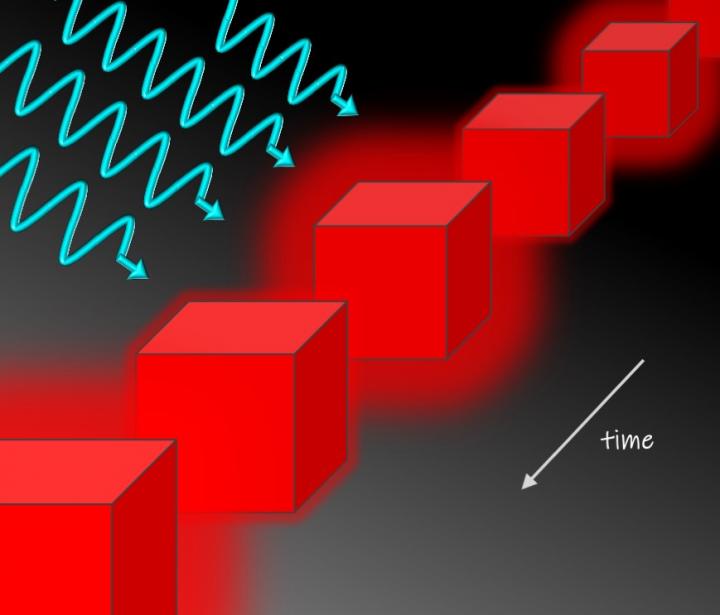
Is it possible for crystals to form in time instead of space? While it appears like an outlandish notion, it turns out that a time crystal may emerge when a physical system of many interacting particles is periodically driven. The defining feature of a time crystal is that a macroscopic observable, such as the electric current in a solid, oscillates at a frequency that is smaller than the driving frequency.

So far, time crystals have been realized in artificial model systems. But now, what about real systems? A piece of a high-temperature superconductor is such a real system – you can buy it online. It is not much to look at, with its brownish, rusty color. Yet its frictionless electron flow at temperatures up to 100 K ( 173 °C) constitutes one of the most spectacular phenomena of material science.

“We propose to turn a high-temperature superconductor into a time crystal by shining a laser on it”, explains first author Guido Homann from the Department of Physics at Universität Hamburg. The frequency of the laser needs to be tuned to the sum resonance of two fundamental excitations of the material. One of these excitations is the elusive Higgs mode, which is conceptually related to the Higgs boson in particle physics. The other excitation is the plasma mode, corresponding to an oscillatory motion of electron pairs, which are responsible for superconductivity.

Co-author Dr. Jayson Cosme from Universität Hamburg, now University of the Philippines, adds that “the creation of a time crystal in a high-temperature superconductor is an important step because it establishes this genuine dynamical phase of matter in the domain of solid-state physics”. Controlling solids by light is not only fascinating from a scientific perspective but also technologically relevant, as emphasized by group leader Prof. Dr. Ludwig Mathey. “The ultimate goal of our research is to design quantum materials on demand.” With their novel proposal, this fascinating endeavor is now advanced towards dynamical states of matter, rather than the usual static states of matter, by laying out a strategy to design time crystals instead of regular crystals, which opens up a new and surprising direction of material design.

###

Publication:

Guido Homann, Jayson G. Cosme, and Ludwig Mathey (2020): Higgs time crystal in a high-Tc superconductor. Phys. Rev. Research 2, 043214 – Published 10 November. DOI: https://doi.org/10.1103/PhysRevResearch.2.043214

Media Contact
Prof. Dr. Ludwig Mathey
[email protected]

Related Journal Article

http://dx.doi.org/10.1103/PhysRevResearch.2.043214

Tags: Atomic/Molecular/Particle PhysicsChemistry/Physics/Materials SciencesMaterialsSuperconductors/Semiconductors
Share12Tweet8Share2ShareShareShare2

Related Posts

Alcohol-Powered Fuel Cells Edge Closer to Market as Engineers Tame Leaky Membranes and Costly Catalysts

Alcohol-Powered Fuel Cells Edge Closer to Market as Engineers Tame Leaky Membranes and Costly Catalysts

October 4, 2026
Banana Peels Turn Into Catalysts That Boost Bio-Oil From Sewage Sludge

Banana Peels Turn Into Catalysts That Boost Bio-Oil From Sewage Sludge

October 4, 2026

Squeezing Polypropylene Flips Its Insulation From Rubbery to Glassy Conduction

October 4, 2026

Sulfated Seaweed Polymer Helps Gels Protect Anthocyanins Until the Gut

October 4, 2026
Please login to join discussion

POPULAR NEWS

  • Alloys That Shrink Their Own Grains: New PIX Mechanism Refines Metals With Heat Alone

    Alloys That Shrink Their Own Grains: New PIX Mechanism Refines Metals With Heat Alone

    29 shares
    Share 12 Tweet 7
  • Endurance Exercise Reshapes the Liver in Males and Females Through Distinct Molecular Routes

    29 shares
    Share 12 Tweet 7
  • Single Transcription Factor PU.1 Rapidly Converts Fibroblasts into Macrophage-Lineage Cells

    29 shares
    Share 12 Tweet 7
  • New Scale Measures How Ready Nurse Educators Really Are for the AI Era

    29 shares
    Share 12 Tweet 7

About

We bring you the latest biotechnology news from best research centers and universities around the world. Check our website.

Follow us

Recent News

Alloys That Shrink Their Own Grains: New PIX Mechanism Refines Metals With Heat Alone

Endurance Exercise Reshapes the Liver in Males and Females Through Distinct Molecular Routes

Single Transcription Factor PU.1 Rapidly Converts Fibroblasts into Macrophage-Lineage Cells

Subscribe to Blog via Email

Success! An email was just sent to confirm your subscription. Please find the email now and click 'Confirm' to start subscribing.

Join 85 other subscribers
  • Contact Us

Bioengineer.org © Copyright 2023 All Rights Reserved.

Welcome Back!

Login to your account below

Forgotten Password?

Retrieve your password

Please enter your username or email address to reset your password.

Log In
No Result
View All Result
  • Homepages
    • Home Page 1
    • Home Page 2
  • News
  • National
  • Business
  • Health
  • Lifestyle
  • Science

Bioengineer.org © Copyright 2023 All Rights Reserved.