Case study of California revealed an additional 348 communities eligible for funding
Credit: NASA
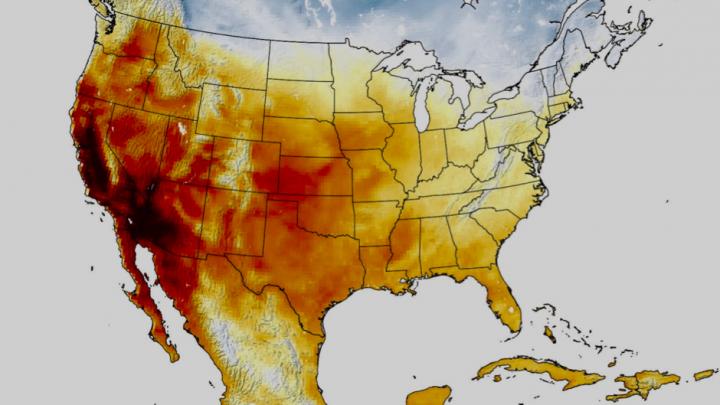
MIAMI–While extreme heat threatens the wellbeing of people all over the world, a new study from scientists at the University of Miami (UM) Rosenstiel School of Marine and Atmospheric Science found that some disadvantaged communities in California could be overlooked for state climate adaptation funds.
As government and communities across the U.S. ramp up efforts for equity-oriented climate change adaptation, questions about how to effectively identify and prioritize the limited funding across communities in practice remain.
In this study, researchers used California as a case study to evaluate how the state is targeting and prioritizing environmental justice communities for extreme heat adaptations. When the researchers analyzed CalEnviroScreen 3.0, California’s program used to designate a census tract as “disadvantaged” and therefore eligible for equity-oriented project monies from the Greenhouse Gas Reduction Fund, they found that relying on CalEnviroScreen alone may result in the state overlooking 348 communities that would be eligible under two alternative indices.
“There are limits to the effectiveness of using a single index to guide a fund with projects and communities as diverse as those under the California Climate Investments program,” said Lynée Turek-Hankins, a doctoral student at UM’s Abess Center for Ecosystem Science and Policy and lead author of the study. “We highlight the need for context-specific tools that can capture local nuances and variabilities.”
Although this study focused specifically on extreme heat in California, its findings are applicable for other climate-related hazards and states, said Turek-Hankins.
“Climate change is a threat multiplier for both people and nature. It amplifies risks for communities already grappling with environmental hazards and social stressors. But getting adaptation right at the implementation stage, attuned to differential impacts and benefits across communities, is far from straightforward,” said Katharine Mach, associate professor in the Department of Marine Ecosystems and Society at the Rosenstiel School and a co-author of the study. “This analysis points to the importance of combining cross-cutting risk screening with attention to context–the hazards, the needs of communities, and the effectiveness of different resiliency strategies.”
###
The study, titled “Risk screening methods for extreme heat: implications for equity-oriented adaptation,” was published on November 4, 2020 in the journal PLOS ONE, The study’s authors include: Lynée Turek-Hankins, Katharine Mach from the University of Miami Rosenstiel School of Marine and Atmospheric Science; and Miyuki Hino from University of North Carolina at Chapel Hill.
The research was funded by the Mentoring Undergraduates in Interdisciplinary Research (MUIR) Program at the Stanford Woods Institute for the Environment, the Rosenstiel School of Marine and Atmospheric Science at the University of Miami, and the Abess Center for Ecosystem Science and Policy at the University of Miami.
About the University of Miami’s Rosenstiel School
The University of Miami is one of the largest private research institutions in the southeastern United States. The University’s mission is to provide quality education, attract and retain outstanding students, support the faculty and their research, and build an endowment for University initiatives. Founded in the 1940’s, the Rosenstiel School of Marine & Atmospheric Science has grown into one of the world’s premier marine and atmospheric research institutions. Offering dynamic interdisciplinary academics, the Rosenstiel School is dedicated to helping communities to better understand the planet, participating in the establishment of environmental policies, and aiding in the improvement of society and quality of life. For more information, visit: http://www.
Media Contact
Diana Udel
[email protected]
Original Source
https:/
Related Journal Article
http://dx.