• HOME
  • NEWS
  • EXPLORE
    • CAREER
      • Companies
      • Jobs
    • EVENTS
    • iGEM
      • News
      • Team
    • PHOTOS
    • VIDEO
    • WIKI
  • BLOG
  • COMMUNITY
    • FACEBOOK
    • INSTAGRAM
    • TWITTER
Monday, December 29, 2025
BIOENGINEER.ORG
No Result
View All Result
  • Login
  • HOME
  • NEWS
  • EXPLORE
    • CAREER
      • Companies
      • Jobs
        • Lecturer
        • PhD Studentship
        • Postdoc
        • Research Assistant
    • EVENTS
    • iGEM
      • News
      • Team
    • PHOTOS
    • VIDEO
    • WIKI
  • BLOG
  • COMMUNITY
    • FACEBOOK
    • INSTAGRAM
    • TWITTER
  • HOME
  • NEWS
  • EXPLORE
    • CAREER
      • Companies
      • Jobs
        • Lecturer
        • PhD Studentship
        • Postdoc
        • Research Assistant
    • EVENTS
    • iGEM
      • News
      • Team
    • PHOTOS
    • VIDEO
    • WIKI
  • BLOG
  • COMMUNITY
    • FACEBOOK
    • INSTAGRAM
    • TWITTER
No Result
View All Result
Bioengineer.org
No Result
View All Result
Home NEWS Science News Chemistry

New multiscale view of the human brain

Bioengineer by Bioengineer
November 4, 2020
in Chemistry
Reading Time: 2 mins read
0
IMAGE
Share on FacebookShare on TwitterShare on LinkedinShare on RedditShare on Telegram

IMAGE

Credit: M. Zhenga et al. /PNAS

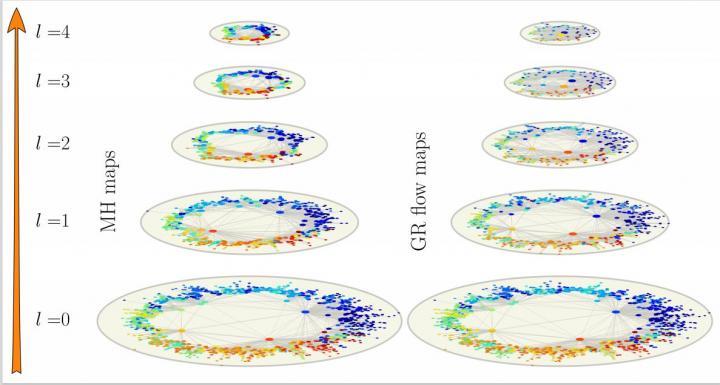
The architecture of the brain supports cognitive and behavioural functions and it is extremely complex with connections at multiple layers that interact with each other. However, research efforts are usually focused on a single spatial scale. In a study led by researchers of the Institute of Complex Systems of the University of Barcelona (UBICS), researchers studied the multiscale spatial organization of the brain and observed that, in a geometric network model, the layers at different resolution are self-similar, that is, as we move away, the geometric and connectivity structure of the layers remains the same.

In order to carry out this study, researchers used two high-quality datasets with maps of neural connections, connectomes, of eighty-four healthy subjects with five anatomical resolutions for each. According to M. Àngels Serrano, ICREA researcher at UBICS, “the results show that brain connectivity at different scales is organized with the same principles that lead to a efficient decentralized communication”.

The structure of the human brain expands over a series of interrelated length scales which increase its complexity. “The self-similarity we determined as a pattern in the multiscale structure of the human connectome introduces the simplicity as an organizing principle”, notes Serrano. This means that underlying connectivity rules that explain this structure are independent from the observation scale -at least within the analysed scales in this study-, “that is, we do not need a specific set of rules for each scale”, concludes Serrano.

The model predicts observations through the application of a renormalization protocol. This method is based on a geometric network model that places the nodes in a hidden metric space, defining a map, so that both nodes are more likely to be connected. This type of model enables researchers to explain the universal features of real networks.

For every scale, there is a remarkable congruence between empirical observations and predictions provided by the model. The results show that the same rules explain the formation of short and long-range connections in the brain within the rank of length scales that cover the used datasets”, concludes the UB researcher.

The implications of this discovery are several. On the one hand, it can be useful in fundamental debates, such as whether the brain is working close to a critical spot. On the other hand, it can have applications for advanced tools on brain functioning simulation.

###

Article reference:

M. Zhenga et al. “Geometric renormalization unravels self-similarity of the multiscale human connectome”. PNAS, https://doi.org/10.1073/pnas.1922248117

Media Contact
Bibiana Bonmati
[email protected]

Original Source

https://www.ub.edu/web/ub/en/menu_eines/noticies/2020/11/011.html

Related Journal Article

http://dx.doi.org/10.1073/pnas.1922248117

Tags: Chemistry/Physics/Materials SciencesneurobiologySystems/Chaos/Pattern Formation/Complexity
Share12Tweet8Share2ShareShareShare2

Related Posts

Cutting Electrolyte Reduction Boosts High-Energy Battery Performance

Cutting Electrolyte Reduction Boosts High-Energy Battery Performance

December 19, 2025
Microenvironment Shapes Gold-Catalysed CO2 Electroreduction

Microenvironment Shapes Gold-Catalysed CO2 Electroreduction

December 11, 2025

Photoswitchable Olefins Enable Controlled Polymerization

December 11, 2025

Cation Hydration Entropy Controls Chloride Ion Diffusion

December 10, 2025
Please login to join discussion

POPULAR NEWS

  • Robotic Waist Tether for Research Into Metabolic Cost of Walking

    NSF funds machine-learning research at UNO and UNL to study energy requirements of walking in older adults

    71 shares
    Share 28 Tweet 18
  • Exploring Audiology Accessibility in Johannesburg, South Africa

    51 shares
    Share 20 Tweet 13
  • Nurses’ Views on Online Learning: Effects on Performance

    70 shares
    Share 28 Tweet 18
  • SARS-CoV-2 Subvariants Affect Outcomes in Elderly Hip Fractures

    44 shares
    Share 18 Tweet 11

About

We bring you the latest biotechnology news from best research centers and universities around the world. Check our website.

Follow us

Recent News

ChatGPT Excels in Forensic Pathology Exam Insights

HiSTaR: Mapping Spatial Domains with Hierarchical Transcriptomics

Evaluating Economic Strategies for Maternal-Neonatal Sepsis Solutions

Subscribe to Blog via Email

Enter your email address to subscribe to this blog and receive notifications of new posts by email.

Join 71 other subscribers
  • Contact Us

Bioengineer.org © Copyright 2023 All Rights Reserved.

Welcome Back!

Login to your account below

Forgotten Password?

Retrieve your password

Please enter your username or email address to reset your password.

Log In
No Result
View All Result
  • Homepages
    • Home Page 1
    • Home Page 2
  • News
  • National
  • Business
  • Health
  • Lifestyle
  • Science

Bioengineer.org © Copyright 2023 All Rights Reserved.