Credit: Gemma Clucas
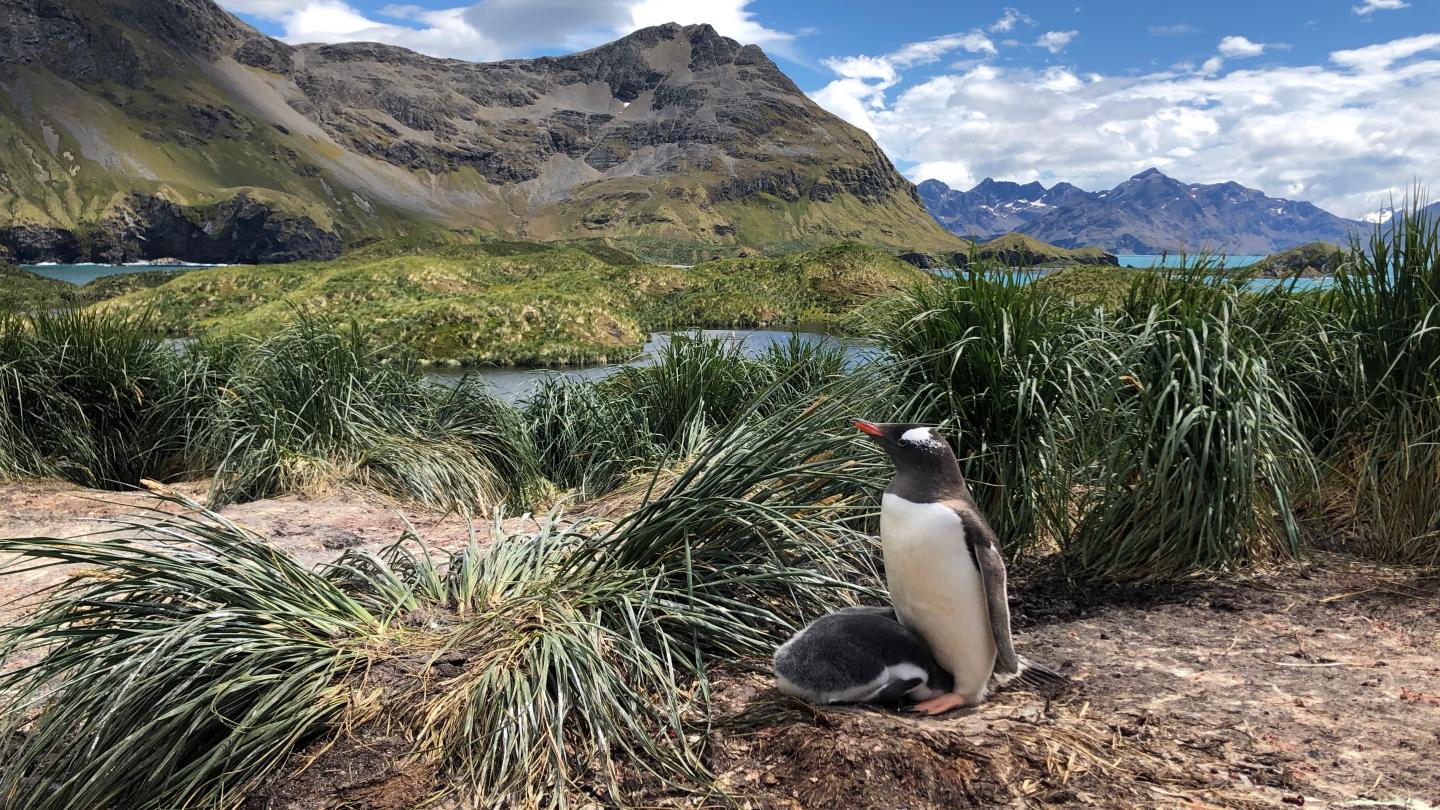
Gentoo penguins should be reclassified as four separate species, say scientists at the Milner Centre for Evolution at the University of Bath, after analysing the genetic and physical differences between populations around the southern hemisphere.
The researchers say that counting them as four separate species will aid in their conservation because it will make it easier to monitor any decline in numbers.
Gentoo penguins, with the Latin name Pygoscelis papua, live in a range of latitudes in the southern hemisphere and are currently split into two subspecies, P. p. ellsworthi and P. p. papua.
The researchers suggest these two sub species should be raised to species level and two new species created, which they have named P. poncetii after the Australian seabird conservationist Sally Poncet, and P. taeniata in recognition of a former proposal for this name dating to the 1920s.
Their study, published in the journal Ecology and Evolution, looked at the genomes of populations living in the Falkland Islands and South Georgia in the southern Atlantic Ocean, the South Shetland Islands in the Antarctic and Kerguelen Islands in the Indian Ocean.
They used genome data to create an evolutionary tree to understand the relationship between the different populations. When they combined these data with measurements of museum specimens from each of the populations, they found clear morphological (physical) and genetic differences between the four populations.
Dr Jane Younger, Prize Fellow from the Milner Centre for Evolution at the University of Bath, led the study. She said: “For the first time, we’ve shown that these penguins are not only genetically distinct, but that they are also physically different too.
“Gentoos tend to stick close to their home colonies, and over hundreds of thousands of years have become geographically isolated from each other to the point where they don’t interbreed with each other, even though they could easily swim the distance that separates them.
“The four species we propose live in quite different latitudes – for example P. ellsworthi lives on the Antarctic continent whereas P. poncetii, P. taeniata and P. papua live further north where conditions are milder, and so it’s not that surprising that they have evolved to adapt to their different habitats.”
PhD student Josh Tyler said: “They look very similar to the untrained eye, but when we measured their skeletons we found statistical differences in the lengths of their bones and the sizes and shape of their beaks.
“It’s a similar story to giraffes, which were revealed in 2016 to be four genetically distinct species.”
The scientists say that regarding the four populations as separate species, gives conservationists a better chance of protecting their diversity because if there’s a decline in one of them it will change the threat status as defined by the IUCN Red List.
Dr Younger said: “Currently gentoo penguins are fairly stable in numbers, however there is some evidence of the northern populations moving further south as the climate gets warmer, so we need to watch them closely.”
The proposed changes to the classification of gentoos will be reviewed by an international committee of scientists which will assess all the evidence in the scientific literature before the new taxonomy is accepted.
###
The study was funded by the American Ornithological Society, Linnean Society, American Museum of Natural History and the Evolution Education Trust. The research team was a collaboration led by the University of Bath (UK) with scientists from Loyola University Chicago, Cornell University and the University of Minnesota (USA).
Joshua Tyler, Matthew T. Bonfitto, Gemma V. Clucas, Sushma Reddy, Jane L. Younger (2020) “Morphometric and genetic evidence for four species of gentoo penguin” is published in Ecology and Evolution. DOI: 10.1002/ece3.6973.
Media Contact
Vicky Just
[email protected]
Original Source
http://www.
Related Journal Article
http://dx.