• HOME
  • NEWS
  • EXPLORE
    • CAREER
      • Companies
      • Jobs
    • EVENTS
    • iGEM
      • News
      • Team
    • PHOTOS
    • VIDEO
    • WIKI
  • BLOG
  • COMMUNITY
    • FACEBOOK
    • INSTAGRAM
    • TWITTER
Thursday, June 25, 2026
BIOENGINEER.ORG
No Result
View All Result
  • Login
  • HOME
  • NEWS
  • EXPLORE
    • CAREER
      • Companies
      • Jobs
        • Lecturer
        • PhD Studentship
        • Postdoc
        • Research Assistant
    • EVENTS
    • iGEM
      • News
      • Team
    • PHOTOS
    • VIDEO
    • WIKI
  • BLOG
  • COMMUNITY
    • FACEBOOK
    • INSTAGRAM
    • TWITTER
  • HOME
  • NEWS
  • EXPLORE
    • CAREER
      • Companies
      • Jobs
        • Lecturer
        • PhD Studentship
        • Postdoc
        • Research Assistant
    • EVENTS
    • iGEM
      • News
      • Team
    • PHOTOS
    • VIDEO
    • WIKI
  • BLOG
  • COMMUNITY
    • FACEBOOK
    • INSTAGRAM
    • TWITTER
No Result
View All Result
Bioengineer.org
No Result
View All Result
Home NEWS Science News Biology

Two centuries of Monarch butterflies show evolution of wing length

Bioengineer by Bioengineer
November 2, 2020
in Biology
Reading Time: 2 mins read
0
IMAGE
Share on FacebookShare on TwitterShare on LinkedinShare on RedditShare on Telegram

IMAGE

Credit: Micah Freedman, UC Davis

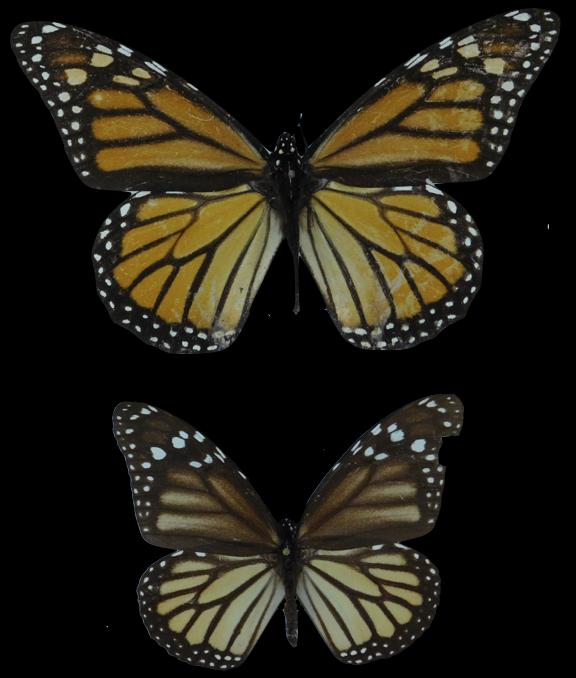
North America’s beloved Monarch butterflies are known for their annual, multi-generation migrations in which individual insects can fly for thousands of miles. But Monarchs have also settled in some locations where their favorite food plants grow year round, so they no longer need to migrate.

Micah Freedman, a graduate student at the Center for Population Biology at UC Davis, took a deep dive into museum collections to see how migration has shaped the species. Monarchs are native to North America, but have also established non-migrating populations in the Caribbean, Central and South America, and islands in the Pacific and Atlantic oceans. These island-hopping butterflies may have been blown by storms before being lucky enough to reach dry land.

Monarchs that established new, non-migrating populations also had those larger wings. But over time, the wings of these colonists got smaller.

Selection at work in opposing directions

The shift between longer and shorter wings shows two opposite selection forces at work, Freedman and colleagues wrote in a paper published this week in Proceedings of the National Academy of Sciences. Migration selects for longer, larger forewings while non-migration seems to relax this and lead to smaller wings.

Alternatively, wing size could be influenced by other environmental factors depending on where butterflies are hatched and grow up. To test this, Freedman raised Monarch butterflies from non-migrating populations in Hawaii, Guam, Australia and Puerto Rico outdoors in Davis, California alongside native migrating Monarchs. The non-migrating butterflies retained their smaller wings, showing that the effect is due to genetics and not the rearing environment.

“Our findings provide a compelling example of how migration-associated traits may be favored during the early stages of range expansion, and also the rate of reductions in those same traits upon loss of migration,” the authors wrote.

###

Freedman’s coauthors on the study are Professor Sharon Strauss and Associate Professor Santiago Ramirez, Department of Evolution and Ecology and Professor Hugh Dingle, Department of Entomology and Nematology. The work was partly supported by the National Science Foundation and the National Geographic Society.

Media Contact
Andy Fell
[email protected]

Original Source

https://egghead.ucdavis.edu/2020/11/02/two-centuries-of-monarch-butterflies-show-evolution-of-wing-length/

Related Journal Article

http://dx.doi.org/10.1073/pnas.2001283117

Tags: BiologyEntomologyEvolution
Share13Tweet8Share2ShareShareShare2

Related Posts

Natural Hallucinogens: Evolution’s Ecological Tools, Not Mere Chemical Byproducts

June 25, 2026

This Famous Butterfly Revealed: Three Distinct Species Hidden in One

June 25, 2026

Scientists Attack Soybean Cyst Nematode by Starving Its Food Source

June 25, 2026

Decoding the Secret Code of a Crucial Immune Sensor

June 24, 2026
Please login to join discussion

POPULAR NEWS

  • Saying Goodbye to PGY-6: Pediatric Fellowship Realities

    103 shares
    Share 41 Tweet 26
  • Multi-Hospital Study Reveals Long Covid Burden Is Twice as High as Current Estimates

    92 shares
    Share 36 Tweet 23
  • Detection of EDCs in Breast Milk and Infant Urine Up to Six Months Highlights Early Exposure Risks

    77 shares
    Share 31 Tweet 19
  • New Drug Candidate Developed at McMaster Shows Potential for Treating Brain Cancer

    58 shares
    Share 23 Tweet 15

About

We bring you the latest biotechnology news from best research centers and universities around the world. Check our website.

Follow us

Recent News

Tracking Lanthanide-Labeled Microplastics in Plants

POSTECH Researchers Slash Cost of Reconstituted Cell-Free Systems by 95%

AI and Physics Collaborate to Design Advanced Hydrogen Storage Materials

Subscribe to Blog via Email

Enter your email address to subscribe to this blog and receive notifications of new posts by email.

Join 82 other subscribers
  • Contact Us

Bioengineer.org © Copyright 2023 All Rights Reserved.

Welcome Back!

Login to your account below

Forgotten Password?

Retrieve your password

Please enter your username or email address to reset your password.

Log In
No Result
View All Result
  • Homepages
    • Home Page 1
    • Home Page 2
  • News
  • National
  • Business
  • Health
  • Lifestyle
  • Science

Bioengineer.org © Copyright 2023 All Rights Reserved.