• HOME
  • NEWS
  • EXPLORE
    • CAREER
      • Companies
      • Jobs
    • EVENTS
    • iGEM
      • News
      • Team
    • PHOTOS
    • VIDEO
    • WIKI
  • BLOG
  • COMMUNITY
    • FACEBOOK
    • INSTAGRAM
    • TWITTER
Saturday, February 7, 2026
BIOENGINEER.ORG
No Result
View All Result
  • Login
  • HOME
  • NEWS
  • EXPLORE
    • CAREER
      • Companies
      • Jobs
        • Lecturer
        • PhD Studentship
        • Postdoc
        • Research Assistant
    • EVENTS
    • iGEM
      • News
      • Team
    • PHOTOS
    • VIDEO
    • WIKI
  • BLOG
  • COMMUNITY
    • FACEBOOK
    • INSTAGRAM
    • TWITTER
  • HOME
  • NEWS
  • EXPLORE
    • CAREER
      • Companies
      • Jobs
        • Lecturer
        • PhD Studentship
        • Postdoc
        • Research Assistant
    • EVENTS
    • iGEM
      • News
      • Team
    • PHOTOS
    • VIDEO
    • WIKI
  • BLOG
  • COMMUNITY
    • FACEBOOK
    • INSTAGRAM
    • TWITTER
No Result
View All Result
Bioengineer.org
No Result
View All Result
Home NEWS Science News Health

Scientist studies the role of a muscle protein in skeletal muscle disorders

Bioengineer by Bioengineer
November 2, 2020
in Health
Reading Time: 2 mins read
0
IMAGE
Share on FacebookShare on TwitterShare on LinkedinShare on RedditShare on Telegram

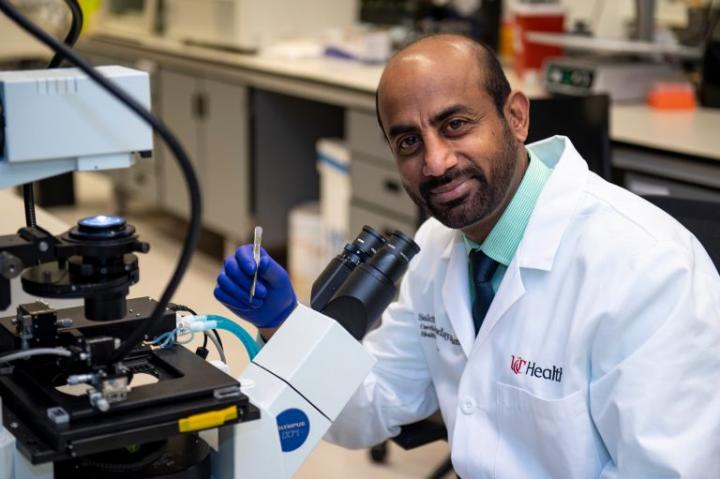
NIAMS grant supports the work of a University of Cincinnati researcher
IMAGE

Credit: Photo by Colleen Kelley/UC Creative + Brand.

A University of Cincinnati researcher has received a five-year $2.3 million grant to study the role a protein in muscles plays in the development of a rare disease. The grant is from the National Institute of Arthritis and Musculoskeletal and Skin Diseases.

The condition, called distal arthrogryposis, is a skeletal muscle disorder characterized by the presence of joint contractures, or a tightening or shortening of the joint causing a deformity, at various parts of the body, particularly in the furthest extremities, explains Sakthivel Sadayappan, PhD, professor in the UC Division of Cardiovascular Health and Disease. The condition affects one in 3,000 live births and leads to increased connective tissue formation around the joints in a way that immobilizes muscle movement leading to deformities in children.

“I branched out of my traditional cardiac research project to include skeletal muscle,” says Sadayappan, who oversees a team of postdoctoral fellows, graduate and medical students in his College of Medicine laboratory. “The structure and functions of [the protein] have similarities but are not identical in heart and skeletal muscles.”

Currently, treatments of distal arthrogryposis diseases can range from simple procedures such an Achilles tendon release to more moderate methods such as elbow and knee surgeries. Other treatments are more involved including surgeries to lengthen limbs or correct spines.

Sadayappan says myosin binding protein-C (MyBP-C) is essential for muscle formation, function and regulation and exists in both heart and skeletal muscle. In skeletal muscle two paralogs (genes) of the myosin binding protein-C, slow skeletal (sMyBP-C) and fast skeletal (fMyBP-C) are present and they are distinct from what is seen in heart muscle. Much of Sadayappan’s previous research has looked at myosin binding protein-C in heart muscles and its role in the development of hypertrophic cardiomyopathy in heart patients.

“The goal of our current research is to define the physiologic mechanisms underlining how mutations in slow skeletal myosin binding protein-C seen in animal models leads to muscle dysfunction and contractures,” says Sadayappan. “We hypothesize that the slow skeletal protein is a key regulator of striated skeletal muscle formation and function.”

Experiments will look at defining the role of myosin binding protein-C in regulating skeletal muscle function in four unique animal models. “Understanding the molecular mechanisms that underlie a reduced contractility in muscle disease should help us identify novel therapeutic targets to improve muscle function in individuals afflicted with distal arthrogryposis,” says Sadayappan.

###

Sadayappan’s work is supported by the National Institute of Arthritis and Musculoskeletal and Skin Diseases grant 1R01AR078001-01.

Media Contact
Cedric Ricks
[email protected]

Original Source

https://www.uc.edu/news/articles/2020/11/uc-scientists-aims-to-advance-our-understanding-of-skeletal-muscle-disorders.html

Tags: Disabled PersonsInternal MedicineMedicine/HealthMusculatureOrthopedic MedicineRehabilitation/Prosthetics/Plastic SurgerySurgery
Share12Tweet8Share2ShareShareShare2

Related Posts

Personalized Guide to Understanding and Reducing Chemicals

February 7, 2026

Inflammasome Protein ASC Drives Pancreatic Cancer Metabolism

February 7, 2026

Phage-Antibiotic Combo Beats Resistant Peritoneal Infection

February 7, 2026

Boosting Remote Healthcare: Stepped-Wedge Trial Insights

February 7, 2026
Please login to join discussion

POPULAR NEWS

  • Robotic Ureteral Reconstruction: A Novel Approach

    Robotic Ureteral Reconstruction: A Novel Approach

    82 shares
    Share 33 Tweet 21
  • Digital Privacy: Health Data Control in Incarceration

    63 shares
    Share 25 Tweet 16
  • Study Reveals Lipid Accumulation in ME/CFS Cells

    57 shares
    Share 23 Tweet 14
  • Breakthrough in RNA Research Accelerates Medical Innovations Timeline

    53 shares
    Share 21 Tweet 13

About

We bring you the latest biotechnology news from best research centers and universities around the world. Check our website.

Follow us

Recent News

Personalized Guide to Understanding and Reducing Chemicals

Inflammasome Protein ASC Drives Pancreatic Cancer Metabolism

Phage-Antibiotic Combo Beats Resistant Peritoneal Infection

Subscribe to Blog via Email

Enter your email address to subscribe to this blog and receive notifications of new posts by email.

Join 73 other subscribers
  • Contact Us

Bioengineer.org © Copyright 2023 All Rights Reserved.

Welcome Back!

Login to your account below

Forgotten Password?

Retrieve your password

Please enter your username or email address to reset your password.

Log In
No Result
View All Result
  • Homepages
    • Home Page 1
    • Home Page 2
  • News
  • National
  • Business
  • Health
  • Lifestyle
  • Science

Bioengineer.org © Copyright 2023 All Rights Reserved.