• HOME
  • NEWS
  • EXPLORE
    • CAREER
      • Companies
      • Jobs
    • EVENTS
    • iGEM
      • News
      • Team
    • PHOTOS
    • VIDEO
    • WIKI
  • BLOG
  • COMMUNITY
    • FACEBOOK
    • INSTAGRAM
    • TWITTER
Saturday, November 21, 2026
BIOENGINEER.ORG
No Result
View All Result
  • Login
  • HOME
  • NEWS
  • EXPLORE
    • CAREER
      • Companies
      • Jobs
        • Lecturer
        • PhD Studentship
        • Postdoc
        • Research Assistant
    • EVENTS
    • iGEM
      • News
      • Team
    • PHOTOS
    • VIDEO
    • WIKI
  • BLOG
  • COMMUNITY
    • FACEBOOK
    • INSTAGRAM
    • TWITTER
No Result
View All Result
Bioengineer.org
No Result
View All Result
Home NEWS Science News

Order in the disorder:

Bioengineer by Bioengineer
October 29, 2020
in Science News
Reading Time: 3 mins read
0
IMAGE
Share on FacebookShare on TwitterShare on LinkedinShare on RedditShare on Telegram

density fluctuations in amorphous silicon discovered
IMAGE

Credit: Eike Gericke/HZB

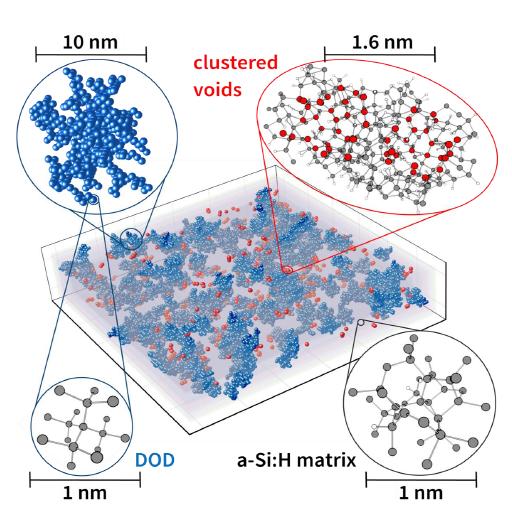
Silicon does not have to be crystalline, but can also be produced as an amorphous thin film. In such amorphous films, the atomic structure is disordered like in a liquid or glass. If additional hydrogen is incorporated during the production of these thin layers, so-called a-Si:H layers are formed. “Such a-Si:H thin films have been known for decades and are used for various applications, for example as contact layers in world record tandem solar cells made of perovskite and silicon, recently developed by HZB” explains Prof. Klaus Lips from HZB. “With this study, we show that the a-Si:H is by no means a homogeneously amorphous material. The amorphous matrix is interspersed with nanometre-sized areas of varying local density, from cavities to areas of extremely high order,” the physicist comments.

In cooperation with the Technical Universities of Eindhoven and Delft, Lips and his team have succeeded for the first time in experimentally observing and quantitatively measuring these inhomogeneities in differently produced a-Si:H thin films. To do this, they combined the results of complementary analytical methods to form an overall picture.

“We find a nanoscopic order in the disorder of the a-Si:H layers by x-ray scattering measurements performed at BESSY II. We were then able to determine the distribution of the hydrogen atoms in the amorphous network by neutron scattering at the former research reactor BER II at the HZB site Wannsee”, says Eike Gericke, PhD student and first author of the paper. Further insights were provided by the electron microscopy performed at the CCMS Corelab and measurements of electron spin resonance (ESR).

“We were able to discover nanometer-sized voids, which are created by slightly more than 10 missing atoms. These voids arrange themselves into clusters with a recurrent distance of about 1.6 nanometres to each other,” explains Gericke. These voids are found in increased concentrations when the a-Si:H layer has been deposited at a very high rate.

The researchers also found nanometre-sized regions with higher order compared to the surrounding disordered material. These densely ordered domains (DOD) contain hardly any hydrogen. “The DODs form aggregates of up to 15 nanometres in diameter and are found in all the a-Si:H materials considered here,” explains Gericke.

“The DOD regions have been theoretically predicted in 2012 and are able to reduce mechanical stress in the material and thus contribute to the stability of the a-Si:H thin film. The voids on the other hand, can promote electronic degradation of the semiconductor layers as indicated by ESR measurements,” says Klaus Lips.

Targeted optimization of manufacturing processes with regard to the substructures now discovered could enable new applications such as optical waveguides for programmable photonic systems or a future silicon battery technology. Last but not least, the findings will also help to finally unravel the microscopic mechanism of light-induced degradation of a-Si:H solar cells, one of the puzzles the scientific community is trying to solve since more than 40 years.

###

Media Contact
Antonia Roetger
antonia.roetger@helmholtz-berlin.de

Original Source

https://www.helmholtz-berlin.de/bin/news_seite?nid=22200;sprache=en;intern=0

Related Journal Article

http://dx.doi.org/10.1103/PhysRevLett.125.185501

Tags: Atomic/Molecular/Particle PhysicsChemistry/Physics/Materials SciencesEnergy/Fuel (non-petroleum)Industrial Engineering/ChemistryMaterialsMolecular PhysicsNanotechnology/Micromachines
Share12Tweet8Share2ShareShareShare2

Related Posts

Reclined Driver Seatback Angles Linked to Severe Thoracic Crash Injuries

Reclined Driver Seatback Angles Linked to Severe Thoracic Crash Injuries

November 21, 2026
Transcriptional Regulatory Circuitry Orchestrates Super-Enhancer Driven LGR5 Activation in Colorectal Cancer

Transcriptional Regulatory Circuitry Orchestrates Super-Enhancer Driven LGR5 Activation in Colorectal Cancer

November 21, 2026

Precast Concrete Shear Walls with UHPC Boundary Connections Improve Seismic Performance

November 21, 2026

Oral PCSK9 Inhibitors Cut LDL Cholesterol by Fifty-Eight Percent in Clinical Trials

November 21, 2026
Please login to join discussion

POPULAR NEWS

  • Phase I Trial of Novel Antibody-Drug Conjugate Shows Early Efficacy in Sarcoma

    Phase I Trial of Novel Antibody-Drug Conjugate Shows Early Efficacy in Sarcoma

    29 shares
    Share 12 Tweet 7
  • New Unified Contraction Framework Establishes Fixed Point Results in Metric Spaces

    29 shares
    Share 12 Tweet 7
  • Early Skin Molecular Signatures Predict Atopic Dermatitis Risk in Asian Infant Cohort

    29 shares
    Share 12 Tweet 7
  • Review Finds Minor Cannabinoids Lack Established Clinical Efficacy for ADHD Treatment

    29 shares
    Share 12 Tweet 7

About

We bring you the latest biotechnology news from best research centers and universities around the world. Check our website.

Follow us

Recent News

Reclined Driver Seatback Angles Linked to Severe Thoracic Crash Injuries

Transcriptional Regulatory Circuitry Orchestrates Super-Enhancer Driven LGR5 Activation in Colorectal Cancer

Precast Concrete Shear Walls with UHPC Boundary Connections Improve Seismic Performance

Subscribe to Blog via Email

Enter your email address to subscribe to this blog and receive notifications of new posts by email.

Join 89 other subscribers
  • Contact Us

Bioengineer.org © Copyright 2023 All Rights Reserved.

Welcome Back!

Login to your account below

Forgotten Password?

Retrieve your password

Please enter your username or email address to reset your password.

Log In
No Result
View All Result
  • Homepages
    • Home Page 1
    • Home Page 2
  • News
  • National
  • Business
  • Health
  • Lifestyle
  • Science

Bioengineer.org © Copyright 2023 All Rights Reserved.