• HOME
  • NEWS
  • EXPLORE
    • CAREER
      • Companies
      • Jobs
    • EVENTS
    • iGEM
      • News
      • Team
    • PHOTOS
    • VIDEO
    • WIKI
  • BLOG
  • COMMUNITY
    • FACEBOOK
    • INSTAGRAM
    • TWITTER
Saturday, February 7, 2026
BIOENGINEER.ORG
No Result
View All Result
  • Login
  • HOME
  • NEWS
  • EXPLORE
    • CAREER
      • Companies
      • Jobs
        • Lecturer
        • PhD Studentship
        • Postdoc
        • Research Assistant
    • EVENTS
    • iGEM
      • News
      • Team
    • PHOTOS
    • VIDEO
    • WIKI
  • BLOG
  • COMMUNITY
    • FACEBOOK
    • INSTAGRAM
    • TWITTER
  • HOME
  • NEWS
  • EXPLORE
    • CAREER
      • Companies
      • Jobs
        • Lecturer
        • PhD Studentship
        • Postdoc
        • Research Assistant
    • EVENTS
    • iGEM
      • News
      • Team
    • PHOTOS
    • VIDEO
    • WIKI
  • BLOG
  • COMMUNITY
    • FACEBOOK
    • INSTAGRAM
    • TWITTER
No Result
View All Result
Bioengineer.org
No Result
View All Result
Home NEWS Science News Health

Brainstem neurons control both behaviour and misbehaviour

Bioengineer by Bioengineer
October 29, 2020
in Health
Reading Time: 2 mins read
0
IMAGE
Share on FacebookShare on TwitterShare on LinkedinShare on RedditShare on Telegram

IMAGE

Credit: Samir Sadik-Ogli

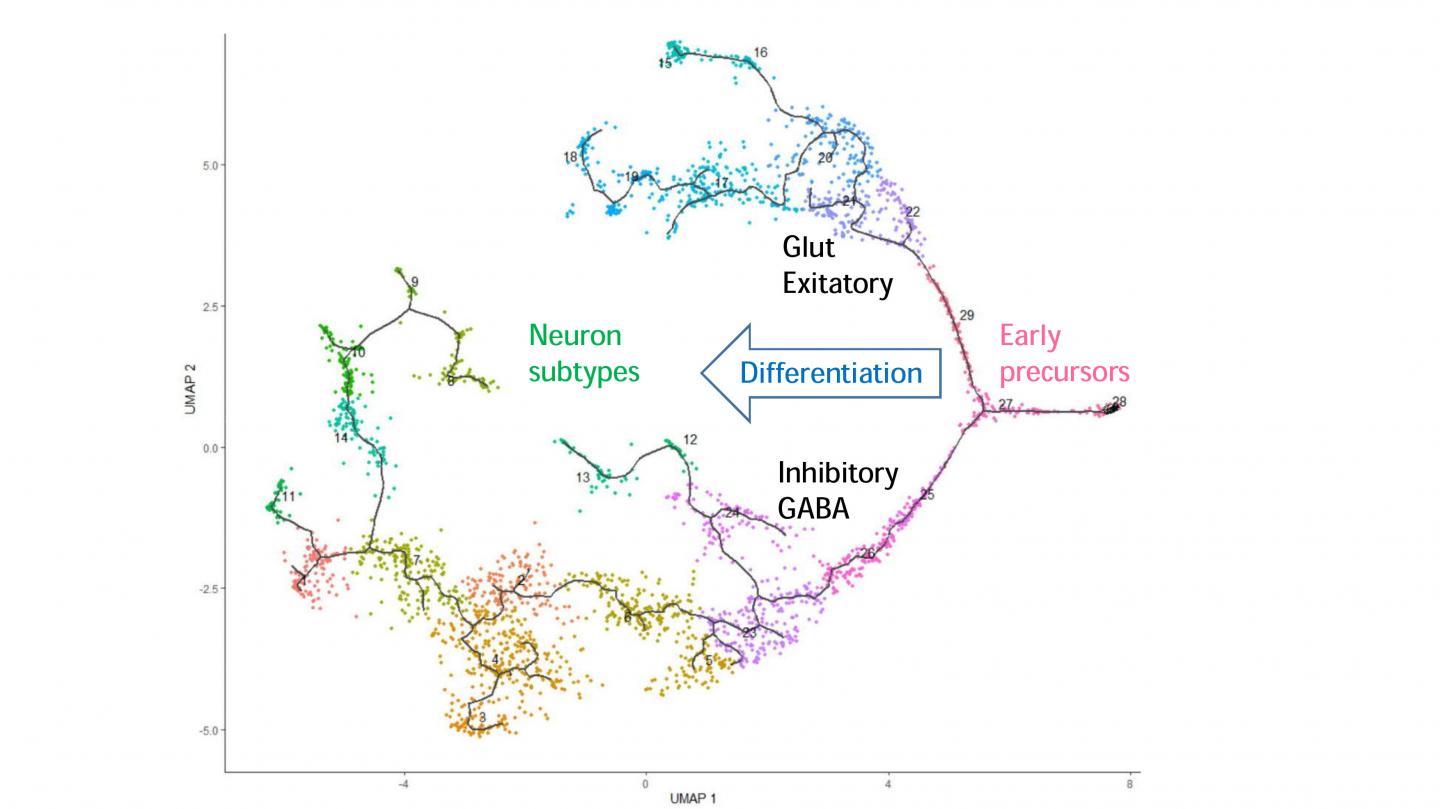
A recent study at the University of Helsinki reveals how gene control mechanisms define the identity of developing neurons in the brainstem. The researchers also showed that a failure in differentiation of the brainstem neurons leads to behavioural abnormalities, including hyperactivity and attention deficit.

The mammalian brain is big, but the state of its activity is controlled by a much smaller number of neurons. Many of these are located in the brainstem, an evolutionarily conserved part of the brain, which controls mood, motivation and motor activity. What are the brainstem neurons like? How do they develop in the embryonic brain? How are defects in their development reflected in brain activity and behaviour?

The research group, led by Professor Juha Partanen at the Faculty of Biological and Environmental Sciences, University of Helsinki, has addressed these questions by studying gene regulation in the embryonic brainstem.

The phenotype of a neuron, to a large extent, is determined already early in an embryo. We have shown how certain selector genes, which are expressed soon after the onset of neuronal differentiation, and control the activity of other neuron specific genes, determine the identity of the developing neuron.

The past few years have provided us with very powerful tools to study gene expression in individual cells. By analysing gene products in embryonic brain cells, we can now follow the differentiation paths of neurons and examine what exactly happens when the developing cells take different paths – for example in becoming a neuron either inhibiting or activating its target. Differentiation paths branch to produce the remarkable neuronal diversity that brain function is based on. According to the gene-expression-based identities, the immature neurons find their location in the brain and make contacts with other components of the neural circuitry.

What if the gene expression signposts point in wrong directions and the developing neurons are misrouted? In the brainstem, this has grave consequences on both brain function and behaviour.

In such a situation, “We have studied mice with an imbalance in differentiation of neurons either activating or inhibiting the dopaminergic and serotonergic neurotransmitter systems. These mice are hyperactive and impulsive, they have changes in their reward sensing and learning. Their hyperactivity can be alleviated with drugs used to treat human attention and hyperactivity deficits,” as Partanen clarifies.

In sum, Partanen indicates that, “Despite active research, the developmental basis of many human behavioural disorders are still poorly understood. We do not know yet if the human counterparts of the neurons we studied are involved in these deficits. Nevertheless, from the perspective of behavioural regulation, this specific group of neurons is highly important and there is still lot to learn about them.”

###

Media Contact
Juha Partanen
[email protected]

Original Source

https://www.helsinki.fi/en/news/life-science-news/brainstem-neurons-control-both-behaviour-and-misbehaviour

Related Journal Article

http://dx.doi.org/10.1016/j.celrep.2020.108268

Tags: Medicine/Healthneurobiology
Share12Tweet8Share2ShareShareShare2

Related Posts

Evaluating Pediatric Emergency Care Quality in Ethiopia

February 7, 2026

TPMT Expression Predictions Linked to Azathioprine Side Effects

February 7, 2026

Improving Dementia Care with Enhanced Activity Kits

February 7, 2026

Decoding Prostate Cancer Origins via snFLARE-seq, mxFRIZNGRND

February 7, 2026
Please login to join discussion

POPULAR NEWS

  • Robotic Ureteral Reconstruction: A Novel Approach

    Robotic Ureteral Reconstruction: A Novel Approach

    82 shares
    Share 33 Tweet 21
  • Digital Privacy: Health Data Control in Incarceration

    63 shares
    Share 25 Tweet 16
  • Study Reveals Lipid Accumulation in ME/CFS Cells

    57 shares
    Share 23 Tweet 14
  • Breakthrough in RNA Research Accelerates Medical Innovations Timeline

    53 shares
    Share 21 Tweet 13

About

We bring you the latest biotechnology news from best research centers and universities around the world. Check our website.

Follow us

Recent News

Evaluating Pediatric Emergency Care Quality in Ethiopia

TPMT Expression Predictions Linked to Azathioprine Side Effects

Improving Dementia Care with Enhanced Activity Kits

Subscribe to Blog via Email

Success! An email was just sent to confirm your subscription. Please find the email now and click 'Confirm' to start subscribing.

Join 73 other subscribers
  • Contact Us

Bioengineer.org © Copyright 2023 All Rights Reserved.

Welcome Back!

Login to your account below

Forgotten Password?

Retrieve your password

Please enter your username or email address to reset your password.

Log In
No Result
View All Result
  • Homepages
    • Home Page 1
    • Home Page 2
  • News
  • National
  • Business
  • Health
  • Lifestyle
  • Science

Bioengineer.org © Copyright 2023 All Rights Reserved.