• HOME
  • NEWS
  • EXPLORE
    • CAREER
      • Companies
      • Jobs
    • EVENTS
    • iGEM
      • News
      • Team
    • PHOTOS
    • VIDEO
    • WIKI
  • BLOG
  • COMMUNITY
    • FACEBOOK
    • INSTAGRAM
    • TWITTER
Sunday, June 28, 2026
BIOENGINEER.ORG
No Result
View All Result
  • Login
  • HOME
  • NEWS
  • EXPLORE
    • CAREER
      • Companies
      • Jobs
        • Lecturer
        • PhD Studentship
        • Postdoc
        • Research Assistant
    • EVENTS
    • iGEM
      • News
      • Team
    • PHOTOS
    • VIDEO
    • WIKI
  • BLOG
  • COMMUNITY
    • FACEBOOK
    • INSTAGRAM
    • TWITTER
  • HOME
  • NEWS
  • EXPLORE
    • CAREER
      • Companies
      • Jobs
        • Lecturer
        • PhD Studentship
        • Postdoc
        • Research Assistant
    • EVENTS
    • iGEM
      • News
      • Team
    • PHOTOS
    • VIDEO
    • WIKI
  • BLOG
  • COMMUNITY
    • FACEBOOK
    • INSTAGRAM
    • TWITTER
No Result
View All Result
Bioengineer.org
No Result
View All Result
Home NEWS Science News Health

How the immune system deals with the gut’s plethora of microbes

Bioengineer by Bioengineer
October 29, 2020
in Health
Reading Time: 2 mins read
0
IMAGE
Share on FacebookShare on TwitterShare on LinkedinShare on RedditShare on Telegram

IMAGE

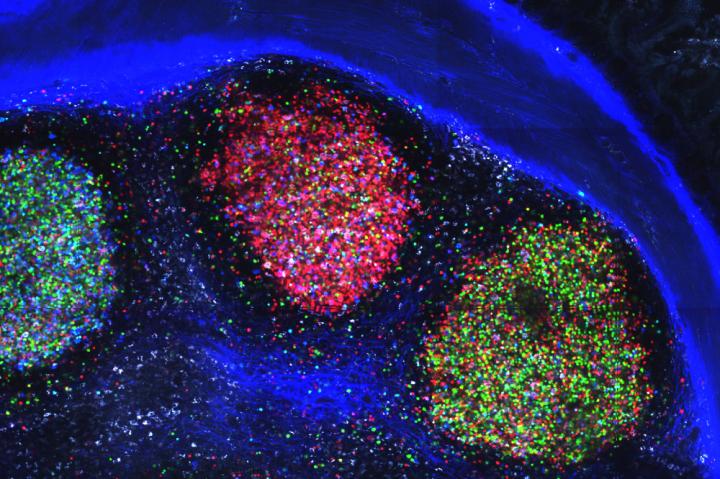
Credit: Laboratory of Lymphocyte Dynamics of The Rockefeller University

The gut is an unusually noisy place, where hundreds of species of bacteria live alongside whatever microbes happen to have hitched a ride in on your lunch. Scientists have long suspected that the gut’s immune system, in the face of so many stimuli, takes an uncharacteristically blunt approach to population control and protection from foreign invaders–churning out non-specific antibodies with broad mandates to mow the gut’s entire microbial lawn without prejudice.

But now, new research published in Nature suggests that the gut’s local immune system can be quite precise, creating antibodies that appear to home in on specific microbiota.

“It was thought that the gut immune system worked sort of like a general-purpose antibiotic, controlling every bug and pathogen,” says Gabriel D. Victora, an immunologist and head of the Laboratory of Lymphocyte Dynamics . “But our new findings tell us that there might be a bit more specificity to this targeting.”

The research suggests that our immune system may play an active part in shaping the composition of our microbiomes, which are tightly linked to health and disease. “A better understanding of this process could one day lead to major implications for conditions where the microbiome is knocked out of balance,” says Daniel Mucida, head of the Laboratory of Mucosal Immunology.

Specificity in the mouse gut

When faced with a pathogen, the immune system’s B cells enter sites called germinal centers where they “learn” to produce specific antibodies until one B cell emerges, finely-tuned to recognize its target with high efficiency. Dubbed a winner clone, this B cell replicates to generate a mob of cells that produce potent antibodies.

Victora, Mucida, and colleagues set out to study how these B cells interact with the melting pot of bacterial species in the gut–an overabundance of potential targets. Looking at the germinal centers that form in mice intestines, they found that about 1 in 10 of these gut-associated germinal centers had clear winner clones. They then homed in on the winning B cells and found that their antibodies were indeed designed to bind with ever increasing potency to specific species of bacteria living in the gut.

The findings show that even in the gut, where millions of microbes wave their thousands of different antigens and vie for the immune system’s attention, germinal centers manage to select specific, consistent winners.

“We can now investigate the winners and look at evolution in germinal centers as an ecological issue involving many different species, as we try to figure out the rules underlying selection in these complex environments,” Victora says. “This opens up a whole new area of inquiry.”

###

Media Contact
Katherine Fenz
[email protected]

Original Source

https://www.rockefeller.edu/news/29507-immune-system-deals-guts-plethora-microbes/

Related Journal Article

http://dx.doi.org/10.1038/s41586-020-2865-9

Tags: BiologyCell BiologyGastroenterologyImmunology/Allergies/AsthmaInternal MedicineMedicine/HealthMolecular Biology
Share12Tweet8Share2ShareShareShare2

Related Posts

Tracking Lanthanide-Labeled Microplastics in Plants

June 25, 2026

Neural Design Enables Zero-Shot Drug-Binding Proteins

June 25, 2026

Genomic Insights into Human Skin Fungi Diversity

June 25, 2026

Chiral Laser Gyroscopes Surpass Lock-In Limit

June 25, 2026
Please login to join discussion

POPULAR NEWS

  • Saying Goodbye to PGY-6: Pediatric Fellowship Realities

    103 shares
    Share 41 Tweet 26
  • Multi-Hospital Study Reveals Long Covid Burden Is Twice as High as Current Estimates

    92 shares
    Share 36 Tweet 23
  • Detection of EDCs in Breast Milk and Infant Urine Up to Six Months Highlights Early Exposure Risks

    77 shares
    Share 31 Tweet 19
  • New Drug Candidate Developed at McMaster Shows Potential for Treating Brain Cancer

    58 shares
    Share 23 Tweet 15

About

We bring you the latest biotechnology news from best research centers and universities around the world. Check our website.

Follow us

Recent News

Tracking Lanthanide-Labeled Microplastics in Plants

POSTECH Researchers Slash Cost of Reconstituted Cell-Free Systems by 95%

AI and Physics Collaborate to Design Advanced Hydrogen Storage Materials

Subscribe to Blog via Email

Success! An email was just sent to confirm your subscription. Please find the email now and click 'Confirm' to start subscribing.

Join 82 other subscribers
  • Contact Us

Bioengineer.org © Copyright 2023 All Rights Reserved.

Welcome Back!

Login to your account below

Forgotten Password?

Retrieve your password

Please enter your username or email address to reset your password.

Log In
No Result
View All Result
  • Homepages
    • Home Page 1
    • Home Page 2
  • News
  • National
  • Business
  • Health
  • Lifestyle
  • Science

Bioengineer.org © Copyright 2023 All Rights Reserved.