• HOME
  • NEWS
  • EXPLORE
    • CAREER
      • Companies
      • Jobs
    • EVENTS
    • iGEM
      • News
      • Team
    • PHOTOS
    • VIDEO
    • WIKI
  • BLOG
  • COMMUNITY
    • FACEBOOK
    • INSTAGRAM
    • TWITTER
Thursday, March 26, 2026
BIOENGINEER.ORG
No Result
View All Result
  • Login
  • HOME
  • NEWS
  • EXPLORE
    • CAREER
      • Companies
      • Jobs
        • Lecturer
        • PhD Studentship
        • Postdoc
        • Research Assistant
    • EVENTS
    • iGEM
      • News
      • Team
    • PHOTOS
    • VIDEO
    • WIKI
  • BLOG
  • COMMUNITY
    • FACEBOOK
    • INSTAGRAM
    • TWITTER
  • HOME
  • NEWS
  • EXPLORE
    • CAREER
      • Companies
      • Jobs
        • Lecturer
        • PhD Studentship
        • Postdoc
        • Research Assistant
    • EVENTS
    • iGEM
      • News
      • Team
    • PHOTOS
    • VIDEO
    • WIKI
  • BLOG
  • COMMUNITY
    • FACEBOOK
    • INSTAGRAM
    • TWITTER
No Result
View All Result
Bioengineer.org
No Result
View All Result
Home NEWS Science News Chemistry

UT Arlington team collaborates with Princeton group on plasma flows

Bioengineer by Bioengineer
October 26, 2020
in Chemistry
Reading Time: 2 mins read
0
IMAGE
Share on FacebookShare on TwitterShare on LinkedinShare on RedditShare on Telegram

DOE grant to fund UTA-Princeton collaboration on laser diagnostics in plasma flows
IMAGE

Credit: UT Arlington

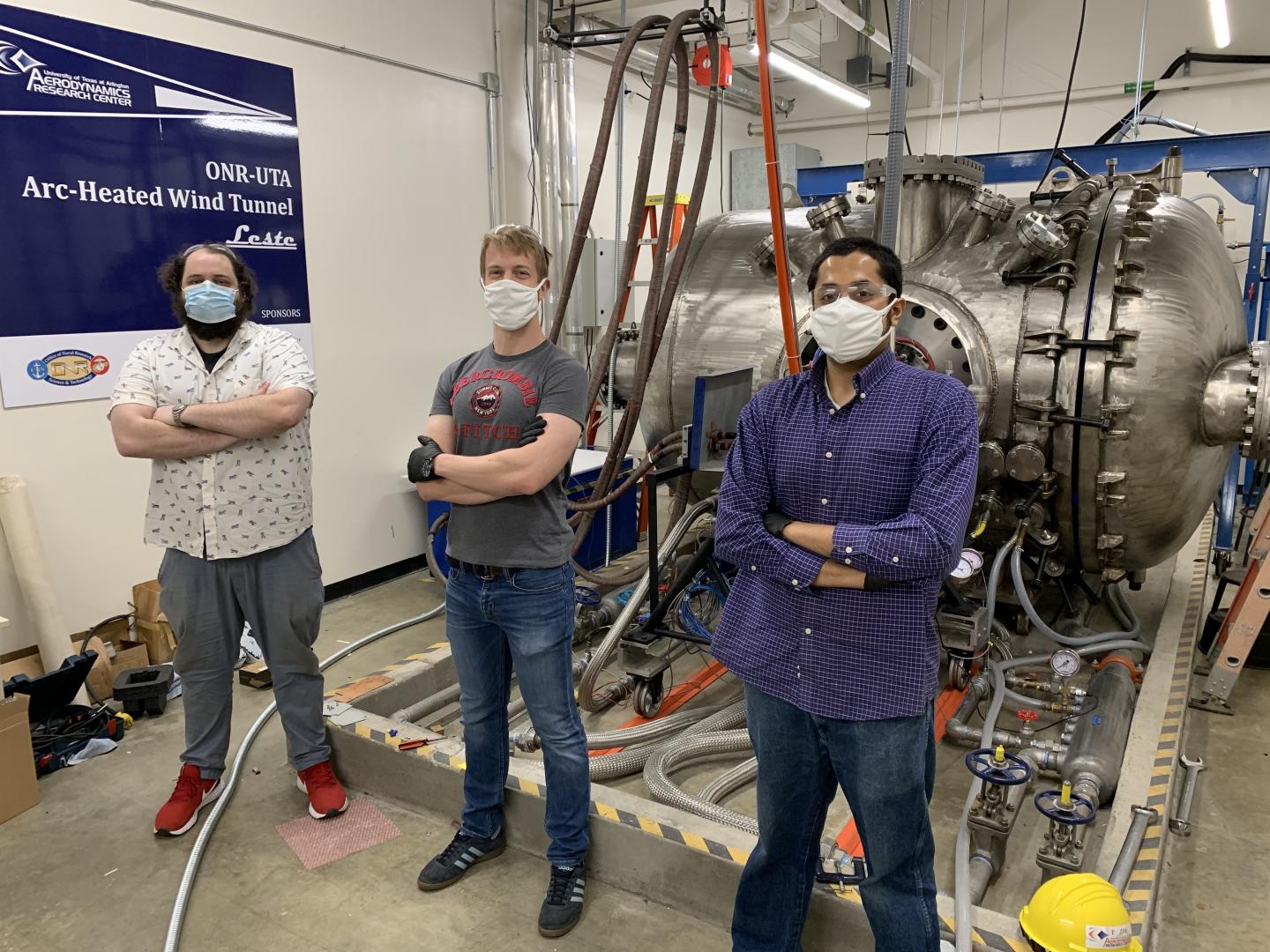
University of Texas at Arlington doctoral students Daniel Palmquist and Vijay Gopal, along with Davide Vigano, a postdoctoral researcher, will study, collaborate and conduct experiments with the Princeton University Plasma Physics Laboratory group, thanks to a Department of Energy grant.

The three are part of Luca Maddalena’s research team at UT Arlington’s Aerodynamics Research Center (ARC). Maddalena is the ARC director and a professor in the Department of Mechanical and Aerospace Engineering.

The $108,940 grant will enable the researchers to gain the technical know-how to perform state-of-the-art femtosecond laser diagnostics in plasma flows. Lasers and optical receivers offer non-intrusive measurements of gas properties by probing a targeted region of gas. Femtosecond (fs) lasers produce a very short laser pulse in the order of one-million-billionth of a second.

This ultra-short laser pulse and the associated quantum mechanical effects on the fluid atoms and molecules offer a unique platform to measure the gas properties in a plasma flow environment, such as their composition and velocity.

“In the research program, ARC members will be exposed to this advanced technique, specifically to measure the number of atoms of oxygen and nitrogen per unit volume using femtosecond laser diagnostics,” Maddalena said.

The wind tunnel, designed at the ARC by Maddalena and his team, opened in June 2019. It is jointly funded by Office of Naval Research (ONR) and the Defense Advanced Research Projects Agency.

The application of these measurements in the arc-heated wind tunnel will help researchers better understand the behavior of heat shields for use in novel hypersonic vehicles and for space exploration applications like planetary entry and re-entry of planetary probes.

“The recent Department of Energy funding will play an important role to bring back fs-laser diagnostics expertise from Princeton to UT Arlington to successfully characterize the arc-heated wind tunnel at the ARC,” Maddalena said.

###

Media Contact
Herb Booth
[email protected]

Original Source

https://www.uta.edu/news/news-releases/2020/10/19/princeton-plasma

Tags: AstrophysicsAtomic/Molecular/Particle PhysicsElectrical Engineering/ElectronicsEnergy SourcesMechanical EngineeringTechnology/Engineering/Computer Science
Share12Tweet8Share2ShareShareShare2

Related Posts

Isolated H2-Reduced Clusters Boost CO2-to-Methanol Catalysis

Isolated H2-Reduced Clusters Boost CO2-to-Methanol Catalysis

March 25, 2026
blank

Physicists Identify Electronic Drivers Behind Flat Band Quantum Materials

March 21, 2026

Würzburg Chemistry Professor Claudia Höbartner Receives Prestigious Honor

March 20, 2026

Scientists Reveal How Magnets Control Metamaterial Behavior

March 20, 2026
Please login to join discussion

POPULAR NEWS

  • blank

    Revolutionary AI Model Enhances Precision in Detecting Food Contamination

    96 shares
    Share 38 Tweet 24
  • Imagine a Social Media Feed That Challenges Your Views Instead of Reinforcing Them

    1003 shares
    Share 397 Tweet 248
  • Uncovering Functions of Cavernous Malformation Proteins in Organoids

    54 shares
    Share 22 Tweet 14
  • Promising Outcomes from First Clinical Trials of Gene Regulation in Epilepsy

    51 shares
    Share 20 Tweet 13

About

We bring you the latest biotechnology news from best research centers and universities around the world. Check our website.

Follow us

Recent News

In-Sensor Cryptography Links Physical Process to Digital Identity

Can Psychosocial Factors Influence Cancer Risk?

Depression Factors in Elderly: Pre vs. Post-COVID Analysis

Subscribe to Blog via Email

Success! An email was just sent to confirm your subscription. Please find the email now and click 'Confirm' to start subscribing.

Join 78 other subscribers
  • Contact Us

Bioengineer.org © Copyright 2023 All Rights Reserved.

Welcome Back!

Login to your account below

Forgotten Password?

Retrieve your password

Please enter your username or email address to reset your password.

Log In
No Result
View All Result
  • Homepages
    • Home Page 1
    • Home Page 2
  • News
  • National
  • Business
  • Health
  • Lifestyle
  • Science

Bioengineer.org © Copyright 2023 All Rights Reserved.