• HOME
  • NEWS
  • EXPLORE
    • CAREER
      • Companies
      • Jobs
    • EVENTS
    • iGEM
      • News
      • Team
    • PHOTOS
    • VIDEO
    • WIKI
  • BLOG
  • COMMUNITY
    • FACEBOOK
    • INSTAGRAM
    • TWITTER
Wednesday, January 14, 2026
BIOENGINEER.ORG
No Result
View All Result
  • Login
  • HOME
  • NEWS
  • EXPLORE
    • CAREER
      • Companies
      • Jobs
        • Lecturer
        • PhD Studentship
        • Postdoc
        • Research Assistant
    • EVENTS
    • iGEM
      • News
      • Team
    • PHOTOS
    • VIDEO
    • WIKI
  • BLOG
  • COMMUNITY
    • FACEBOOK
    • INSTAGRAM
    • TWITTER
  • HOME
  • NEWS
  • EXPLORE
    • CAREER
      • Companies
      • Jobs
        • Lecturer
        • PhD Studentship
        • Postdoc
        • Research Assistant
    • EVENTS
    • iGEM
      • News
      • Team
    • PHOTOS
    • VIDEO
    • WIKI
  • BLOG
  • COMMUNITY
    • FACEBOOK
    • INSTAGRAM
    • TWITTER
No Result
View All Result
Bioengineer.org
No Result
View All Result
Home NEWS Science News Chemistry

Light on efficiency loss in organic solar cells

Bioengineer by Bioengineer
October 26, 2020
in Chemistry
Reading Time: 2 mins read
0
IMAGE
Share on FacebookShare on TwitterShare on LinkedinShare on RedditShare on Telegram

IMAGE

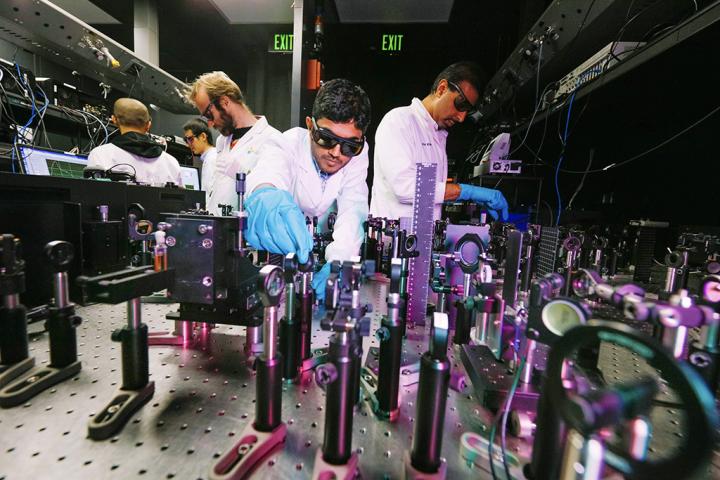
Credit: © 2020 KAUST; Anastasia Serin

Insight into energy losses that affect the conversion of light into electricity could help enhance organic solar cell efficiencies. A KAUST-led team of organic chemists, materials engineers, spectroscopists and theoretical physicists from six research groups has extensively evaluated efficiency-limiting processes in organic photovoltaic systems.

To harvest light, cutting-edge organic solar cells rely on bulk heterojunctions, blends of light-responsive electron donor and acceptor materials. When light strikes the heterojunction, the resulting excited states are pairs of electrons and positively charged holes that need to be separated to make electric current. During charge separation, the donor gives electrons to the acceptor, and the acceptor transfers holes to the donor. Therefore, the efficiency of the solar cells depends on two key factors: the electron affinity offset between these materials, which corresponds to the ability of the acceptor to gain an electron and drives electron transfer; and the ionization energy offset, which represents the propensity of the donor to release an electron, facilitating hole transfer.

Nonfullerene acceptors (NFAs) have recently yielded solar cells with conversion efficiencies nearing 20 percent, outperforming fullerene-based acceptors that had previously dominated. “Key to these record efficiencies is the design and synthesis of materials that combine efficient charge generation with minimal energy losses,” explains team leader Frédéric Laquai. “However, the precise role of the energy offsets and their related processes is unclear, which has stalled the development of design rules for NFA-based systems” he adds.

To address this, the multidisciplinary team devised an approach to monitor the photophysical processes that influence charge generation in 23 different NFA-based systems. “With our collaborator, Denis Andrienko from the Max Planck Institute for Polymer Research in Germany, we developed a concise model that enabled us to correlate our experimental observations to physical parameters and chemical structures,” says research scientist, Julien Gorenflot.

The researchers discovered that, contrary to recent reports, substantial ionization energy offsets were needed to generate charges. In contrast, electron affinity offsets failed to induce charge separation regardless of their magnitude. These unexpected findings result from a process known as Förster resonance energy transfer, which appears to compete with electron transfer. Postdoc Catherine De Castro explains that “this is an immediate consequence of the design principle of the blends, where donor and acceptor present overlapping emission and absorption, which facilitates energy transfer.”

The team plans to design new materials combining enhanced charge generation efficiencies with lower energy losses. “This will help reduce the efficiency gap to other emerging photovoltaic technologies and bring organic photovoltaics closer to maturity and application,” Gorenflot says.

###

Media Contact
Michael Cusack
[email protected]

Related Journal Article

http://dx.doi.org/10.1038/s41563-020-00835-x

Tags: Chemistry/Physics/Materials SciencesEnergy/Fuel (non-petroleum)MaterialsOpticsPolymer Chemistry
Share14Tweet9Share3ShareShareShare2

Related Posts

blank

Thermal [2+2] Cycloaddition Builds Gem-Difluoro Bicycloalkanes

January 13, 2026
blank

Cobalt-Catalyzed Thioester Coupling via Siloxycarbene

January 12, 2026

Advancing Alkene Chemistry: Homologative Difunctionalization Breakthrough

January 8, 2026

Biocompatible Ligand Enables Safe In-Cell Protein Arylation

January 8, 2026
Please login to join discussion

POPULAR NEWS

  • Enhancing Spiritual Care Education in Nursing Programs

    154 shares
    Share 62 Tweet 39
  • PTSD, Depression, Anxiety in Childhood Cancer Survivors, Parents

    147 shares
    Share 59 Tweet 37
  • Robotic Ureteral Reconstruction: A Novel Approach

    73 shares
    Share 29 Tweet 18
  • Study Reveals Lipid Accumulation in ME/CFS Cells

    52 shares
    Share 21 Tweet 13

About

BIOENGINEER.ORG

We bring you the latest biotechnology news from best research centers and universities around the world. Check our website.

Follow us

Recent News

Validating Blenkin Taylor vs London Atlas for Aussie Dental Aging

Astaxanthin’s Role in Easing Exercise Muscle Damage

Understanding Nurses’ Views on Dual-Diagnosis Care in Ghana

Subscribe to Blog via Email

Enter your email address to subscribe to this blog and receive notifications of new posts by email.

Join 71 other subscribers
  • Contact Us

Bioengineer.org © Copyright 2023 All Rights Reserved.

Welcome Back!

Login to your account below

Forgotten Password?

Retrieve your password

Please enter your username or email address to reset your password.

Log In
No Result
View All Result
  • Homepages
    • Home Page 1
    • Home Page 2
  • News
  • National
  • Business
  • Health
  • Lifestyle
  • Science

Bioengineer.org © Copyright 2023 All Rights Reserved.