Demonstrated the mechanism behind the secondary generation of cavitation clouds that mechanically fractionates surrounding tissue in focused ultrasound treatment. Laid the groundwork for precise removal of the target tissue.
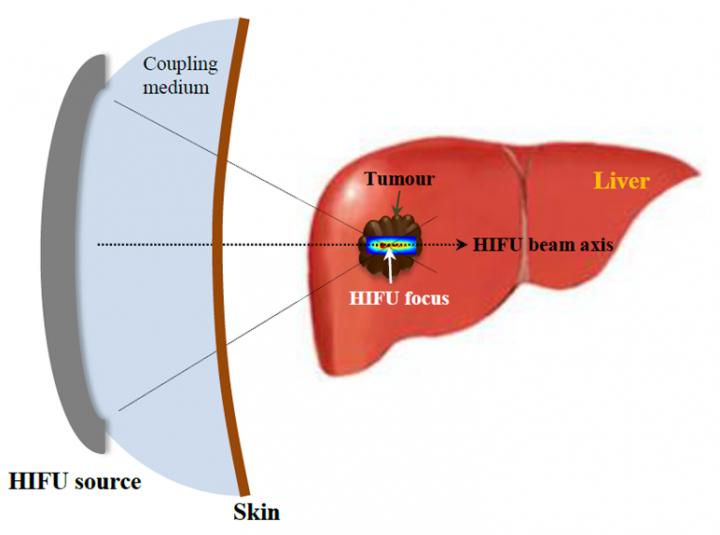
Credit: Korea Institue of Science and Technology(KIST)
Focusing ultrasound energy on a target site in the body to generate heat can burn and destroy the tissue in the site without a surgical procedure. This method is clinically applied to treat uterine fibroids, prostatic hyperplasia, prostate cancer, metastatic bone tumor and other types of tumor to destroy tumor cells using heat. However, there is a potential problem that the surrounding tissue may be burned in the process due to heat diffusion.
In 2019, at the Korea Institute of Science and Technology (KIST) Center for Bionics, Dr. Ki Joo Pahk’s research team confirmed the possibility of precisely fractionating target tumor cells, as though it is cut out using a knife, without causing heat damage to any other part of the body by using high-intensity focused ultrasound (HIFU), an ultrasound with an acoustic pressure in megapascals (MPa) that is much more powerful than existing ultrasound, and revealed the mechanism behind the procedure.(?Ultrasonics Sonochemistry. 2019, 53, 164-177)
In the process of physically destroying the tissue without the use of heat, a boiling vapor bubble is generated at the target site of the HIFU, and it is by the kinetic energy of this primary vapor bubble that the target tumor tissue gets destroyed. However, during the process, cavitation bubble clouds can be subsequently generated between the boiling bubble and the HIFU transducer, leading to unwanted cell destruction. This made it necessary to identify the cause of their formation and to accurately predict the locations of their occurrence.
In order to reveal the mechanism of cavitation bubble clouds formation occurring when tumor tissue is removed by HIFU, the research team at KIST developed a mathematical model as part of their follow-up study and examined the impact of the primary boiling vapor bubble on nonlinear wave propagation. The results showed that the secondary generation of bubbles was caused by a constructive interference of the backscattered shockwave by the boiling bubble with the incoming incident shockwaves and it is within the range of this interference that the secondary bubbles formed. Based on the images obtained using a high-speed camera, it was found that the area where the interference occurred and the area where the secondary bubbles were generated were closely matched.
These findings not only explain the mechanism behind the secondary bubbles formation but also help predict where they will occur, thereby presenting the possibility of destroying target tissue with greater safety and precision.
Dr. Pahk from KIST said, “This study has shown that cavitation bubble clouds can be subsequently generated as a result of a shock scattering effect after a boiling vapor bubble forms where the ultrasound is focused. Using the mathematical developed in this study, it will be possible to predict the locations of bubble formation and the potential site that gets destroyed. I hope that the ultrasound technology under development will be developed in an ultra-precision focused ultrasound technology enabling physical destruction of only the tumor tissue, without the need for surgery, so that it can be applied clinically in the future.”
###
This study was carried out with a grant from the Ministry of Science and ICT (MSIT), as part of the Institutional R&D Program of KIST and the Creative Convergence Research Program of the National Research Council of Science & Technology (NST). It was published in the latest edition of Ultrasonics Sonochemistry (IF: 6.513, Top 1.562% in the field of JCR), a leading international journal in the field of acoustics.
Media Contact
Do-Hyun Kim
[email protected]
Related Journal Article
http://dx.