• HOME
  • NEWS
  • EXPLORE
    • CAREER
      • Companies
      • Jobs
    • EVENTS
    • iGEM
      • News
      • Team
    • PHOTOS
    • VIDEO
    • WIKI
  • BLOG
  • COMMUNITY
    • FACEBOOK
    • INSTAGRAM
    • TWITTER
Saturday, February 7, 2026
BIOENGINEER.ORG
No Result
View All Result
  • Login
  • HOME
  • NEWS
  • EXPLORE
    • CAREER
      • Companies
      • Jobs
        • Lecturer
        • PhD Studentship
        • Postdoc
        • Research Assistant
    • EVENTS
    • iGEM
      • News
      • Team
    • PHOTOS
    • VIDEO
    • WIKI
  • BLOG
  • COMMUNITY
    • FACEBOOK
    • INSTAGRAM
    • TWITTER
  • HOME
  • NEWS
  • EXPLORE
    • CAREER
      • Companies
      • Jobs
        • Lecturer
        • PhD Studentship
        • Postdoc
        • Research Assistant
    • EVENTS
    • iGEM
      • News
      • Team
    • PHOTOS
    • VIDEO
    • WIKI
  • BLOG
  • COMMUNITY
    • FACEBOOK
    • INSTAGRAM
    • TWITTER
No Result
View All Result
Bioengineer.org
No Result
View All Result
Home NEWS Science News Chemistry

Australian research shows NASA’s James Webb telescopes will reveal hidden galaxies

Bioengineer by Bioengineer
October 15, 2020
in Chemistry
Reading Time: 3 mins read
0
IMAGE
Share on FacebookShare on TwitterShare on LinkedinShare on RedditShare on Telegram

Blinding glare of quasars can be overcome
IMAGE

Credit: NASA

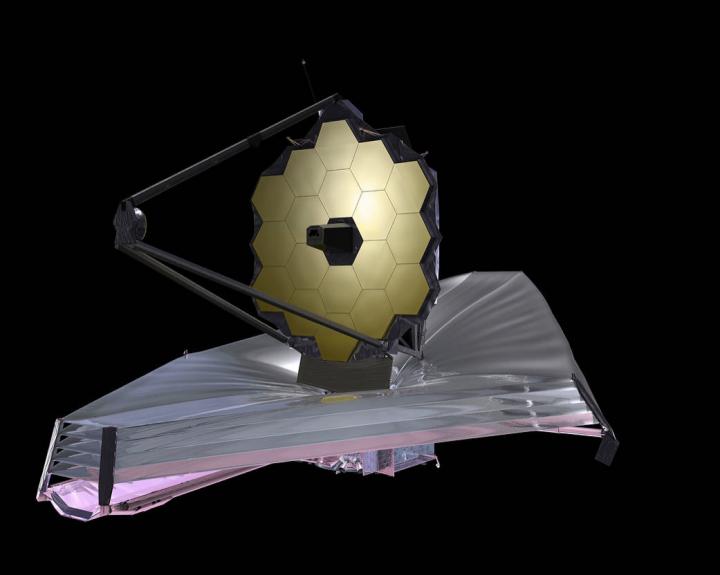
Two new studies from the University of Melbourne will help the largest, most powerful and complex space telescope ever built to uncover galaxies never before seen by humanity.

The papers are published in The Astrophysical Journal and the Monthly Notices of the Royal Astronomical Society and show that NASA’s James Webb Space Telescope, scheduled for launch late next year, will reveal hidden galaxies.

Powerful lights called ‘quasars’ are the brightest objects in the universe. Powered by supermassive black holes up to a trillion times the mass of our Sun, they outshine entire galaxies of billions of stars.

Simulations led by Science PhD candidate, Madeline Marshall, show that while even NASA’s Hubble Space Telescope can’t see galaxies currently hidden by these quasars, the James Webb Telescope will be able to get past the glare.

“Webb will open up the opportunity to observe these very distant host galaxies for the first time,” said Ms Marshall, who conducted her research at the ARC Centre of Excellence in All Sky Astrophysics in 3 Dimensions (ASTRO 3D).

“That can help us answer questions like: How can black holes grow so big so fast? Is there a relationship between the mass of the galaxy and the mass of the black hole, like we see in the nearby universe?”

Although quasars are known to reside at the centers of galaxies, it has been difficult to tell what those galaxies are like and how they compare to galaxies without quasars.

“Ultimately, Webb’s observations should provide new insights into these extreme systems,” said ASTRO 3D co-author Stuart Wyithe of the University of Melbourne.

“The data it gathers will help us understand how a black hole could grow to weigh a billion times as much as our Sun in just a billion years. These big black holes shouldn’t exist so early because there hasn’t been enough time for them to grow so massive.”

The University of Melbourne team collaborated with researchers from the US, China, Germany, and The Netherlands to use the Hubble Space Telescope to try to observe these galaxies.

They then used a state-of-the-art computer simulation called BlueTides, which was developed by a team led by ASTRO 3D distinguished visitor, Tiziana Di Matteo, from Carnegie Mellon University in Pittsburgh, Pennsylvania, US.

“BlueTides is designed to study the formation and evolution of galaxies and quasars in the first billion years of the universe’s history,” said Yueying Ni of Carnegie Mellon University, who ran the BlueTides simulation.

“Its large cosmic volume and high spatial resolution enables us to study those rare quasar hosts on a statistical basis.”

The team used these simulations to determine what Webb’s cameras would see if the observatory studied these distant systems. They found that distinguishing the host galaxy from the quasar would be possible, although still challenging due to the galaxy’s small size on the sky.

They also found that the galaxies hosting quasars tended to be smaller than average, spanning only about 1/30 the diameter of the Milky Way despite containing almost as much mass as our galaxy.

“The host galaxies are surprisingly tiny compared to the average galaxy at that point in time,” said Ms Marshall.

###

Media Contact
Lito Vilisoni Wilson
[email protected]

Tags: AstronomyAstrophysicsExperiments in SpacePlanets/MoonsSatellite Missions/ShuttlesSpace/Planetary ScienceStars/The Sun
Share12Tweet8Share2ShareShareShare2

Related Posts

blank

Breakthrough in Environmental Cleanup: Scientists Develop Solar-Activated Biochar for Faster Remediation

February 7, 2026
blank

Cutting Costs: Making Hydrogen Fuel Cells More Affordable

February 6, 2026

Scientists Develop Hand-Held “Levitating” Time Crystals

February 6, 2026

Observing a Key Green-Energy Catalyst Dissolve Atom by Atom

February 6, 2026
Please login to join discussion

POPULAR NEWS

  • Robotic Ureteral Reconstruction: A Novel Approach

    Robotic Ureteral Reconstruction: A Novel Approach

    82 shares
    Share 33 Tweet 21
  • Digital Privacy: Health Data Control in Incarceration

    63 shares
    Share 25 Tweet 16
  • Study Reveals Lipid Accumulation in ME/CFS Cells

    57 shares
    Share 23 Tweet 14
  • Breakthrough in RNA Research Accelerates Medical Innovations Timeline

    53 shares
    Share 21 Tweet 13

About

We bring you the latest biotechnology news from best research centers and universities around the world. Check our website.

Follow us

Recent News

Neg-Entropy: The Key Therapeutic Target for Chronic Diseases

Multidisciplinary Evidence-Based Guidelines for Therapeutic Drug Monitoring of Biologics in Inflammatory Bowel Disease

Early Tuberculosis Treatment Lowers Sepsis Mortality in People with HIV

Subscribe to Blog via Email

Enter your email address to subscribe to this blog and receive notifications of new posts by email.

Join 73 other subscribers
  • Contact Us

Bioengineer.org © Copyright 2023 All Rights Reserved.

Welcome Back!

Login to your account below

Forgotten Password?

Retrieve your password

Please enter your username or email address to reset your password.

Log In
No Result
View All Result
  • Homepages
    • Home Page 1
    • Home Page 2
  • News
  • National
  • Business
  • Health
  • Lifestyle
  • Science

Bioengineer.org © Copyright 2023 All Rights Reserved.