Researchers use a simple, inexpensive technique to develop a new fast-acting form of deltamethrin that may help with growing insecticide resistance
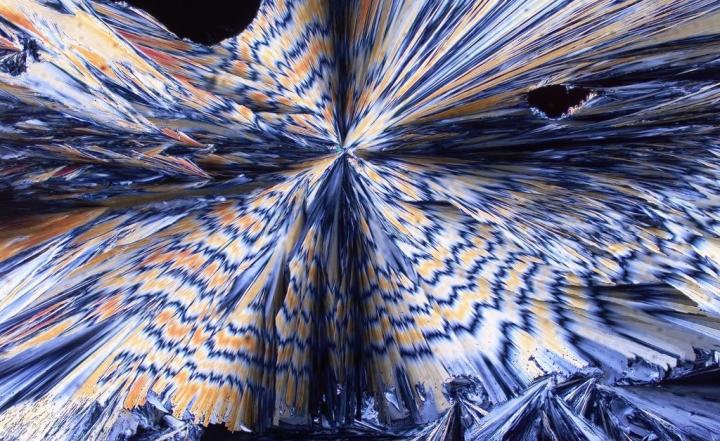
Credit: Jingxiang Yang, NYU
p>Through a simple process of heating and cooling, New York University researchers have created a new crystal form of deltamethrin–a common insecticide used to control malaria–resulting in an insecticide that is up to 12 times more effective against mosquitoes than the existing form.
The findings, published in the journal Proceedings of the National Academy of Sciences (PNAS), may provide a much-needed and affordable insecticide alternative in the face of growing resistance among mosquitoes.
“The use of more active crystal forms of insecticides is a simple and powerful strategy for improving commercially available compounds for malaria control, circumventing the need for developing new products in the ongoing fight against mosquito-borne diseases,” said Bart Kahr, professor of chemistry at NYU and one of the study’s senior authors.
“Improvements in malaria control are needed as urgently as ever during the global COVID-19 crisis,” added Kahr. “The number of deaths from malaria in Africa this year is projected to double as a result of coronavirus-related disruptions to supply chains. We need public health measures to curtail both infectious diseases, and for malaria, this includes more effective insecticides.”
Malaria is a major public health challenge worldwide, with more than 200 million cases and 400,000 deaths reported each year. Insecticides such as deltamethrin can prevent the spread of diseases carried by mosquitoes and are often sprayed indoors and on bed nets. However, mosquitoes are increasingly becoming resistant to insecticides, leaving researchers and public health officials searching for alternatives with new modes of action.
Many insecticides, including deltamethrin, are in the form of crystals–the research focus for Kahr and fellow NYU chemistry professor Michael Ward. When mosquitoes step on insecticide crystals, the insecticide is absorbed through their feet and, if effective, kills the mosquitoes.
As part of their research on crystal formation and growth, Kahr and Ward study and manipulate insecticide crystals, exploring their alternative forms. In their PNAS study, the researchers heated the commercially available form of deltamethrin to 110°C/230°F for a few minutes and let it cool to room temperature; this resulted in a new crystallized form of deltamethrin, composed of long, tiny fibers radiating from a single point.
When tested on Anopheles quadrimaculatus and Aedes aegypti mosquitoes–both of which transmit malaria–and fruit flies, the new crystal form of deltamethrin worked up to 12 times faster than the existing form. Fast-acting insecticides are important for quickly controlling mosquitoes before they reproduce or continue spreading diseases.
The new form also remained stable–and able to rapidly kill mosquitoes–for at least three months.
To simulate how the two forms of deltamethrin would perform in stemming the spread of malaria, the researchers turned to epidemiological modeling that suggests that using the new form in indoor spraying in place of the original form would significantly suppress malaria transmission, even in regions with high levels of insecticide resistance. Moreover, less of the new form would need to be used to achieve the same effect, potentially lowering the cost of mosquito control programs and reducing environmental exposure to the insecticide.
“Deltamethrin has been a leading tool in combating malaria, but it faces an uncertain future, threatened by developing insecticide resistance. The simple preparation of this new crystal form of deltamethrin, coupled with its stability and markedly greater efficacy, shows us that the new form can serve as a powerful and affordable tool for controlling malaria and other mosquito-borne diseases,” said Ward.
###
In addition to Kahr and Ward, study authors include NYU researchers Jingxiang Yang, Bryan Erriah, Chunhua T. Hu, Ethan Reiter, Xiaolong Zhu, as well as Vilmalí López-Mejías and Isis Paola Carmona-Sepúlveda of the University of Puerto Rico. The research was supported by the National Science Foundation (NSF) and its Materials Research Science and Engineering Center (MRSEC) program (Award No. DMR-1420073). The X-ray facility was also supported in part by the NSF (Award No. CRIF/CHE-0840277).
Media Contact
Rachel Harrison
[email protected]
Related Journal Article
http://dx.