Helping NASA scientists understand major flares and life around other stars
Credit: NASA/SDO
NASA’s extensive fleet of spacecraft allows scientists to study the Sun extremely close-up – one of the agency’s spacecraft is even on its way to fly through the Sun’s outer atmosphere. But sometimes taking a step back can provide new insight.
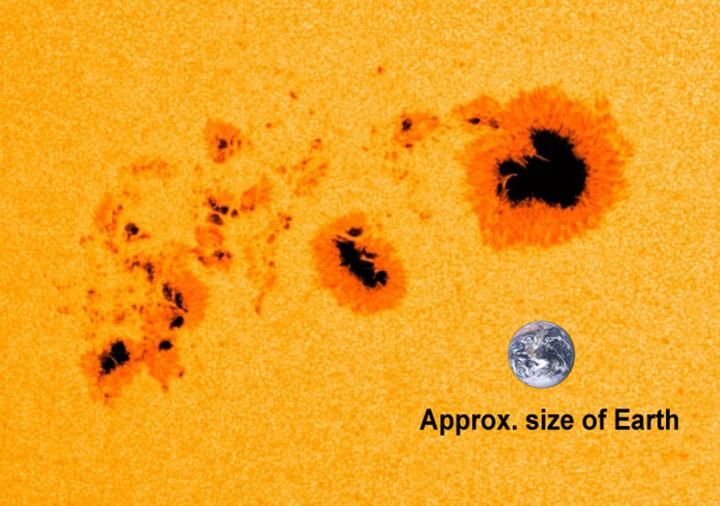
In a new study, scientists looked at sunspots – darkened patches on the Sun caused by its magnetic field – at low resolution as if they were trillions of miles away. What resulted was a simulated view of distant stars, which can help us understand stellar activity and the conditions for life on planets orbiting other stars.
“We wanted to know what a sunspot region would look like if we couldn’t resolve it in an image,” said Shin Toriumi, lead author on the new study and scientist at ?the Institute of Space and Astronautical Science at JAXA. “So, we used the solar data as if it came from a distant star to have a better connection between solar physics and stellar physics.”
Sunspots are often precursors to solar flares – intense outbursts of energy from the surface of the Sun – so monitoring sunspots is important to understanding why and how flares occur. Additionally, understanding the frequency of flares on other stars is one of the keys to understanding their chance of harboring life. Having a few flares may help build up complex molecules like RNA and DNA from simpler building blocks. But too many strong flares can strip entire atmospheres, rendering a planet uninhabitable.
To see what a sunspot and its effect on the solar atmosphere would look like on a distant star, the scientists started with high-resolution data of the Sun from NASA’s Solar Dynamics Observatory and JAXA/NASA’s Hinode mission. By adding up all the light in each image, the scientists converted the high-resolution images into single datapoints. Stringing subsequent datapoints together, the scientists created plots of how the light changed as the sunspot passed across the Sun’s rotating face. These plots, which scientists call light curves, showed what a passing sunspot on the Sun would look like if it were many light-years away.
https:/
“The Sun is our closest star. Using solar observing satellites, we can resolve signatures on the surface 100 miles wide,” said Vladimir Airapetian, co-author on the new study and astrophysicist at NASA’s Goddard Space Flight Center in Greenbelt, Maryland. “On other stars you might only get one pixel showing the entire surface, so we wanted to create a template to decode activity on other stars.”
The new study, published in the Astrophysical Journal, looked at simple cases where there is just one group of sunspots visible across the entire face of the Sun. Even though NASA and JAXA missions have continually gathered observations of the Sun for over a decade, these cases are quite rare. Usually there are either several sunspots – such as during the solar maximum, which we are now moving toward – or none at all. In all the years of data, the scientists only found a handful of instances of just one isolated sunspot group.
Studying these events, the scientists found the light curves differed when they measured different wavelengths. In visible light, when a singular sunspot appears at the center of the Sun, the Sun is dimmer. However, when the sunspot group is near the edge of the Sun, it’s actually brighter due to faculae – bright magnetic features around sunspots – because, near the edge, the hot walls of their nearly vertical magnetic fields become increasingly visible.
The scientists also looked at the light curves in x-ray and ultraviolet light, which show the atmosphere above the sunspots. As the atmospheres above sunspots are magnetically heated, the scientists found brightening there at some wavelengths. However, the scientists also unexpectedly discovered that the heating could also cause a dimming in the light coming from the lower temperature atmosphere. These findings may provide a tool to diagnose the environments of spots on the stars.
“So far we’ve done the best-case scenarios, where there’s only one sunspot visible,” Toriumi said. “Next we are planning on doing some numerical modeling to understand what happens if we have multiple sunspots.”
By studying stellar activity on young stars in particular, scientists can glean a view of what our young Sun may have been like. This will help scientists understand how the young Sun – which was overall more dim but active – impacted Venus, Earth and Mars in their early days. It could also help explain why life on Earth started four billion years ago, which some scientists speculate is linked to intense solar activity.
Studying young stars can also contribute to scientists’ understanding of what triggers superflares – those that are 10 to 1000 times stronger than the biggest seen on the Sun in recent decades. Young stars are typically more active, with superflares happening almost daily. Whereas, on our more mature Sun, they may only occur once in a thousand years or so.
Spotting young suns that that are conducive to supporting habitable planets, helps scientists who focus on astrobiology, the study of the origin evolution, and distribution of life in the universe. Several next generation telescopes in production, which will be able to observe other stars in x-ray and ultraviolet wavelengths, could use the new results to decode observations of distant stars. In turn, this will help identify those stars with appropriate levels of stellar activity for life – and that can then be followed up by observations from other upcoming high-resolution missions, such as NASA’s James Webb Space Telescope.
###
Media Contact
Mara Johnson-Groh
[email protected]
Original Source
https:/
![Tuning Endergonic Triplet Photosensitization Enables Bicyclo[1.1.0]butane–Alkene Cycloadditions](https://bioengineer.org/wp-content/uploads/2026/08/Tuning-Endergonic-Triplet-Photosensitization-Enables-Bicyclo110butane–Alkene-Cycloadditions-120x86.jpg)