• HOME
  • NEWS
  • EXPLORE
    • CAREER
      • Companies
      • Jobs
    • EVENTS
    • iGEM
      • News
      • Team
    • PHOTOS
    • VIDEO
    • WIKI
  • BLOG
  • COMMUNITY
    • FACEBOOK
    • INSTAGRAM
    • TWITTER
Sunday, January 25, 2026
BIOENGINEER.ORG
No Result
View All Result
  • Login
  • HOME
  • NEWS
  • EXPLORE
    • CAREER
      • Companies
      • Jobs
        • Lecturer
        • PhD Studentship
        • Postdoc
        • Research Assistant
    • EVENTS
    • iGEM
      • News
      • Team
    • PHOTOS
    • VIDEO
    • WIKI
  • BLOG
  • COMMUNITY
    • FACEBOOK
    • INSTAGRAM
    • TWITTER
  • HOME
  • NEWS
  • EXPLORE
    • CAREER
      • Companies
      • Jobs
        • Lecturer
        • PhD Studentship
        • Postdoc
        • Research Assistant
    • EVENTS
    • iGEM
      • News
      • Team
    • PHOTOS
    • VIDEO
    • WIKI
  • BLOG
  • COMMUNITY
    • FACEBOOK
    • INSTAGRAM
    • TWITTER
No Result
View All Result
Bioengineer.org
No Result
View All Result
Home NEWS Science News Health

Human heart in space: What can we learn from mathematical modeling

Bioengineer by Bioengineer
October 8, 2020
in Health
Reading Time: 2 mins read
0
IMAGE
Share on FacebookShare on TwitterShare on LinkedinShare on RedditShare on Telegram

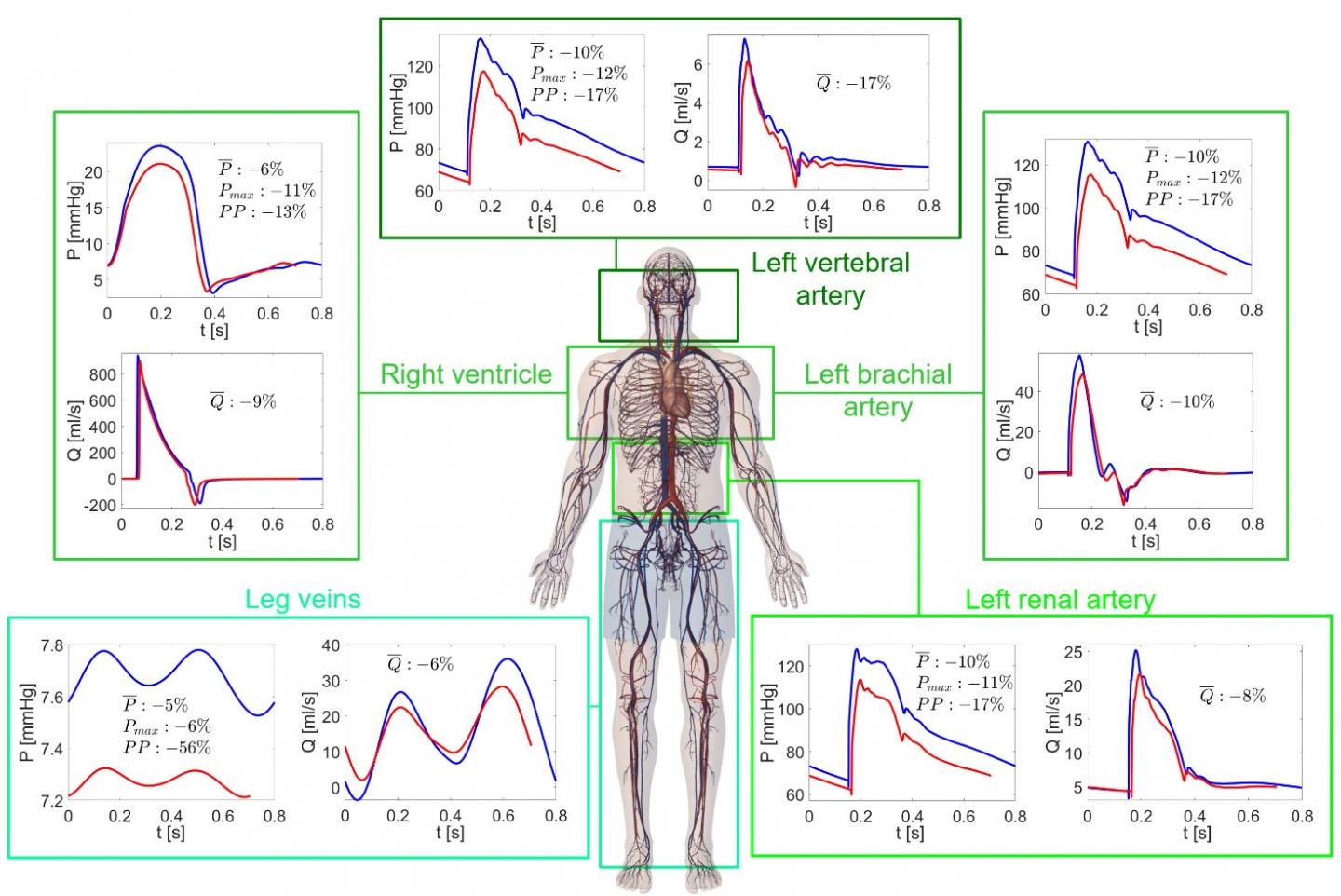
The research carried out by the Politecnico di Torino shows that space flight ages astronauts’ heart
IMAGE

Credit: Politecnico di Torino

Human spaceflight has been fascinating man for centuries, representing the intangible need to explore the unknown, challenge new frontiers, advance technology and push scientific boundaries further. A key aspect of long-term human spaceflight is the physiological response and the consequent microgravity (0G) adaptation, which has all the features of accelerated aging involving almost every body system: muscle atrophy and bone loss, onset of balance and coordination problems, loss of functional capacity of the cardiovascular system.

A research published in recent days in npj Microgravity – a prestigious journal of the Nature group “Cardiovascular deconditioning during long-term spaceflight through multiscale modeling”) – and conducted by Caterina Gallo, Luca Ridolfi and Stefania Scarsoglio shows that human spaceflight reduces exercise tolerance and ages astronauts’ heart.

The study is based on a mathematical model which allowed to investigate some spaceflight mechanisms inducing cardiovascular deconditioning, that is the adaptation of the cardiovascular system to a less demanding environment.

Understanding 0G configuration is crucial to ensure the full health and well-being of astronauts in view of the now imminent missions to the Moon and Mars. Moreover, since spaceflight deconditioning has features similar to accelerated aging, gravitational physiology may lead to useful insights to delay or prevent the modern lifestyle medical disorders related with living longer.

The proposed study compared the cardiovascular response in microgravity (0G) conditions with what happens on Earth: several hemodynamic parameters – such as cardiac work, oxygen consumption and contractility indexes, as well as arterial pressure – were reduced. Exercise tolerance of a spaceflight traveler was found to be comparable to an untrained person with a sedentary lifestyle. At the capillary-venous level significant waveform alterations were observed which can modify the regular perfusion and average nutrient supply at the cellular level.

“Present findings” professor Scarsoglio observes “are useful to design future long-term spaceflights, individuate optimal countermeasures and understand the state of health of astronauts when prompt physical capacity at the time of restoration of partial gravity (e.g., Moon/Mars landing) is required”.

###

Media Contact
Relazioni Media
[email protected]

Tags: AgingCardiologyMedicine/HealthMetabolism/Metabolic Diseases
Share12Tweet8Share2ShareShareShare2

Related Posts

Person-Centered Communication Care: A Mixed Methods Study

January 25, 2026

Bisphosphonates Cut Fragility Fractures in Jordan

January 25, 2026

Combatting Antifungal Resistance in Candida Onychomycosis

January 25, 2026

Revolutionizing Corynebacterium diphtheriae Strain Classification

January 25, 2026
Please login to join discussion

POPULAR NEWS

  • Enhancing Spiritual Care Education in Nursing Programs

    156 shares
    Share 62 Tweet 39
  • PTSD, Depression, Anxiety in Childhood Cancer Survivors, Parents

    149 shares
    Share 60 Tweet 37
  • Robotic Ureteral Reconstruction: A Novel Approach

    80 shares
    Share 32 Tweet 20
  • Digital Privacy: Health Data Control in Incarceration

    62 shares
    Share 25 Tweet 16

About

We bring you the latest biotechnology news from best research centers and universities around the world. Check our website.

Follow us

Recent News

Revolutionary Model Predicts Lysine Hydroxybutyrylation Sites

Reconfiguration and Movement in Amoebot Models

Refueling Fleet Test Reveals Endurance Insights

Subscribe to Blog via Email

Enter your email address to subscribe to this blog and receive notifications of new posts by email.

Join 71 other subscribers
  • Contact Us

Bioengineer.org © Copyright 2023 All Rights Reserved.

Welcome Back!

Login to your account below

Forgotten Password?

Retrieve your password

Please enter your username or email address to reset your password.

Log In
No Result
View All Result
  • Homepages
    • Home Page 1
    • Home Page 2
  • News
  • National
  • Business
  • Health
  • Lifestyle
  • Science

Bioengineer.org © Copyright 2023 All Rights Reserved.