• HOME
  • NEWS
  • EXPLORE
    • CAREER
      • Companies
      • Jobs
    • EVENTS
    • iGEM
      • News
      • Team
    • PHOTOS
    • VIDEO
    • WIKI
  • BLOG
  • COMMUNITY
    • FACEBOOK
    • INSTAGRAM
    • TWITTER
Thursday, May 21, 2026
BIOENGINEER.ORG
No Result
View All Result
  • Login
  • HOME
  • NEWS
  • EXPLORE
    • CAREER
      • Companies
      • Jobs
        • Lecturer
        • PhD Studentship
        • Postdoc
        • Research Assistant
    • EVENTS
    • iGEM
      • News
      • Team
    • PHOTOS
    • VIDEO
    • WIKI
  • BLOG
  • COMMUNITY
    • FACEBOOK
    • INSTAGRAM
    • TWITTER
  • HOME
  • NEWS
  • EXPLORE
    • CAREER
      • Companies
      • Jobs
        • Lecturer
        • PhD Studentship
        • Postdoc
        • Research Assistant
    • EVENTS
    • iGEM
      • News
      • Team
    • PHOTOS
    • VIDEO
    • WIKI
  • BLOG
  • COMMUNITY
    • FACEBOOK
    • INSTAGRAM
    • TWITTER
No Result
View All Result
Bioengineer.org
No Result
View All Result
Home NEWS Science News Chemistry

Breaking the coupling process

Bioengineer by Bioengineer
October 6, 2020
in Chemistry
Reading Time: 2 mins read
0
IMAGE
Share on FacebookShare on TwitterShare on LinkedinShare on RedditShare on Telegram

IMAGE

Credit: Illustration: Gerhard Stock, Steffen Wolf

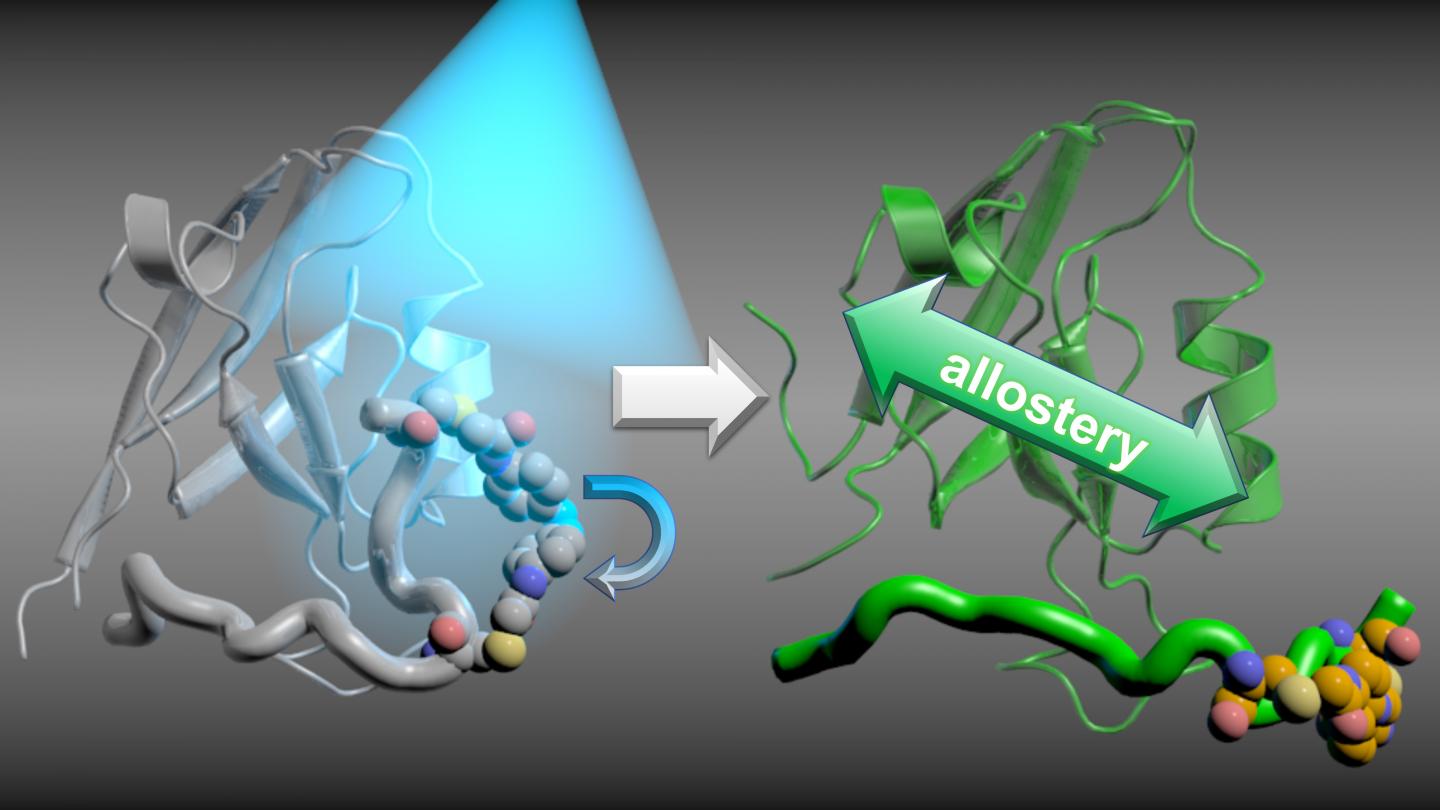
Proteins transduce information and signals within the human body by changes in their structures. For example, hormones binding to their target proteins cause a structural change which in turn opens new binding sites for other proteins elsewhere on the surface of the protein. Researchers refer to this coupling of different, distant binding sites as allostery. An interruption of this coupling leads to signals not being passed on.

This can be achieved by molecules specifically designed for this purpose, which thereby obtain pharmacological effects as analgesics or chemotherapeutic agents. To selectively design such molecules, scientists need to learn more about the possible mechanisms of allostery. A team led by Prof. Dr. Gerhard Stock from the Biomolecular Dynamics group at the Institute of Physics at the University of Freiburg and Prof. Dr. Peter Hamm from the Institute of Chemistry at the University of Zurich, Switzerland provides important insights into the molecular details of allostery in the journal PNAS.

The researchers tracked time-resolved allosteric changes in the test protein PDZ2, which are caused by the binding of a peptide ligand. To this end, the research group at the University of Zurich performed time-resolved vibrational spectroscopy, while the physicists at the University of Freiburg simulated the corresponding changes on an atomistic level using the bwHPC cluster BinAC at Tübingen. This combination enabled the scientists to understand how a change in the ligand binding mode induces protein structure changes passing through the protein with atomic resolution and a time scale range from picoseconds to microseconds. The real-time observation of signal transduction in proteins showed that allostery is based on changes in both the structure and dynamics of the protein, which exhibits hierarchical dynamics, where a structural change takes about ten times longer than a preceding change.

###

Original publication:

Bozovic, O., Zanobini, C., Gulzar, A., Jankovic, B., Buhrke, D., Post, M., Wolf, S., Stock, G., Hamm, P. (2020): Real-time observation of ligand-induced allosteric transitions in a PDZ domain. In: PNAS. DOI: 10.1073/pnas.2012999117

Contact:

Institute of Physics

Faculty for Mathematics and Physics

University of Freiburg

Media Contact
Prof. Dr. Gerhard Stock
[email protected]

Related Journal Article

http://dx.doi.org/10.1073/pnas.2012999117

Tags: BiologyBiomechanics/BiophysicsChemistry/Physics/Materials SciencesMedicine/HealthMolecular Biology
Share12Tweet8Share2ShareShareShare2

Related Posts

Advancing In Vivo and In Situ Monitoring: Science Bulletin Highlights Host-Based Antifouling Gold Nanotube Sensor for Selective Detection of Mechanically Sensitive Serotonin Release in Intestinal Mucosa — Chemistry

Advancing In Vivo and In Situ Monitoring: Science Bulletin Highlights Host-Based Antifouling Gold Nanotube Sensor for Selective Detection of Mechanically Sensitive Serotonin Release in Intestinal Mucosa

May 20, 2026
How Magnetic Orientation Could Influence the Building Blocks of Life — Chemistry

How Magnetic Orientation Could Influence the Building Blocks of Life

May 20, 2026

Breaking a 200-Year-Old Belief: Novel Surface Design Achieves Two Distinct Wetting States on One Substrate

May 20, 2026

Unveiling Sound Waves: Scientists Discover Hidden Behaviors in Acoustic Phenomena

May 20, 2026
Please login to join discussion

POPULAR NEWS

  • blank

    New Study Reveals Plants Can Detect the Sound of Rain

    733 shares
    Share 292 Tweet 183
  • ESMO 2025: mRNA COVID Vaccines Enhance Efficacy of Cancer Immunotherapy

    303 shares
    Share 121 Tweet 76
  • Research Indicates Potential Connection Between Prenatal Medication Exposure and Elevated Autism Risk

    846 shares
    Share 338 Tweet 212
  • Breastmilk Balances E. coli and Beneficial Bacteria in Infant Gut Microbiomes

    58 shares
    Share 23 Tweet 15

About

We bring you the latest biotechnology news from best research centers and universities around the world. Check our website.

Follow us

Recent News

Electrographic Seizures in Tuberous Sclerosis Neonates

Cusp Singularity Boosts Chip-Scale Gyroscope Sensitivity

NutriGrow Delphi Sets Standards for Preterm Nutrition Reporting

Subscribe to Blog via Email

Enter your email address to subscribe to this blog and receive notifications of new posts by email.

Join 82 other subscribers
  • Contact Us

Bioengineer.org © Copyright 2023 All Rights Reserved.

Welcome Back!

Login to your account below

Forgotten Password?

Retrieve your password

Please enter your username or email address to reset your password.

Log In
No Result
View All Result
  • Homepages
    • Home Page 1
    • Home Page 2
  • News
  • National
  • Business
  • Health
  • Lifestyle
  • Science

Bioengineer.org © Copyright 2023 All Rights Reserved.