A computational investigation combining spin-polarized density functional theory and coverage-dependent microkinetic modeling has established that engineered copper-palladium surface ensembles accelerate formic acid decomposition by one to two orders of magnitude compared to pure palladium substrates. Conducted across temperatures ranging from 300 to 500 Kelvin at 1 bar of pressure, the study demonstrates that the incorporation of copper into the outermost layer of a palladium (111) surface dramatically alters surface reaction kinetics and intermediate binding affinities. Formic acid, an organic liquid medium with a gravimetric hydrogen content of 4.4 weight percent, serves as an appealing candidate for safe chemical hydrogen storage and on-demand generation. However, deploying monometallic palladium catalysts to release stored hydrogen typically leads to catalytic deactivation caused by carbon monoxide poisoning alongside suboptimal reaction selectivity. By examining atomic-scale elementary steps on a reconstructed palladium-copper model, the new theoretical findings confirm that bimetallic ensemble configurations preserve exceptionally high hydrogen purity exceeding 99.99 percent while substantially lowering the overall kinetic barrier to continuous decomposition.
The catalytic conversion of formic acid molecules operates through two competing and fundamentally distinct reaction pathways: a desired dehydrogenation route yielding molecular hydrogen and carbon dioxide, and an undesired dehydration pathway that generates water and carbon monoxide. In fuel cell operations, even trace quantities of carbon monoxide generated via dehydration poison platinum electrocatalysts, rendering high dehydrogenation selectivity an indispensable prerequisite for practical clean energy applications. Although monometallic palladium surfaces facilitate carbon-hydrogen and oxygen-hydrogen bond cleavages, their operational longevity is constantly hindered by the stubborn accumulation of strongly bound carbon monoxide molecules. Previous experimental explorations into bimetallic systems demonstrated that alloying palladium with coinage metals such as gold or silver improved catalytic activity, yet the scarcity and prohibitive expenses of noble metals restrict wide commercialization. In contrast, copper is an earth-abundant, cost-effective transition metal capable of modifying the local electronic environment of palladium, creating atomic ensembles that substantially modify adsorption behaviors without requiring precious-metal additives.
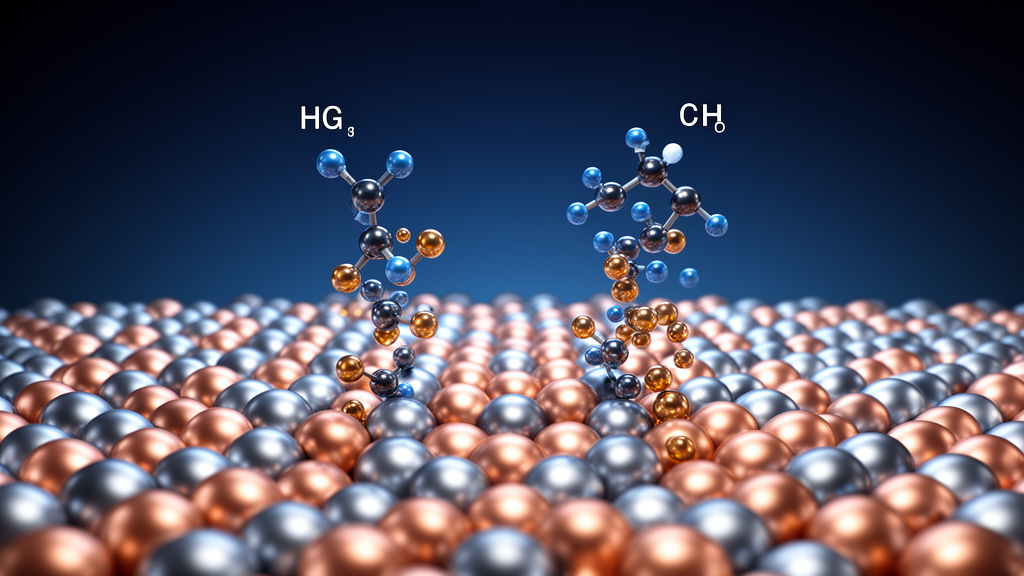
To establish the physical mechanisms governing this catalytic enhancement, the researcher constructed a four-layer slab model featuring a three-by-three surface unit cell representing the copper-palladium alloy surface. In this computational configuration, three palladium atoms in the outermost surface layer were substituted with copper atoms, establishing localized active sites above a bulk palladium lattice characterized by a 3.96-angstrom constant. First-principles electronic structure evaluations were executed utilizing the Vienna Ab initio Simulation Package within the generalized gradient approximation parameterized by Perdew, Burke, and Ernzerhof. Electron-ion core interactions were resolved using projector-augmented wave potentials, accompanied by a plane-wave basis set energy cutoff of 400 electronvolts and surface Brillouin zone sampling through a four-by-four-by-one Monkhorst-Pack k-point grid. To prevent spurious periodic electrostatic interactions between adjacent repeating slabs, a vacuum buffer exceeding 15 angstroms was enforced along the surface-normal direction, with the top two layers and adsorbed chemical species fully relaxed until atomic residual forces declined below 0.03 electronvolts per angstrom.
Calculations of intermediate adsorption energies and ground-state geometries revealed pronounced differences between the alloyed surface and pristine palladium. On the copper-palladium surface, the formate intermediate binds in a bidentate top-top geometry via both oxygen atoms to adjacent palladium atoms, exhibiting an oxygen-palladium distance of 2.14 angstroms and an adsorption energy of negative 2.47 electronvolts. Its isomer, the carboxyl intermediate, binds through its carbon atom atop a single palladium atom with a carbon-palladium length of 1.97 angstroms, an oxygen-hydrogen bond pointed toward the metal plane, and an adsorption energy of negative 2.13 electronvolts. Hydroxyl fragments anchor across bridge sites between two neighboring palladium atoms at an oxygen-palladium separation of 2.13 angstroms, yielding an adsorption energy of negative 2.45 electronvolts. In comparative terms, formate, carboxyl, and hydroxyl intermediates bind to the alloy surface more strongly than to pristine palladium by margins ranging from 0.07 to 0.16 electronvolts, establishing favorable thermodynamic ground states for reactant chemisorption.
Conversely, the adsorption energies of atomic hydrogen and carbon monoxide on the alloy surface display a reversed binding trend that underpins catalytic durability. Both species favor threefold face-centered cubic hollow sites composed of both palladium and copper atoms, yet geometric analysis shows they consistently displace closer to surrounding palladium atoms than to copper. For atomic hydrogen, the calculated bond lengths measure 1.78 angstroms to palladium and 1.83 angstroms to copper, delivering a total adsorption energy of negative 2.64 electronvolts, which represents a 0.04 electronvolt weakening relative to pure palladium. More critically, carbon monoxide exhibits carbon-palladium and carbon-copper distances of 2.01 and 2.38 angstroms respectively, producing an adsorption energy of negative 1.53 electronvolts. This corresponds to a 0.15 electronvolt attenuation in binding strength compared to the negative 1.68 electronvolts calculated for unalloyed palladium. Because carbon monoxide binds more weakly, the catalyst avoids irreversible site blockage, thereby enabling continuous substrate turnover.
Elementary reaction steps evaluated using the force-reversed method for transition-state determination delineated the complete kinetic landscape across both dehydrogenation and dehydration routes. The initial dissociative adsorption of gas-phase formic acid occurs without an activation barrier on both clean surfaces, exothermically forming either co-adsorbed carboxyl and hydrogen with an enthalpy change of negative 1.00 electronvolt, or co-adsorbed formate and hydrogen at negative 0.95 electronvolt. Downstream carboxyl dehydrogenation into carbon dioxide and surface hydrogen requires an activation barrier of 0.55 electronvolts on the alloyed surface, which is 0.03 electronvolts lower than that on pristine palladium. Concurrently, molecular hydrogen recombination possesses an activation barrier of 1.09 electronvolts, dropping from 1.15 electronvolts on monometallic palladium. In sharp contrast, the competing dehydration side-step splitting carboxyl into adsorbed carbon monoxide and hydroxyl confronts a barrier of 0.69 electronvolts, representing an increase of 0.08 electronvolts relative to unpromoted palladium. The side-reaction producing water from hydroxyl and hydrogen similarly sees its barrier climb from 0.68 to 0.80 electronvolts.
To extrapolate these discrete energy coordinates into steady-state catalytic behavior under realistic operating environments, the author implemented a comprehensive microkinetic model explicitly incorporating lateral adsorbate interactions across the 300 to 500 Kelvin temperature domain. Microkinetic simulations demonstrated that the formic acid decomposition rate on the alloyed surface outpaces that of pristine palladium by one to two orders of magnitude across the entire temperature spectrum, while the overall apparent activation energy drops from 89 kilojoules per mole down to 74 kilojoules per mole. Across this broad thermal window, the calculated reaction rate escalates by five orders of magnitude as temperatures increase from room conditions to 500 Kelvin. Simultaneously, dehydrogenation selectivity toward molecular hydrogen remains persistently above 99.99 percent, validating that the energetic bias against the carboxyl dissociation pathway successfully suppresses dehydrative carbon monoxide formation under dynamic steady-state conditions.
Kinetic branching analyses revealed that the reaction mechanism on the alloy catalyst proceeds predominantly through carboxyl-mediated dehydrogenation rather than the alternative formate-mediated pathway. This preference stems from two distinct catalytic features: the activation barrier for carboxyl dehydrogenation is 0.09 electronvolts lower than that for formate dehydrogenation, and steady-state surface coverage of carboxyl exceeds that of formate by a factor ranging between 1.12 and 3.86. At 300 Kelvin, the carboxyl dehydrogenation channel accounts for approximately 95 percent of total catalytic throughput. Although elevated temperatures progressively amplify the kinetic contribution of the formate pathway from 5 percent up to 25 percent at 500 Kelvin, carboxyl dehydrogenation remains the chief conduit for hydrogen generation. Meanwhile, the pathway governing carboxyl dehydration into carbon monoxide and hydroxyl remains virtually inactive across all simulated conditions, explaining why water and carbon monoxide byproducts are suppressed to near-undetectable trace levels.
Degree of rate control evaluations systematically quantified the individual catalytic steps governing overall reaction velocity, identifying carboxyl dehydrogenation and carbon monoxide desorption as the dual rate-determining steps of the system. Because carboxyl cleavage serves as the dominant conduit for hydrogen release, lowering its activation energy yields an immediate proportional increase in total reaction speed. Carbon monoxide desorption shares this kinetic control because the catalyst surface remains predominantly populated by adsorbed carbon monoxide and atomic hydrogen regardless of operating temperature. All other reaction intermediates, including reactive formate and carboxyl species, maintain surface coverages below ten to the negative sixth power of a monolayer, reflecting instantaneous onward consumption. Because carbon monoxide binds more loosely to the copper-palladium surface, thermal desorption proceeds smoothly, attenuating lateral repulsive forces among crowded surface intermediates and continually regenerating vacant palladium ensembles necessary to accommodate incoming formic acid reactants.
The study also benchmarked the bimetallic catalyst against complex high-entropy alloy surfaces reported in prior computational literature, contextualizing the fundamental role played by local coordination and strain. On a high-entropy alloy containing gold, copper, iridium, platinum, and palladium, isolated copper-palladium ensemble sites exhibited higher decomposition activities than those found on the current substrate, while hydrogen selectivity was similar for both catalysts. The computational model attributes this activity variance to differences in coordination numbers and lattice strain imparted by differing metal matrices, indicating that further geometric tuning could optimize reaction rates even further. By clarifying that incorporating earth-abundant copper weakens carbon monoxide adsorption and frees vacant active sites, the research provides a theoretical basis for designing cost-efficient, poison-resistant palladium catalysts for formic acid decomposition.
Subject of Research: Density functional theory and microkinetic analysis of formic acid decomposition on bimetallic copper-palladium surfaces
Article Title: Enhanced activity and CO poisoning resistance of Pd2Cu/Pd(111) for HCOOH decomposition: a DFT and microkinetic study with lateral interactions
Article References: Su, H. (2026). Enhanced activity and CO poisoning resistance of Pd2Cu/Pd(111) for HCOOH decomposition: a DFT and microkinetic study with lateral interactions. Frontiers in Chemistry, 14, Article 2033395. https://doi.org/10.3389/fchem.2026.2033395
Image Credits: AI Generated
DOI: 10.3389/fchem.2026.2033395
Keywords: formic acid decomposition, hydrogen storage, palladium catalysts, copper-palladium alloy, density functional theory, microkinetic modeling, lateral interactions, carbon monoxide poisoning, hydrogen selectivity, dehydrogenation pathway, rate-determining steps, degree of rate control, catalytic kinetics, surface chemistry, apparent activation energy, bimetallic ensembles, transition state calculations
News Source: Bethany Barker. (November 23, 2026). Computational Modeling Predicts Copper-Palladium Catalysts Accelerate Formic Acid Decomposition. Scienmag.