Recent findings suggest the repeated evolution of similar traits in island lizards was not channelled by developmental responses to the environment, as commonly thought
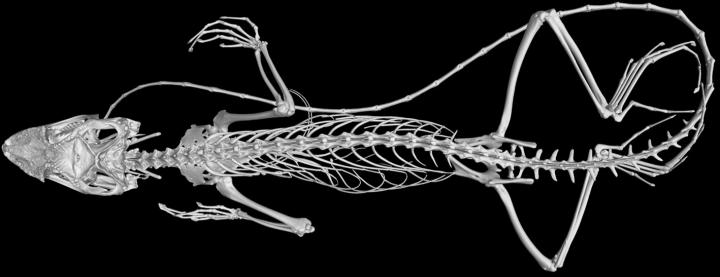
Credit: Nathalie Feiner (CC BY 4.0)
Scientists have challenged a popular theory behind the evolution of similar traits in island lizards, in a study published recently in eLife.
The findings in Greater Antillean Anolis lizards provide insights on why creatures often evolve similar physical features independently when living in similar habitats. They suggest that the role of developmental plasticity in shaping adaptive evolution may be less important than commonly thought.
Developmental plasticity refers to how development responds to the environment, in particular the way that an organism’s genetic constitution (or genotype) interacts with its environment during development to produce a particular set of characteristics (or phenotype).
“Anolis lizards that live on all four of the Greater Antillean islands have independently and repeatedly evolved six different body types for maneuvering through their given habitat,” says lead author Nathalie Feiner, Researcher at the Department of Biology, Lund University, Sweden. “As a result, they make a great model for studying why evolution often repeats itself.”
To address this question, Feiner and the team used micro computed tomography scans to measure the shoulder, hip and leg bones of 95 species of anoles that live on the Greater Antillean islands. Their work revealed that several of the species’ body shapes evolved along similar trajectories.
“These body shapes are adapted by natural selection, but several different shapes could in principle perform equally well in a given habitat,” says senior author Tobias Uller, Professor of Evolutionary Biology at the Department of Biology, Lund University. “As a result, repeated evolution is more likely to occur when species share a developmental biology that makes some characteristics appear readily, while others are rare or even impossible.”
One source of these developmental biases can be found in how individuals respond to different environments, a hypothesis known as plasticity-led evolution. The researchers tested how the anoles’ bones responded to stresses induced by climbing and running to see if these changes directly matched the skeletal structure (or morphology) of those specialised to a given habitat.
To do this, they raised two groups of anoles – some that typically perch on narrow twigs, and others that typically run and climb on tree trunks – on two different types of surfaces, which changed the way the animals moved or perched, as well as their morphology. However, these changes were poorly matched to the evolutionary divergence between habitat specialists that evolved repeatedly on different islands.
“The responsiveness of bone to mechanical stress is a good candidate for plasticity-led evolution,” Feiner explains. “But this responsiveness does not seem to have channelled the evolution of the locomotor skeleton in Anolis lizards. Instead, our findings suggest that the morphologies that evolved again and again in these lizards are likely due to simple genetic changes.”
###
Reference
The paper ‘Plasticity and evolutionary convergence in the locomotor skeleton of Greater Antillean Anolis lizards’ can be freely accessed online at https:/
An accompanying eLife Insight article ‘Adaptation: Evolution of island lizards remains a mystery’ is also available at https:/
Contents, including text, figures and data, are free to reuse under a CC BY 4.0 license.
Media contact
Emily Packer, Media Relations Manager
eLife
[email protected]
01223 855373
About eLife
eLife is a non-profit organisation created by funders and led by researchers. Our mission is to accelerate discovery by operating a platform for research communication that encourages and recognises the most responsible behaviours. We work across three major areas: publishing, technology and research culture. We aim to publish work of the highest standards and importance in all areas of biology and medicine, including Evolutionary Biology, while exploring creative new ways to improve how research is assessed and published. We also invest in open-source technology innovation to modernise the infrastructure for science publishing and improve online tools for sharing, using and interacting with new results. eLife receives financial support and strategic guidance from the Howard Hughes Medical Institute, the Knut and Alice Wallenberg Foundation, the Max Planck Society and Wellcome. Learn more at https:/
To read the latest Evolutionary Biology research published in eLife, visit https:/
Media Contact
Emily Packer
[email protected]
Original Source
https:/
Related Journal Article
http://dx.