• HOME
  • NEWS
  • EXPLORE
    • CAREER
      • Companies
      • Jobs
    • EVENTS
    • iGEM
      • News
      • Team
    • PHOTOS
    • VIDEO
    • WIKI
  • BLOG
  • COMMUNITY
    • FACEBOOK
    • INSTAGRAM
    • TWITTER
Monday, May 11, 2026
BIOENGINEER.ORG
No Result
View All Result
  • Login
  • HOME
  • NEWS
  • EXPLORE
    • CAREER
      • Companies
      • Jobs
        • Lecturer
        • PhD Studentship
        • Postdoc
        • Research Assistant
    • EVENTS
    • iGEM
      • News
      • Team
    • PHOTOS
    • VIDEO
    • WIKI
  • BLOG
  • COMMUNITY
    • FACEBOOK
    • INSTAGRAM
    • TWITTER
  • HOME
  • NEWS
  • EXPLORE
    • CAREER
      • Companies
      • Jobs
        • Lecturer
        • PhD Studentship
        • Postdoc
        • Research Assistant
    • EVENTS
    • iGEM
      • News
      • Team
    • PHOTOS
    • VIDEO
    • WIKI
  • BLOG
  • COMMUNITY
    • FACEBOOK
    • INSTAGRAM
    • TWITTER
No Result
View All Result
Bioengineer.org
No Result
View All Result
Home NEWS Science News Chemistry

Are China’s pollution remediation efforts making the planet warmer?

Bioengineer by Bioengineer
September 29, 2020
in Chemistry
Reading Time: 2 mins read
0
IMAGE
Share on FacebookShare on TwitterShare on LinkedinShare on RedditShare on Telegram

China’s efforts to combat aerosol pollution resulted in warming throughout the northern latitudes
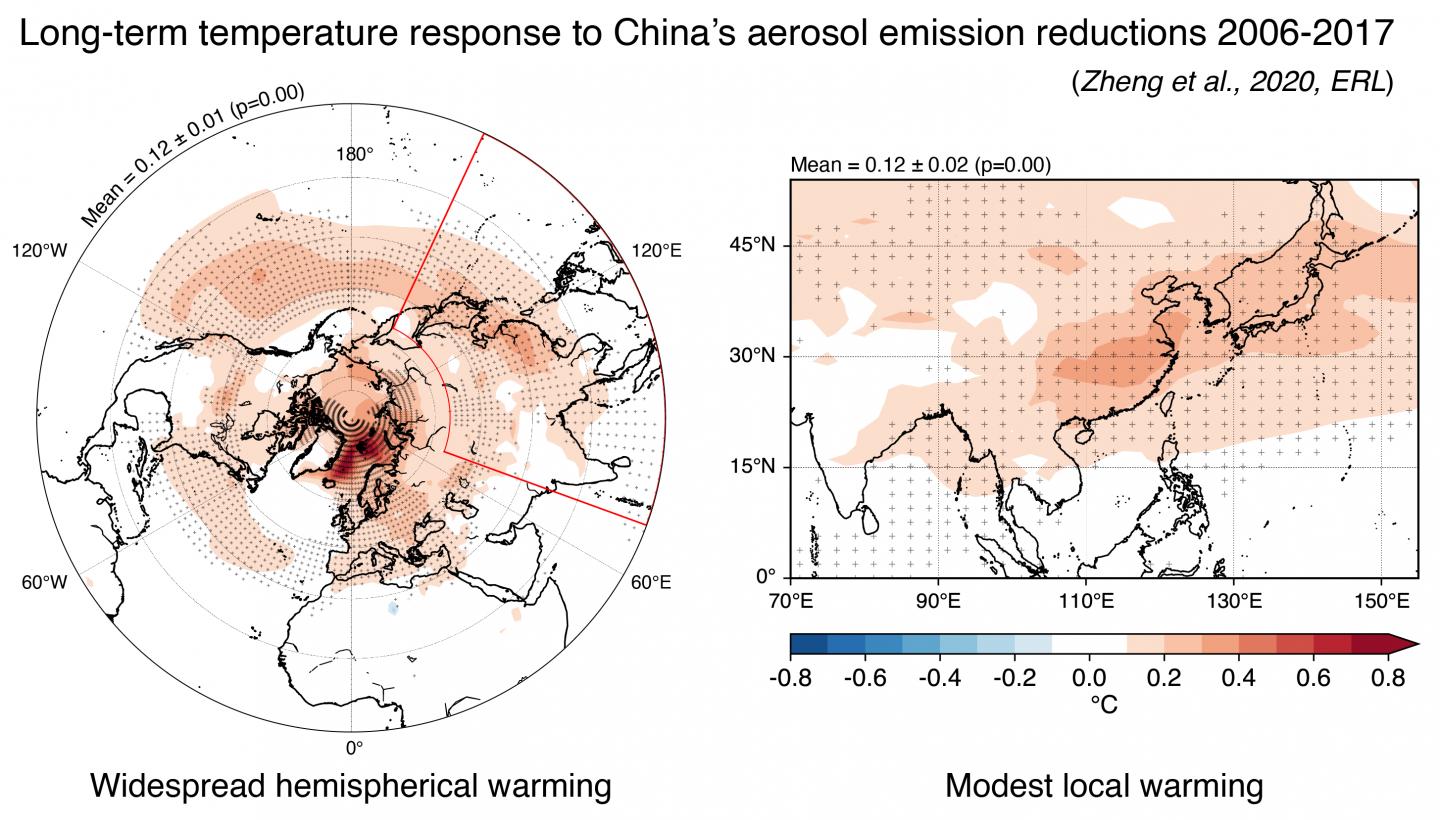
IMAGE

Credit: Yixuan Zheng, Ken Caldeira, Dan Tong,Steven Davis, and Qiang Zhang.

Washington, DC– A 10-year effort by China to improve air quality and reduce pollution-related health risks has caused warming in areas across the northern hemisphere, according to new work published in Environmental Research Letters.

Aerosols are tiny particles that are spewed into the atmosphere by human activities, such as burning coal and wood, or by geological phenomena, like volcanos. Their negative effects on air quality can damage human health and agricultural productivity.

Similar to how the aerosols emitted in a volcanic eruption can cause global temperatures to drop, some aerosols from human activity also have a cooling effect on the climate. Unlike greenhouse gases, which induce global warming by trapping heat in the atmosphere, aerosol particles can cause sunlight to be reflected away from the planet either directly or by interacting with clouds.

“This means that some of the effects of global warming are being masked by aerosol pollution,” explained lead author, Carnegie’s Yixuan Zheng.

Between 2006 and 2017, the Chinese government implemented clean-air policies to reduce the public health risks of aerosol pollutants like sulfate, a cooling agent. These efforts have possibly saved as many as half a million lives a year.

Zheng, along with Carnegie colleague Ken Caldeira, UC Irvine’s Dan Tong and Steven Davis, and Qiang Zhang of Tsinghua University, set out to investigate how these aerosol reductions have affected the global climate.

They applied a sophisticated model based on atmospheric and oceanic systems over a 100-year period, which revealed that China’s pollution-reduction policies might have unmasked about 0.1 degrees Celsius (0.2 degrees Fahrenheit) of greenhouse-gas-induced warming throughout the northern hemisphere–not just in China itself.

“The health risks associated with particulate pollution are very serious and mitigation efforts are unquestionably a good thing,” Caldeira said. “But it’s also important to understand how ongoing and future efforts to improve air quality will create additional challenges in the international fight against climate change.”

###

The Carnegie Institution for Science (carnegiescience.edu) is a private, nonprofit organization headquartered in Washington, D.C., with six research departments throughout the U.S. Since its founding in 1902, the Carnegie Institution has been a pioneering force in basic scientific research. Carnegie scientists are leaders in plant biology, developmental biology, astronomy, materials science, global ecology, and Earth and planetary science.

Media Contact
Ken Caldeira
[email protected]

Related Journal Article

http://dx.doi.org/10.1088/1748-9326/ab9e21

Tags: Atmospheric ChemistryAtmospheric ScienceClimate ChangeClimate ScienceEnergy SourcesPollution/RemediationTemperature-Dependent Phenomena
Share12Tweet8Share2ShareShareShare2

Related Posts

Miniature Sensor Uses Light to Detect Touch — Chemistry

Miniature Sensor Uses Light to Detect Touch

May 8, 2026
Iron Minerals Determine Whether Dissolved Organic Matter Fuels Microbes or Becomes Long-Term Carbon Storage — Chemistry

Iron Minerals Determine Whether Dissolved Organic Matter Fuels Microbes or Becomes Long-Term Carbon Storage

May 8, 2026

Kate Evans Appointed Associate Lab Director for Biological and Environmental Systems Science at ORNL

May 8, 2026

Advancing Multiscale Modeling and Overcoming Operational Challenges in Autothermal COâ‚‚-to-Methanol Reactors

May 8, 2026
Please login to join discussion

POPULAR NEWS

  • Research Indicates Potential Connection Between Prenatal Medication Exposure and Elevated Autism Risk

    840 shares
    Share 336 Tweet 210
  • New Study Reveals Plants Can Detect the Sound of Rain

    727 shares
    Share 290 Tweet 181
  • Salmonella Haem Blocks Macrophages, Boosts Infection

    61 shares
    Share 24 Tweet 15
  • Breastmilk Balances E. coli and Beneficial Bacteria in Infant Gut Microbiomes

    57 shares
    Share 23 Tweet 14

About

We bring you the latest biotechnology news from best research centers and universities around the world. Check our website.

Follow us

Recent News

New Post-Hoc Analysis Explores Daily Oral Orforglipron Use in Adults Over 65 with Obesity, Regardless of Diabetes Status

Evaluating Digoxin Use in Patients with Symptomatic Rheumatic Heart Disease

Evaluating the Effectiveness and Safety of Digitalis Glycosides in Treating Heart Failure

Subscribe to Blog via Email

Enter your email address to subscribe to this blog and receive notifications of new posts by email.

Join 82 other subscribers
  • Contact Us

Bioengineer.org © Copyright 2023 All Rights Reserved.

Welcome Back!

Login to your account below

Forgotten Password?

Retrieve your password

Please enter your username or email address to reset your password.

Log In
No Result
View All Result
  • Homepages
    • Home Page 1
    • Home Page 2
  • News
  • National
  • Business
  • Health
  • Lifestyle
  • Science

Bioengineer.org © Copyright 2023 All Rights Reserved.