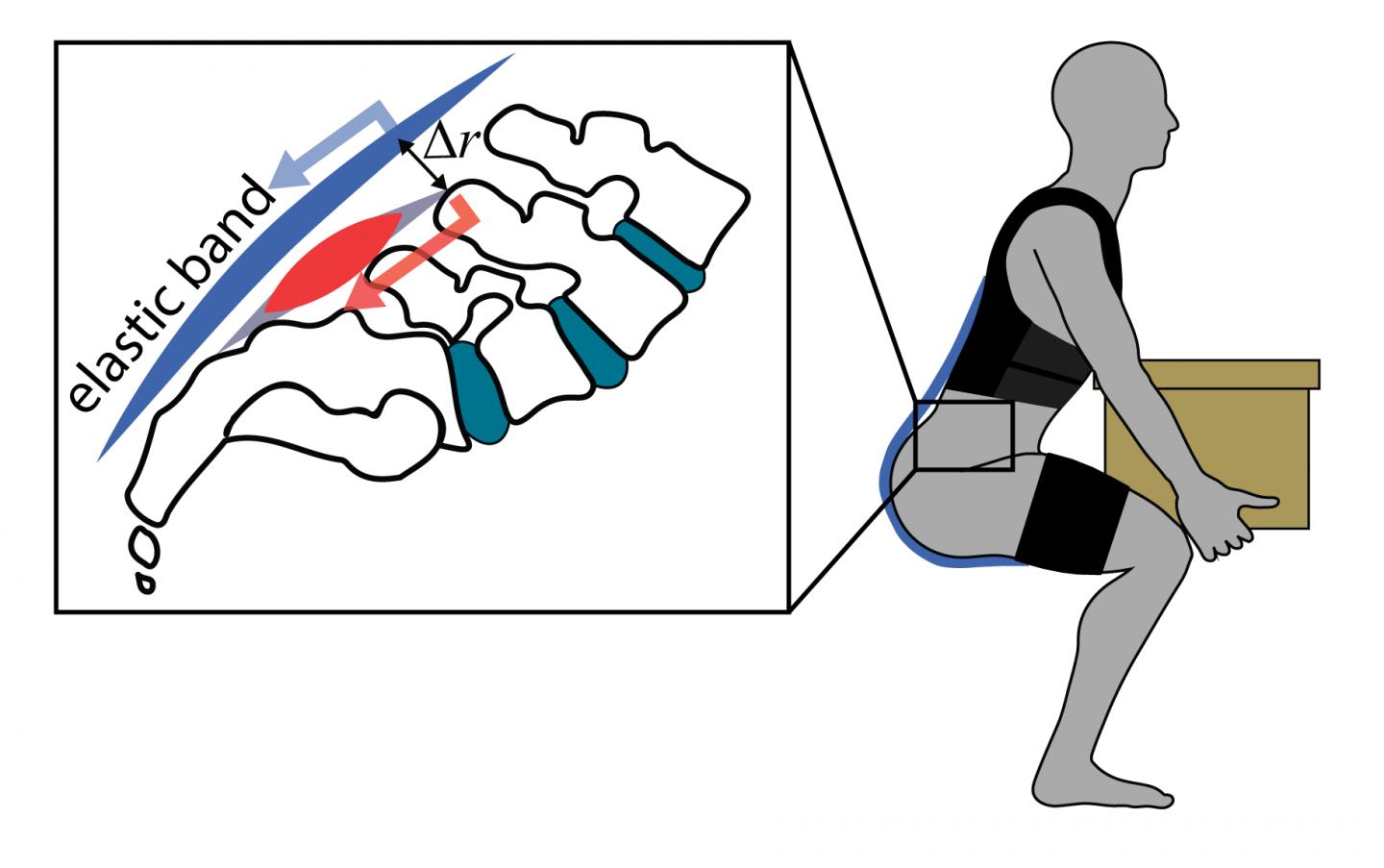
Credit: Karl Zelik
Vanderbilt University engineers have determined that their back-assist exosuit, a clothing-like device that supports human movement and posture, can reduce fatigue by an average of 29-47 percent in lower back muscles. The exosuit’s functionality presents a promising new development for individuals who work in physically demanding fields and are at risk for back pain, including medical professionals and frontline workers.
The article describing the experiment and findings, “Low-Profile Elastic Exosuit Reduces Back Muscle Fatigue,” was published in the Nature journal Scientific Reports on September 29.
The research, led by Assistant Professor of Mechanical Engineering Karl Zelik and recent Ph.D. graduate and primary author Erik Lamers, used surface electromyography techniques to measure changes in low back muscle fatigue in male and female participants, who were given physical tasks to perform both with and without the exosuit.
The wearable technology developed by Zelik’s team may conjure images of Iron Man’s suit, but it does not rely on motors or batteries. Instead, the low-profile, elastic exosuit applies assistive forces that cooperate with the low back extensor muscles, to relieve strain on the muscles and spine, and to help reduce injury risks.
This study showed that wearing the exosuit made holding a 35-pound weight (the average weight of a 4-year-old child) less tiring on the back than holding a 24-pound weight (the average weight of an 18-month-old baby) without the exosuit.
“These findings show how exosuits could provide valuable back relief to frontline and essential workers who have been taking a physical toll and supporting all of us throughout this pandemic. What we learned has the potential to shape the biomechanical and industrial standards of future wearable technologies,” said Zelik, who holds secondary appointments in biomedical engineering and in physical medicine and rehabilitation.
The work also demonstrated a sharpened understanding of how the latissimus dorsi muscles (the “lats”)–those that adduct, extend and medially rotate the shoulder joint–affect low back mechanics. While previous research has shown that the lats generally do not contribute much to supporting the low back, the investigators discovered that, as people get tired, they may suddenly recruit the lats to offload the main back extensor muscles to a significant degree.
“The lats act sort of like an exosuit. When a person’s low back muscles become over-strained and fatigued, they summon extra assistance from their lats to relieve this back strain and fatigue. The elastic bands in our exosuit work the same way to help sustain endurance and strength,” said Lamers, a National Science Foundation Graduate Research Fellow who worked in Vanderbilt’s Center for Rehabilitation Engineering and Assistive Technology.
Zelik, a former collegiate athlete who competed in the long jump and triple jump, knows firsthand how intensive physical activity can fatigue the body. He also understands the importance of ensuring that the exosuit and its utility are built with inclusive design practices. “Wearables are going to change the way we work and live, and we want to improve safety, health and well-being for everyone. One of the critical challenges moving forward will be to ensure that all wearable technology is developed to serve and protect both women and men. We are thrilled that this research helped lead to the first commercial exosuit or exoskeleton designed with both male- and female-fits,” Zelik said.
###
This work was supported by Lamers’ NSF Graduate Research Fellowship and a Vanderbilt University Discovery Grant. The NSF Graduate Research Fellowship Program provides support for individuals selected early in their graduate careers based on their demonstrated potential for significant achievements in science and engineering. Aaron Yang, an assistant professor of physical medicine and rehabilitation at Vanderbilt University Medical Center, and two Vanderbilt undergraduates, Juliana Soltys and Keaton Scherpereel, collaborated on this study.
Media Contact
Marissa Shapiro
[email protected]
Original Source
http://news.