Combining light and sound adds depth information that boosts security of biometric authentication
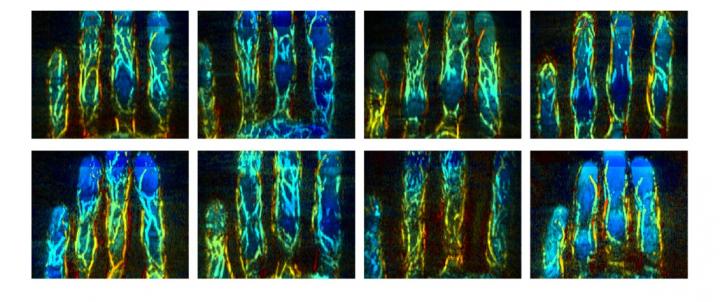
Credit: Jun Xia, University at Buffalo, The State University of New York
WASHINGTON — Biometric authentication, which uses unique anatomical features such as fingerprints or facial features to verify a person’s identity, is increasingly replacing traditional passwords for accessing everything from smartphones to law enforcement systems. A newly developed approach that uses 3D images of finger veins could greatly increase the security of this type of authentication.
“The 3D finger vein biometric authentication method we developed enables levels of specificity and anti-spoofing that were not possible before,” said Jun Xia, from University at Buffalo, The State University of New York, research team leader. “Since no two people have exactly the same 3D vein pattern, faking a vein biometric authentication would require creating an exact 3D replica of a person’s finger veins, which is basically not possible.”
In the Optical Society (OSA) journal Applied Optics, the researchers describe their new approach, which represents the first time that photoacoustic tomography has been used for 3D finger vein biometric authentication. Tests of the method on people showed that it can correctly accept or reject an identity 99 percent of the time.
“Due to the COVID-19 pandemic, many jobs and services are now performed remotely,” said research team member Giovanni Milione, from NEC Laboratories America, Inc. “Because our technique detects invisible features in 3D, it could be used to enable better authentication techniques to protect personnel data and sensitive documents.”
Adding depth information
Although other biometric authentication approaches based on finger veins have been developed, they are all based on 2D images. The additional depth from a 3D image increases security by making it more difficult to fake an identity and less likely that the technique will accept the wrong person or reject the right one.
To accomplish 3D biometric authentication using the veins in a person’s fingers, the researchers turned to photoacoustic tomography, an imaging technique that combines light and sound. First, light from a laser is used to illuminate the finger. If the light hits a vein, it creates a sound much in the same way that a grill creates a “poof” sound when it is first lit. The system then detects that sound with an ultrasound detector and uses it to reconstruct a 3D image of the veins.
“It has been challenging to use photoacoustic tomography for 3D finger vein biometric authentication because of the bulky imaging system, small field of view and inconvenient positioning of the hand,” said Xia. “We addressed these issues in the new system design through a better combination of light and acoustic beams and custom-made transducers to improve the imaging field of view.”
Designing a practical system
To better integrate light illumination and acoustic detection, the researcher fabricated a new light- and acoustic-beam combiner. They also designed an imaging window that allows the hand to be naturally placed on the platform, similar to a full-size fingerprint scanner. Another critical development was a new matching algorithm, developed by Wenyao Xu from the Computer science and Engineering department that allows biometric identification and matching of features in 3D space.
The researchers tested their new system with 36 people by imaging their four left and four right fingers. The tests showed that the approach was not only feasible but also accurate, especially when multiple fingers were used.
“We envision this technique being used in critical facilities, such as banks and military bases, that require a high level of security,” said Milione. “With further miniaturization 3D vein authentication could also be used in personal electronics or be combined with 2D fingerprints for two-factor authentication.”
The researchers are now working to make the system even smaller and to reduce the imaging time to less than one second. They note that it should be possible to implement the photoacoustic system in smartphones since ultrasound systems have already been developed for use in smartphones. This could enable portable or wearable systems that perform biometric authentication in real time.
###
Paper: Y. Zhan, A. S. Rathore, G. Milione, Y. Wang, W. Zheng, W. Xu, J. Xia, “3D Finger vein Biometric Authentication with Photoacoustic Tomography,” Applied Optics, 59, 28, 8751-8758 (2020).
DOI: https:/
About Applied Optics
Applied Optics publishes in-depth peer-reviewed content about applications-centered research in optics. These articles cover research in optical technology, photonics, lasers, information processing, sensing and environmental optics. Applied Optics is published three times per month by The Optical Society and overseen by Editor-in-Chief Ronald Driggers, University of Central Florida, USA. For more information, visit OSA Publishing.
About The Optical Society
Founded in 1916, The Optical Society (OSA) is the leading professional organization for scientists, engineers, students and business leaders who fuel discoveries, shape real-life applications and accelerate achievements in the science of light. Through world-renowned publications, meetings and membership initiatives, OSA provides quality research, inspired interactions and dedicated resources for its extensive global network of optics and photonics experts. For more information, visit osa.org.
Media Contact
Media Contact
James Merrick
[email protected]
Original Source
https:/
Related Journal Article
http://dx.