• HOME
  • NEWS
  • EXPLORE
    • CAREER
      • Companies
      • Jobs
    • EVENTS
    • iGEM
      • News
      • Team
    • PHOTOS
    • VIDEO
    • WIKI
  • BLOG
  • COMMUNITY
    • FACEBOOK
    • INSTAGRAM
    • TWITTER
Monday, December 29, 2025
BIOENGINEER.ORG
No Result
View All Result
  • Login
  • HOME
  • NEWS
  • EXPLORE
    • CAREER
      • Companies
      • Jobs
        • Lecturer
        • PhD Studentship
        • Postdoc
        • Research Assistant
    • EVENTS
    • iGEM
      • News
      • Team
    • PHOTOS
    • VIDEO
    • WIKI
  • BLOG
  • COMMUNITY
    • FACEBOOK
    • INSTAGRAM
    • TWITTER
  • HOME
  • NEWS
  • EXPLORE
    • CAREER
      • Companies
      • Jobs
        • Lecturer
        • PhD Studentship
        • Postdoc
        • Research Assistant
    • EVENTS
    • iGEM
      • News
      • Team
    • PHOTOS
    • VIDEO
    • WIKI
  • BLOG
  • COMMUNITY
    • FACEBOOK
    • INSTAGRAM
    • TWITTER
No Result
View All Result
Bioengineer.org
No Result
View All Result
Home NEWS Science News Biology

Snakes disembowel and feed on the organs of living toads in a first for science

Bioengineer by Bioengineer
September 28, 2020
in Biology
Reading Time: 2 mins read
0
IMAGE
Share on FacebookShare on TwitterShare on LinkedinShare on RedditShare on Telegram

IMAGE

Credit: Winai Suthanthangjai

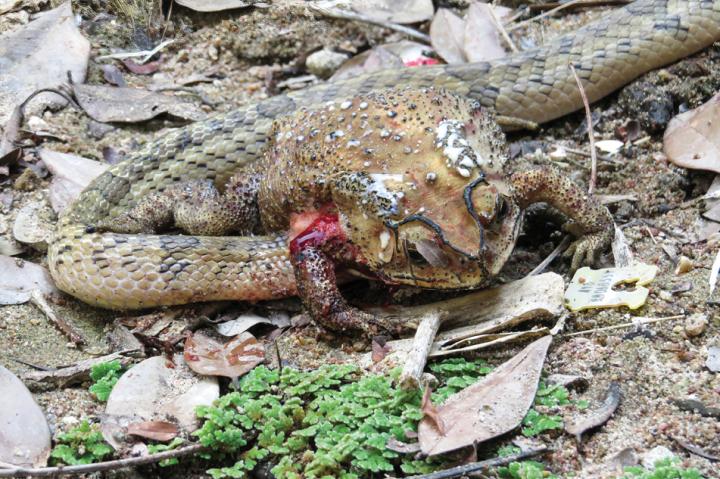
While the majority of snakes would normally swallow their prey whole, the Small-banded Kukri Snake seems to have evolved a particularly macabre feeding habit that has never before been witnessed in a serpent.

During a survey on the relatively small-bodied Asian kukri snakes in Thailand, a Danish-Thai research team, led by Henrik Bringsøe, documented three occasions where a snake uses its enlarged posterior maxillary teeth to cut open the abdomen of a large poisonous toad, then inserts its entire head and pull out the organs one by one, while the prey is still alive. The discovery is published in the open-access, peer-reviewed journal Herpetozoa.

In those gory attacks, the toads struggled vigorously to escape and avoid being eviscerated alive, but, on all occasions, this was in vain. The assaults could last for up to a few hours, depending on the organs the snake would pull out first.

The toads observed belong to the quite common species called Asian Black-spotted Toad (Duttaphrynus melanostictus), which is known to secret a potent toxin from their prominent parotid glands, located on the neck and all over the back. Could it be that the snakes have adopted this sophisticated and gruesome approach to avoid being poisoned?

In a fourth, and equally important, case, an adult kukri snake attacked a somewhat smaller individual of the same toad species. This time around, the snake swallowed the entire toad. Why, the researchers still remain to understand. One hypothesis is that smaller toads are less toxic than adults. On the other hand, the kukri snakes might be indeed resistant to the Asian Black-spotted toad’s poison, yet the large size of adult toads could be what have prevented swallowing the whole victim in the three afore-mentioned cases.

“At present, we cannot answer any of these questions, but we will continue to observe and report on these fascinating snakes in the hope that we will uncover further interesting aspects of their biology,” says Bringsøe.

“Perhaps you’d be pleased to know that kukri snakes are, thankfully, harmless to humans. However, I wouldn’t recommend being bitten by one of those. The thing is that they can inflict large wounds that bleed for hours, because of the anticoagulant agent these snakes inject into the victim’s bloodstream. Their teeth are designed to inflict lacerations rather than punctures, so your finger would feel as if cut apart! This secretion, produced by two glands, called Duvernoy’s glands and located behind the eyes of the snakes, are likely beneficial while the snakes spend hours extracting toad organs,” he explains in conclusion.

###

Media Contact
Henrik Bringsøe
[email protected]

Related Journal Article

http://dx.doi.org/10.3897/herpetozoa.33.e57096

Tags: BiodiversityBiologyEcology/EnvironmentEvolutionZoology/Veterinary Science
Share12Tweet8Share2ShareShareShare2

Related Posts

Future of Algeria’s Endemic Oak Under Climate Change

Future of Algeria’s Endemic Oak Under Climate Change

December 29, 2025
blank

New Nuclei Isolation Unveils Litopenaeus vannamei Cell Atlas

December 28, 2025

Unlocking Rice Quality: GWAS Sheds Light on Traits

December 28, 2025

Chloroplast Genome of Ecklonia maxima: A Comparative Study

December 27, 2025
Please login to join discussion

POPULAR NEWS

  • Robotic Waist Tether for Research Into Metabolic Cost of Walking

    NSF funds machine-learning research at UNO and UNL to study energy requirements of walking in older adults

    71 shares
    Share 28 Tweet 18
  • Exploring Audiology Accessibility in Johannesburg, South Africa

    51 shares
    Share 20 Tweet 13
  • Nurses’ Views on Online Learning: Effects on Performance

    70 shares
    Share 28 Tweet 18
  • SARS-CoV-2 Subvariants Affect Outcomes in Elderly Hip Fractures

    44 shares
    Share 18 Tweet 11

About

We bring you the latest biotechnology news from best research centers and universities around the world. Check our website.

Follow us

Recent News

Neonatal ICU Exposures Affect Newborn Brain Development

Girdin Silencing Boosts Mebendazole’s Ovarian Cancer Fight

Eco-Friendly Zinc Oxide from Palm Leaves for Amoxicillin Degradation

Subscribe to Blog via Email

Enter your email address to subscribe to this blog and receive notifications of new posts by email.

Join 71 other subscribers
  • Contact Us

Bioengineer.org © Copyright 2023 All Rights Reserved.

Welcome Back!

Login to your account below

Forgotten Password?

Retrieve your password

Please enter your username or email address to reset your password.

Log In
No Result
View All Result
  • Homepages
    • Home Page 1
    • Home Page 2
  • News
  • National
  • Business
  • Health
  • Lifestyle
  • Science

Bioengineer.org © Copyright 2023 All Rights Reserved.