Proof-of-concept study shows that stopping the construction of nuclear pore complexes selectively kills cancer cells
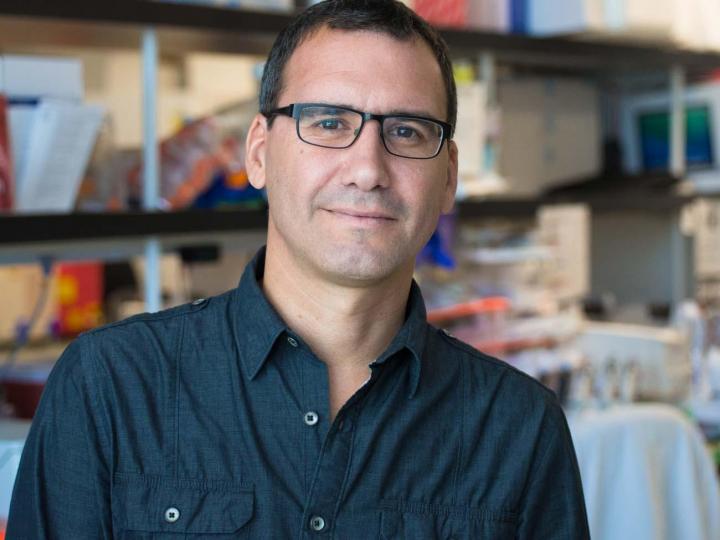
Credit: Sanford Burnham Prebys Medical Discovery Institute
Scientists at Sanford Burnham Prebys Medical Discovery Institute have shown that blocking the construction of nuclear pores complexes–large channels that control the flow of materials in and out of the cell nucleus–shrank aggressive tumors in mice while leaving healthy cells unharmed. The study, published in Cancer Discovery, a journal of the American Association for Cancer Research, reveals a new Achilles heel for cancer that may lead to better treatments for deadly tumors such as melanoma, leukemia and colorectal cancer.
“Nuclear pore complexes are the ‘doors’ that all materials pass through to gain entry to the cell’s nucleus. Because cancer cells are rapidly growing and dividing they need and create more nuclear pore complexes than normal cells,” says Maximiliano D’Angelo, Ph.D., associate professor in the Development, Aging and Regeneration Program at Sanford Burnham Prebys. “Our study is the first to demonstrate that by blocking the formation of these nuclear ‘doors’ we can selectively kill cancer cells.”
A promising new way to treat cancer
Because cancer cells are highly dependent on the nuclear transport process–the movement of molecules through nuclear pores–targeting the nuclear transport machinery is a promising strategy for cancer therapies. D’Angelo is hopeful that targeting the formation of nuclear pore complexes, which only impacts dividing cells and thus would likely only kill cancer cells, may offer a safe way to treat many cancer types. However, until now this hypothesis had not yet been tested.
In the study, D’Angelo and his team tested this hypothesis by transplanting human tumor cells that are unable to form nuclear pore complexes into mice. Three different tumor cell types were tested–melanoma, leukemia and colorectal cancer–which are known to be especially reliant on nuclear pore complexes. The scientists found that all of these mice had smaller tumors and slower tumor growth.
“We showed that the inability to build nuclear pore channels is devastating for rapidly-growing cancer cells, but doesn’t seem to have an impact on healthy cells–which simply halt their growth, and then recover,” says Stephen Sakuma, a graduate student in the D’Angelo lab and first author of the study. “Our findings provide an important proof of concept that this approach could lead to a new type of cancer treatment, which might be especially beneficial for aggressive or metastatic cancers that are difficult to treat.”
From discovery to drug
Now that the scientists have demonstrated that their approach works, they are working to find a drug that can block the formation of nuclear pore complexes. This work is ongoing at the Conrad Prebys Center for Chemical Genomics at Sanford Burnham Prebys, one of the most advanced drug discovery centers in the nonprofit world.
“In addition to one day helping people with tough-to-treat cancers, we envision this drug candidate might be used to prevent drug resistance, which happens when tumors adopt properties to resist therapy,” says D’Angelo. “Tumors would have a hard time adopting to an environment where their ‘doors’ are removed, so this drug might help certain treatments, such as targeted therapies, remain effective for longer periods of time.”
###
Additional study authors include Marcela Raices, Joana Borlido, Valeria Guglielmi and Ethan Y.S. Zhu of Sanford Burnham Prebys. The study’s DOI is 10.1158/2159-8290.CD-20-0581.
This work was supported by the National Institutes of Health (RO1AR065083, RO1AR065083-S1, R01AI148668, P30CA030199) and the American Cancer Society (RSG-17-148-01-CCG).
About Sanford Burnham Prebys Medical Research Institute
Sanford Burnham Prebys is a preeminent, independent biomedical research institute dedicated to understanding human biology and disease and advancing scientific discoveries to profoundly impact human health. For more than 40 years, our research has produced breakthroughs in cancer, neuroscience, immunology and children’s diseases, and is anchored by our NCI-designated Cancer Center and advanced drug discovery capabilities. For more information, visit us at SBPdiscovery.org or on Facebook at facebook.com/SBPdiscovery and on Twitter @SBPdiscovery.
Media Contact
Susan Gammon
[email protected]
Related Journal Article
http://dx.