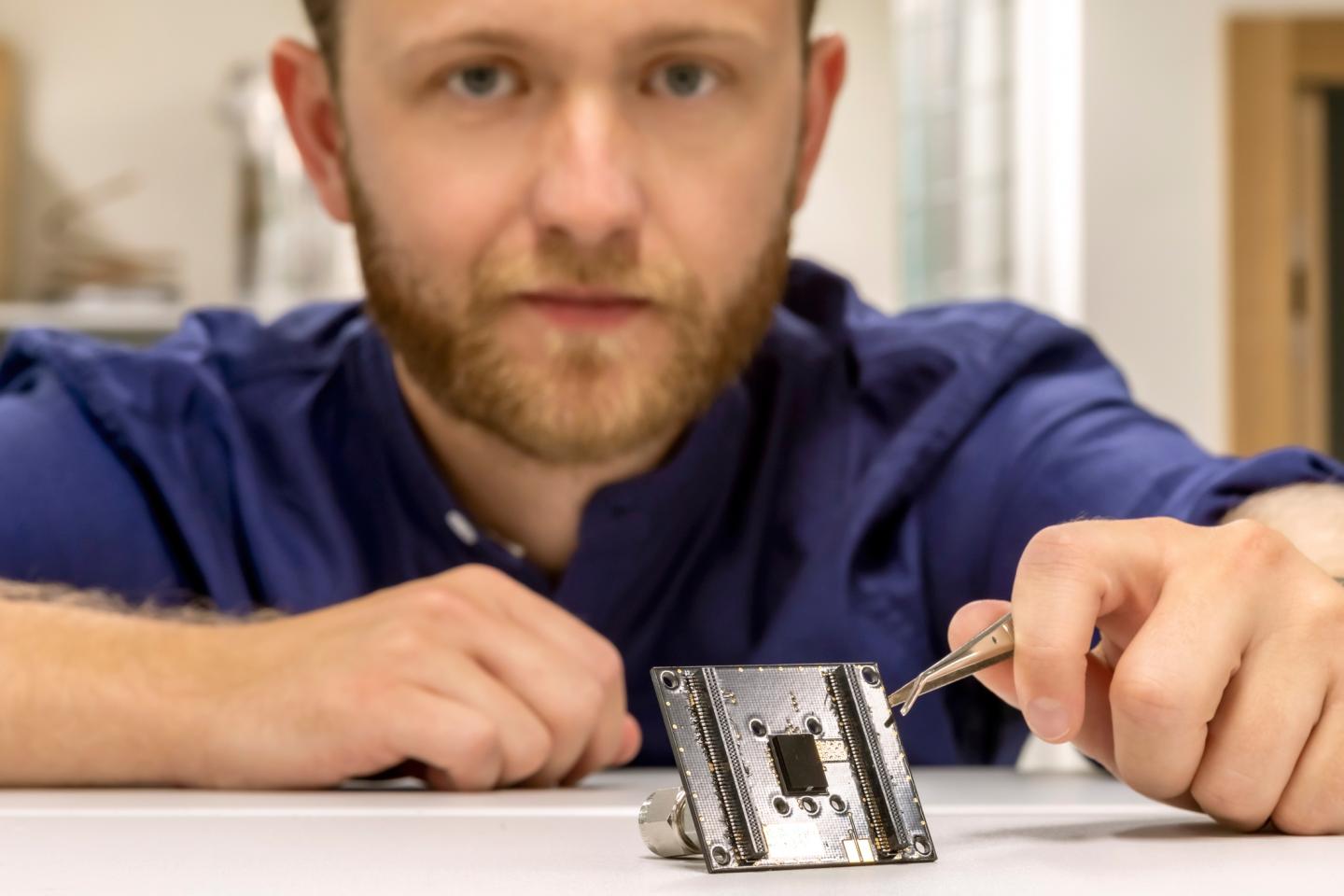
Credit: © Lunghammer – TU Graz
It is slightly smaller than two one-cent coins stacked on top of each other, is particularly energy-efficient due to its size, requires no maintenance and can be integrated in mobile devices. It is the smallest particle sensor in the world. With this 12 x 9 x 3 millimetre innovation, smartphones, smart watches or fitness wristbands can for the first time measure the quality of the ambient air in real time and sound the alarm in the event of increased fine dust values.
Innovative implementation
The sensor was developed by Paul Maierhofer as part of his dissertation at the Institute of Electrical Measurement and Sensor Systems at Graz University of Technology together with experts from the semiconductor manufacturer ams AG and with researchers from Silicon Austria Labs (SAL). The development was based on well-known methods of conventional measuring instruments as well as modern manufacturing and integration methods, which brought the project team together in an innovation process. The innovation is the miniaturization itself, as Maierhofer explains: “The sensor is right at the limit of what is physically and technically feasible and involves a lot of tricks to function at this size.”
Adapting behaviour to ambient air
The immense social benefit of this new innovative particle sensor is obvious. According to a study by the European Environment Agency (EEA), over 400,000 people die prematurely every year in Europe alone as a result of particulate matter pollution. With the help of wearables equipped with the new particle sensor, each and every individual can monitor the ambient air and react immediately in the case of health-endangering fine dust values. “For example, by avoiding particularly polluted routes when jogging or on the daily commute to work,” says Alexander Bergmann, head of the Institute of Electrical Measurement and Sensor Systems at TU Graz and doctoral supervisor of Paul Maierhofer.
Improving air quality
Not only in wearables, the sensor can also be integrated in local applications – both in the home and outdoors – and thus provides an unprecedented variety of measured values. Bergmann is convinced that this represents a break from the past in air quality monitoring: “Close-meshed and comprehensive monitoring of air quality has so far failed due to the size, complexity and cost of currently available measuring sensors. Our particle sensor fills a gap here.” The data obtained can serve as a basis for further regulatory measures and raise public awareness of the particulate matter problem.
The series production aimed at by semiconductor manufacturer ams is intended to achieve a price that is significantly lower than the currently available sensors.
###
This research is anchored in the Fields of Expertise “Mobility & Production” and “Sustainable Systems”, two of five strategic focal areas of Graz University of Technology.
The Institute of Electrical Measurement and Sensor Systems at TU Graz is one of the world’s leading institutions in the field of particle measurement. At EU level, researchers from the Institute are involved in the Horizon2020 projects CARES (for more information, see TU Graz News), DownToTen (News report from January 2020) and SENSmat (http://www.
About ams AG
ams is an international leader in the development and manufacture of high-performance sensor solutions. The product portfolio includes sensor solutions, sensor ICs as well as interfaces and the associated software for customers in the markets of consumerism, mobile communications, industry, medical technology and automotive engineering.
ams, headquartered in Premstätten/Austria, employs about 9,000 people worldwide and is an important partner for more than 8,000 customers worldwide. ams is listed on the SIX Swiss Exchange (ticker symbol: AMS). Further information about ams, see https:/
Media Contact
Alexander Bergmann
[email protected]
Original Source
https:/