• HOME
  • NEWS
  • EXPLORE
    • CAREER
      • Companies
      • Jobs
    • EVENTS
    • iGEM
      • News
      • Team
    • PHOTOS
    • VIDEO
    • WIKI
  • BLOG
  • COMMUNITY
    • FACEBOOK
    • INSTAGRAM
    • TWITTER
Saturday, February 7, 2026
BIOENGINEER.ORG
No Result
View All Result
  • Login
  • HOME
  • NEWS
  • EXPLORE
    • CAREER
      • Companies
      • Jobs
        • Lecturer
        • PhD Studentship
        • Postdoc
        • Research Assistant
    • EVENTS
    • iGEM
      • News
      • Team
    • PHOTOS
    • VIDEO
    • WIKI
  • BLOG
  • COMMUNITY
    • FACEBOOK
    • INSTAGRAM
    • TWITTER
  • HOME
  • NEWS
  • EXPLORE
    • CAREER
      • Companies
      • Jobs
        • Lecturer
        • PhD Studentship
        • Postdoc
        • Research Assistant
    • EVENTS
    • iGEM
      • News
      • Team
    • PHOTOS
    • VIDEO
    • WIKI
  • BLOG
  • COMMUNITY
    • FACEBOOK
    • INSTAGRAM
    • TWITTER
No Result
View All Result
Bioengineer.org
No Result
View All Result
Home NEWS Science News Biology

Dino teeth research prove giant predatory dinosaur lived in water

Bioengineer by Bioengineer
September 21, 2020
in Biology
Reading Time: 2 mins read
0
IMAGE
Share on FacebookShare on TwitterShare on LinkedinShare on RedditShare on Telegram

Portsmouth Palaeontologists establish Spinosaurus was a real life ‘river monster’
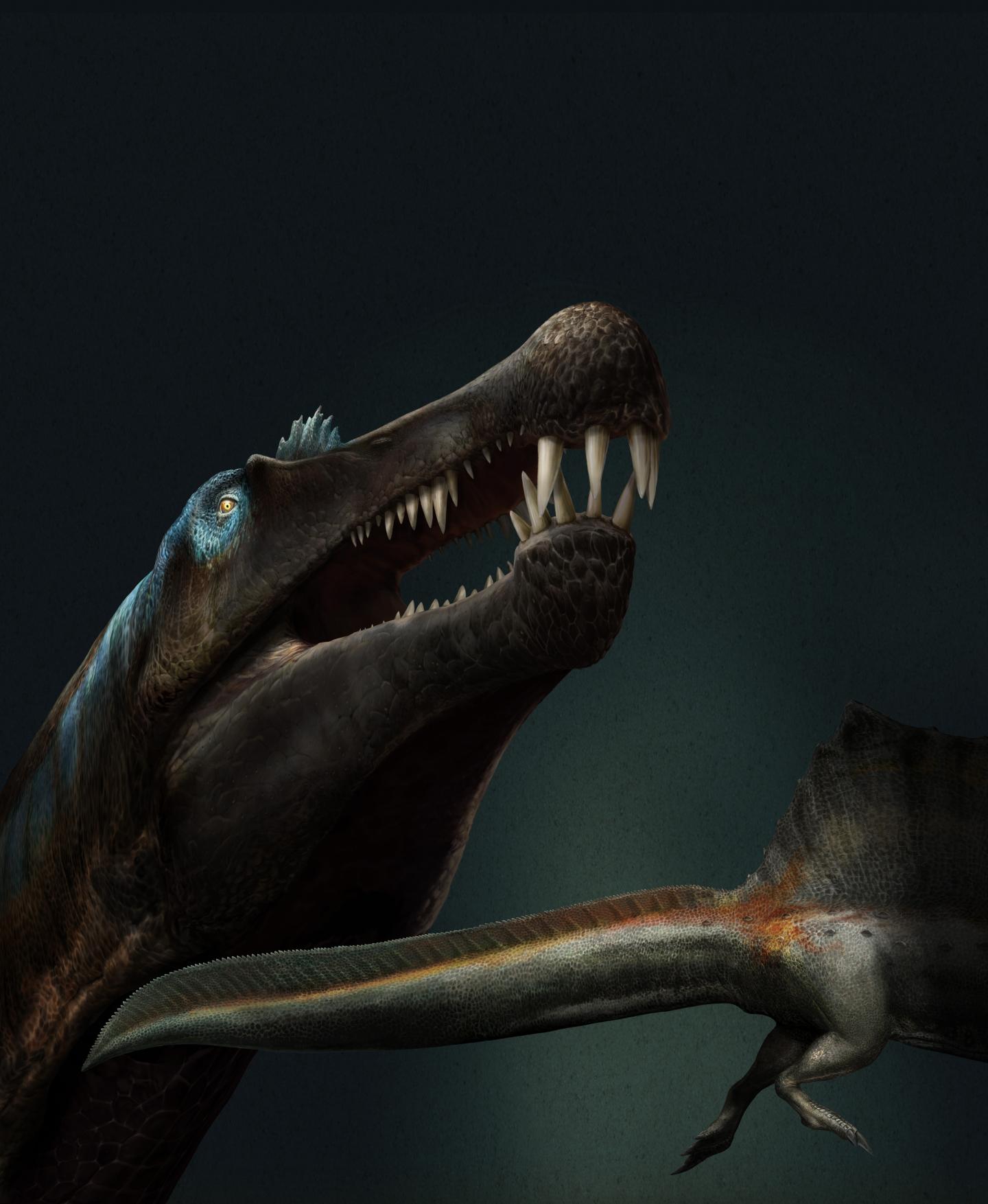
IMAGE

Credit: Davide Bonadonna

A discovery of more than a thousand dinosaur teeth, by a team of researchers from the University of Portsmouth, proves beyond reasonable doubt that Spinosaurus, the giant predator made famous by the movie Jurassic Park III as well as the BBC documentary Planet Dinosaur was an enormous river-monster.

Research published today in the journal Cretaceous Research proves that Spinosaurus aegyptiacus, a 15 metre long, six-tonne beast was in fact the most commonly found creature in the Kem Kem river system, which flowed through the Sahara Desert 100 million years ago.

Until recently it was believed that dinosaurs lived exclusively on land. However, research published earlier this year showed that Spinosaurus was well adapted to an aquatic lifestyle, due to its newly discovered tail. This latest research of 1,200 teeth found in the same region further supports this theory.

Scientists from the University of Portsmouth collected the fossilised remains from the site of an ancient river bed in Morocco. After analysing all of them it was discovered there was an abundance of Spinosaurus teeth, which are distinct and easily identifiable.

David Martill, Professor of Palaeobiology at the University of Portsmouth, said:

“The huge number of teeth we collected in the prehistoric river bed reveals that Spinosaurus was there in huge numbers, accounting for 45 per cent of the total dental remains. We know of no other location where such a mass of dinosaur teeth have been found in bone-bearing rock.

“The enhanced abundance of Spinosaurus teeth, relative to other dinosaurs, is a reflection of their aquatic lifestyle. An animal living much of its life in water is much more likely to contribute teeth to the river deposit than those dinosaurs that perhaps only visited the river for drinking and feeding along its banks.

“From this research we are able to confirm this location as the place where this gigantic dinosaur not only lived but also died. The results are fully consistent with the idea of a truly water-dwelling, “river monster”.”

Professor Martill worked alongside two students studying for their Masters Degree in Paleontology at the University of Portsmouth.

Thomas Beevor said: “The Kem Kem river beds are an amazing source of Spinosaurus remains. They also preserve the remains of many other Cretaceous creatures including sawfish, coelacanths, crocodiles, flying reptiles and other land-living dinosaurs. With such an abundance of Spinosaurus teeth, it is highly likely that this animal was living mostly within the river rather than along its banks.”

Aaron Quigley, explained the process of sorting through the teeth: “After preparing all the fossils, we then assessed each one in turn. The teeth of Spinosaurus have a distinct surface. They have a smooth round cross section which glints when held up to the light. We sorted all 1200 teeth into species and then literally counted them all up. Forty-five per cent of our total find were Spinosaurus teeth.”

###

Media Contact
Emma Gaisford
[email protected]

Related Journal Article

http://dx.doi.org/10.1016/j.cretres.2020.104627

Tags: ArchaeologyEvolutionOld WorldPaleontology
Share13Tweet8Share2ShareShareShare2

Related Posts

Florida Cane Toad: Complex Spread and Selective Evolution

Florida Cane Toad: Complex Spread and Selective Evolution

February 7, 2026
New Study Uncovers Mechanism Behind Burn Pit Particulate Matter–Induced Lung Inflammation

New Study Uncovers Mechanism Behind Burn Pit Particulate Matter–Induced Lung Inflammation

February 6, 2026

DeepBlastoid: Advancing Automated and Efficient Evaluation of Human Blastoids with Deep Learning

February 6, 2026

Navigating the Gut: The Role of Formic Acid in the Microbiome

February 6, 2026
Please login to join discussion

POPULAR NEWS

  • Robotic Ureteral Reconstruction: A Novel Approach

    Robotic Ureteral Reconstruction: A Novel Approach

    82 shares
    Share 33 Tweet 21
  • Digital Privacy: Health Data Control in Incarceration

    63 shares
    Share 25 Tweet 16
  • Study Reveals Lipid Accumulation in ME/CFS Cells

    57 shares
    Share 23 Tweet 14
  • Breakthrough in RNA Research Accelerates Medical Innovations Timeline

    53 shares
    Share 21 Tweet 13

About

We bring you the latest biotechnology news from best research centers and universities around the world. Check our website.

Follow us

Recent News

Phage-Antibiotic Combo Beats Resistant Peritoneal Infection

Boosting Remote Healthcare: Stepped-Wedge Trial Insights

Barriers and Boosters of Seniors’ Physical Activity in Karachi

Subscribe to Blog via Email

Enter your email address to subscribe to this blog and receive notifications of new posts by email.

Join 73 other subscribers
  • Contact Us

Bioengineer.org © Copyright 2023 All Rights Reserved.

Welcome Back!

Login to your account below

Forgotten Password?

Retrieve your password

Please enter your username or email address to reset your password.

Log In
No Result
View All Result
  • Homepages
    • Home Page 1
    • Home Page 2
  • News
  • National
  • Business
  • Health
  • Lifestyle
  • Science

Bioengineer.org © Copyright 2023 All Rights Reserved.