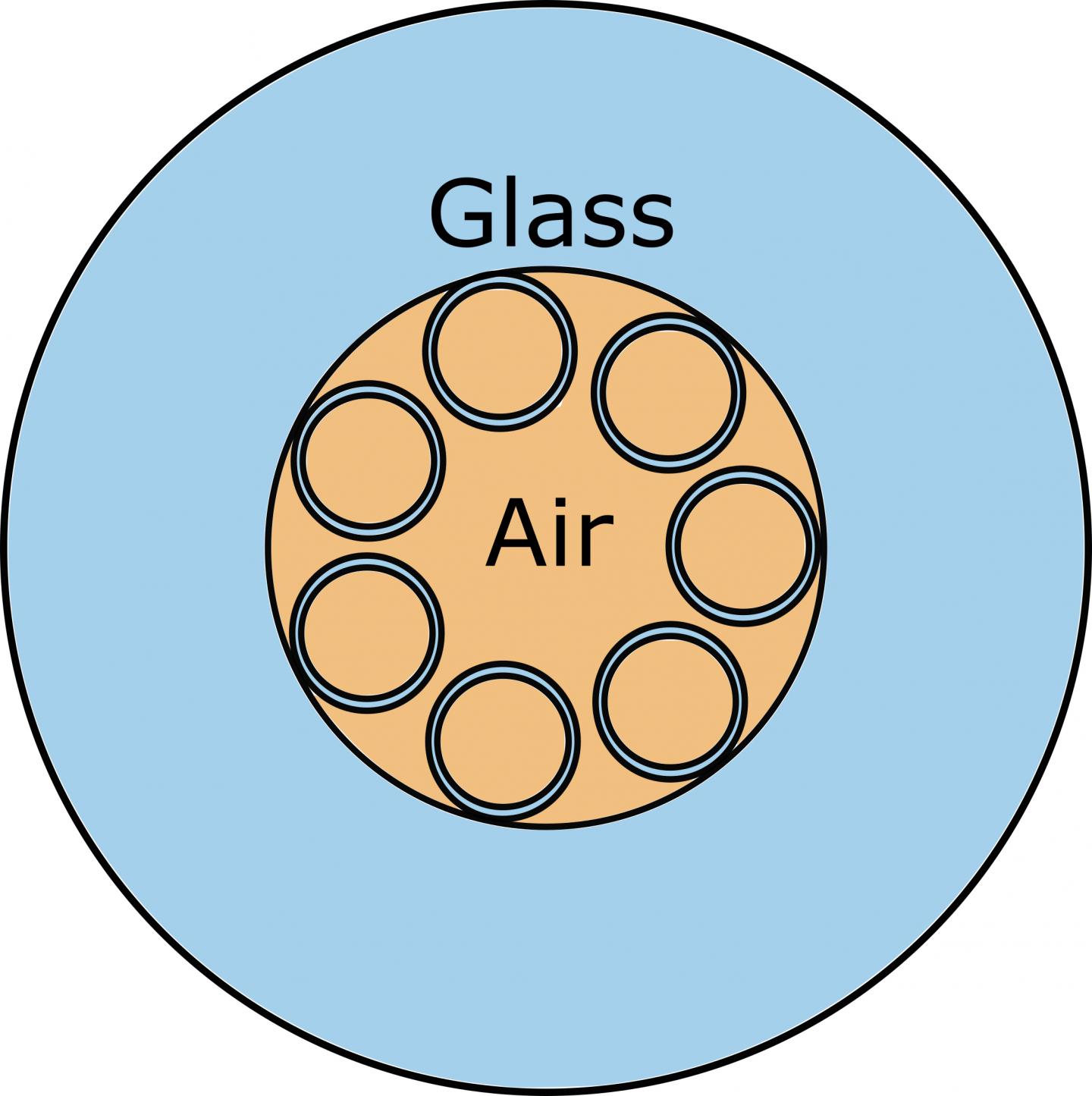
Credit: Arjun Iyer/Renninger lab/University of Rochester
A new hollow optical fiber greatly reduces the “noise” interfering with the signals it transmits compared to the single-mode fibers now widely used, researchers at the University of Rochester report.
The anti-resonant hollow-core fiber, created by researchers at the University of Central Florida, produces a thousand times less “noise” – and the lowest levels ever recorded from interference caused by acoustic phonons arising from the glass in the fiber at room temperatures.
To document this, researchers in the lab of William Renninger, assistant professor of optics, developed a highly sensitive measuring technique. Their findings are reported in a paper published in APL Photonics.
“It’s a very valuable fiber, and despite a lot of interest in it by researchers and some companies, nobody had really studied the behavior of phonons supported by the structure, and to what extent it actually reduced ‘noise,’ ” says Renninger, an expert in experimental and theoretical nonlinear optics.
The lab’s findings conclusively demonstrate that the fiber is a “promising platform for low noise applications, such as for quantum information processing and optical communications,” writes lead author Arjun Iyer, a graduate research associate in Renninger’s lab.
A unique answer to ‘noise’
“Noise” refers to any disturbance that masks or disrupts a signal being sent by light through an optical fiber. One such disturbance is caused by phonons – quantized acoustic or sound waves that occur at atomic and subatomic levels, in this case in the glass of an optical fiber.
Phonons cause a beam of light to “scatter” off the acoustic waves, creating splinter beams of different frequencies, or colors, that can interfere with, and reduce the energy of, the main beam. While some forms of scattering can be useful for specific applications, it interferes with quantum applications and even basic optical communications.
Noise can be reduced by cooling the fibers to extremely low, cryogenic temperatures, but that’s “very expensive and complicated,” Renninger says. Another approach is to attempt to use complicated error-correcting algorithms to correct for noise.
The anti-resonant hollow-core fiber, however, represents a straightforward solution that works even at room temperatures. Created by co-author Rodrigo Amezcua Correa and other researchers at CREOL, the College of Optics and Photonics at the University of Central Florida, the fiber features a unique arrangement of seven hollow capillaries arranged around a hollow core inside the fiber.
This results in minimal overlap between the fiber’s outer layer of glass and the light traveling through the core, eliminating interference from acoustic phonons emanating from the glass.
Tests by Renninger’s lab showed that the arrangement is 10 times more effective at reducing noise than other hollow fiber designs. “The little noise that’s left is caused by acoustic waves in the air inside the fiber, so if you were to evacuate the air it would be another 100 times more effective,” Renninger says. “You would have incredibly low noise”.
“If the fate of the world depended on reducing acoustic noise in optical fibers, this is the one you would want to use.”
###
The study was supported with funding from the Army Research Office and Renninger’s National Science Foundation CAREER award.
Other coauthors are Wendao Xu, a graduate research associate in Renninger’s lab, and Enrique Antonio-Lopez, a research scientist at CREOL.
Media Contact
Bob Marcotte
[email protected]
Related Journal Article
http://dx.