Credit: University of Ottawa
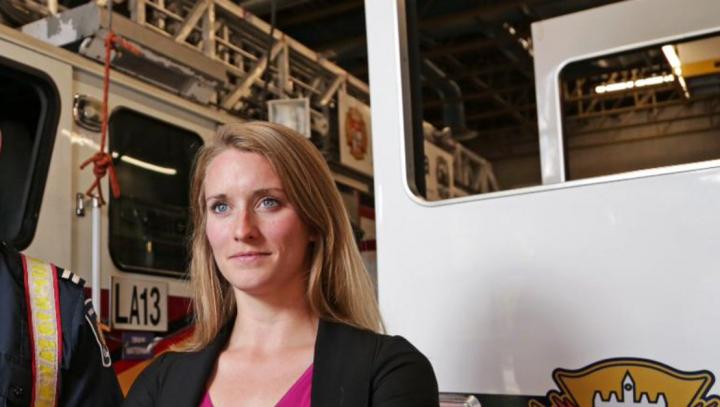
Jennifer Keir, a uOttawa PhD student and Research Associate whose research investigates firefighters’ health and their occupational exposure to hazardous substances, has been named the 2020 Fire Researcher of the Year by the Canadian Fire Chiefs Association.
In October 2017, Jennifer Keir and her research team published a groundbreaking study in the journal Environmental Science & Technology revealing Ottawa Fire Service firefighters had from three to more than five times the amount of harmful chemicals in their urine after being at the scene of a fire compared to before their arrival. The study suggested that chemicals entered their bodies mainly through skin contact.
Jennifer Keir agreed to answer our questions.
1- What does the Fire Researcher of the Year Award mean to you?
“It’s an honor to receive this award. I feel privileged to be able to conduct research with the amazing men and women of the fire service, so to receive an award in return is very special. There’s some great work coming from Canadian fire researchers right now and I’m fortunate to be a part of it.”
2- You and a team of researchers at the University of Ottawa published a study in 2017 about the chemical exposure experienced by Ottawa Fire Service firefighters during on-shift, emergency fire operation. What impact had that research on firefighters and on your career?
“I think what impacted firefighters the most from this research was finding out the areas and magnitude of contamination from on-shift firefighting. Many firefighters know that they are exposed to combustion emissions from the smell of smoke and the appearance of soot on themselves, their gear, and their environment, but to have this contamination measured analytically, and have numbers put behind it, really illustrated the severity of this issue.
The study also highlighted many questions that remain to be answered, most notably: what do we do to prevent and/or reduce these exposures? I have two wonderful supervisors, Dr. Jules Blais and Dr. Paul White, who supported me in continuing this research and pursuing answers to these questions, which led me to where I am today, working on a PhD.”
3- How has your life changed since the publication of this research? What did you learn?
“Since the publication of our 2017 research, I’ve had the opportunity to speak with firefighters and fire researchers from around the world and gain different perspectives. For example, I’ve learned about exposure prevention protocols that various departments are implementing and the hurdles that some face when it comes to implementing these new protocols (e.g., tight budgets, logistical issues such as extreme weather). These different perspectives allow me to see what areas are lacking research and where we need to put our focus next.”
4- Are there any developments linked to this research that you can share?
“After our 2017 study, we knew firefighters were experiencing significant exposures so next we wanted to pursue ways to reduce those exposures. We again collaborated with the Ottawa Fire Services and received funding from the Canadian Forces Fire Marshal, International Association of Fire Fighters, Ottawa Professional Fire Fighters Association, l’Association des pompiers de Montréal, and l’Institut de protection contre les incendies du Québec to conduct more research.”
5- What projects are you working on now?
“We are currently wrapping up a study that assessed the ability of post-fire skin cleaning methods to reduce firefighters’ exposures. The idea is that immediately after a fire, a firefighter would clean off his or her skin to reduce the amount of time combustion by-products are on the skin in hopes of reducing the amount being absorbed into the body. There are several products on the market for this “post-fire dermal decontamination” for firefighters but none have been rigorously studied in this way. The results will provide firefighters with scientific evidence to develop better protocols to reduce their exposures.”
###
Media Contact
Justine Boutet
[email protected]
Original Source
http://media.