The question is one that has been unresolved despite 50 years of research
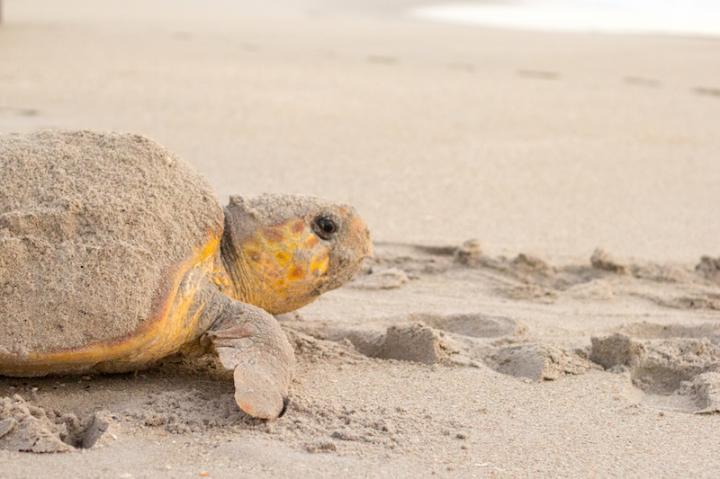
Credit: Photo credit: Gustavo Stahelin/University of Central Florida Marine Turtle Research Group. Permit #: FL MTP-186
ORLANDO, Sept. 14, 2020 – A University of Central Florida researcher is co-author of a new paper that may help answer why some animals have a magnetic “sixth” sense, such as sea turtles’ ability to return to the beach where they were born.
The question is one that has been unresolved despite 50 years of research.
“The search for a mechanism has been proposed as one of the last major frontiers in sensory biology and described as if we are ‘searching for a needle in a hay stack,'” says Robert Fitak, an assistant professor in UCF’s Department of Biology, part of UCF’s College of Sciences.
Fitak and researchers in the United Kingdom and Israel recently authored an article in Philosophical Transactions of the Royal Society B that proposes a hypothesis that the magnetic sense comes from a symbiotic relationship with magnetotactic bacteria.
Magnetotactic bacteria are a special type of bacteria whose movement is influenced by magnetic fields, including the Earth’s.
Animals that sense Earth’s magnetic field include sea turtles, birds, fish and lobsters. Sea turtles, for example, can use the ability for navigation to return to the beach where they were born.
Learning how organisms interact with magnetic fields can improve humans’ understanding of how to use Earth’s magnetic fields for their own navigation purposes. It can also inform ecological research into the effects of human modifications of the magnetic environment, such as constructing power lines, on biodiversity. Research into the interaction of animals with magnetic fields can also aid the development of therapies that use magnetism for drug delivery.
In the article, the researchers review the arguments for and against the hypothesis, present evidence published in support that has arisen in the past few years, as well as offer new supportive evidence of their own.
Their new evidence comes from Fitak, who mined one of the largest genetic databases of microbes, known as the Metagenomic Rapid Annotations using Subsystems Technology database, for the presence of magnetotactic bacteria that had been found in animal samples.
Previous microbial diversity studies have often focused on large patterns of the presence or absence of bacteria phyla in animals rather than specific species, Fitak says.
“The presence of these magnetotactic bacteria had been largely overlooked, or ‘lost in the mud’ amongst the massive scale of these datasets,” he says.
Fitak found, for the first time, that magnetotactic bacteria are associated with many animals, including a penguin species, loggerhead sea turtles, bats and Atlantic right whales.
For instance, Candidatus Magnetobacterium bavaricum regularly occurred in penguins and loggerhead sea turtles, while Magnetospirillum and Magnetococcus regularly occurred in the mammal species brown bats and Atlantic right whales.
Fitak says researchers still don’t know where in the animal that the magnetotactic bacteria would live, but it could be that they would be associated with nervous tissue, like the eye or brain.
“I’m working with the co-authors and local UCF researchers to develop a genetic test for these bacteria, and we plan to subsequently screen various animals and specific tissues, such as in sea turtles, fish, spiny lobsters and birds,” Fitak says.
Before joining UCF in 2019, Fitak worked for more than four years as a postdoctoral researcher at Duke University performing experiments to identify genes related to a magnetic sense in fish and lobsters using modern genomic techniques.
He says the hypothesis that animals use magnetic bacteria in a symbiotic way to gain a magnetic sense warrants further exploration but still needs more evidence before anything conclusive can be stated.
###
Fitak received his doctorate in genetics from the University of Arizona and his bachelor’s in molecular genetics from The Ohio State University. He is a member of UCF’s Genomics and Bioinformatics Cluster.
Study co-authors included Eviatar Natan with The Aleph Lab, Ltd., in Oxford, England; and Yuval Werber and Yoni Vortman with Tel-Hai Academic College in Tel Hai, Israel.
CONTACT: Robert H. Wells, Office of Research, [email protected]
Media Contact
Robert H Wells
[email protected]
Related Journal Article
http://dx.