• HOME
  • NEWS
  • EXPLORE
    • CAREER
      • Companies
      • Jobs
    • EVENTS
    • iGEM
      • News
      • Team
    • PHOTOS
    • VIDEO
    • WIKI
  • BLOG
  • COMMUNITY
    • FACEBOOK
    • INSTAGRAM
    • TWITTER
Saturday, February 7, 2026
BIOENGINEER.ORG
No Result
View All Result
  • Login
  • HOME
  • NEWS
  • EXPLORE
    • CAREER
      • Companies
      • Jobs
        • Lecturer
        • PhD Studentship
        • Postdoc
        • Research Assistant
    • EVENTS
    • iGEM
      • News
      • Team
    • PHOTOS
    • VIDEO
    • WIKI
  • BLOG
  • COMMUNITY
    • FACEBOOK
    • INSTAGRAM
    • TWITTER
  • HOME
  • NEWS
  • EXPLORE
    • CAREER
      • Companies
      • Jobs
        • Lecturer
        • PhD Studentship
        • Postdoc
        • Research Assistant
    • EVENTS
    • iGEM
      • News
      • Team
    • PHOTOS
    • VIDEO
    • WIKI
  • BLOG
  • COMMUNITY
    • FACEBOOK
    • INSTAGRAM
    • TWITTER
No Result
View All Result
Bioengineer.org
No Result
View All Result
Home NEWS Science News Chemistry

Theoretical prediction of reverse intersystem crossing for organic semiconductors

Bioengineer by Bioengineer
September 8, 2020
in Chemistry
Reading Time: 2 mins read
0
IMAGE
Share on FacebookShare on TwitterShare on LinkedinShare on RedditShare on Telegram

Promoting the development of organic light-emitting diode materials
IMAGE

Credit: Naoya Aizawa

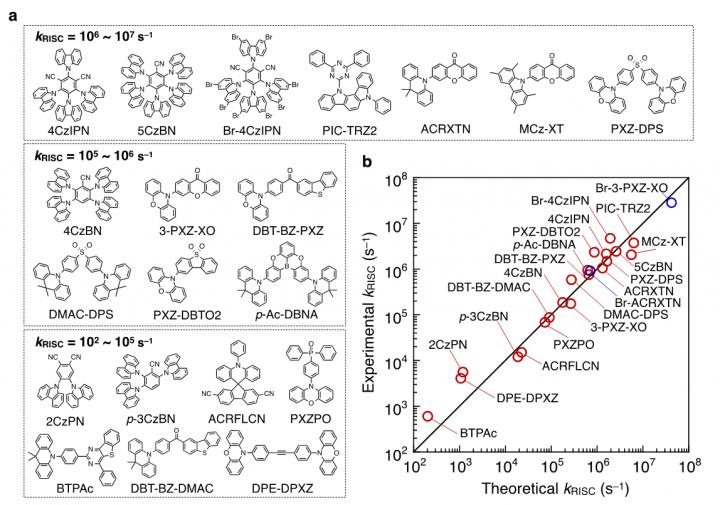
The joint research team of RIKEN and Hokkaido University developed a method to predict rate constants of reverse intersystem crossing (RISC)(1) associated with light emission efficiency of organic semiconductors used for Organic Light-Emitting Diode (OLED)(2) through quantum chemical calculations with computers.

Thermally activated delayed fluorescence (TADF) materials have been expected to be the next-generation OLED materials. One of the challenges for the practical application of the materials is development of TADF materials with faster RISC. Our developed method has demonstrated accurate prediction of RISC rate constants for various TADF materials. Organic semiconductors designed based on this prediction method presented high RISC rate constant of 10000000 per seconds or higher. In the future, with materials informatics studies using the method in combination with machine learning, we would be able to establish theories and scientific principles, which would lead to drastic improvement in efficient virtual screening and device performance of OLED materials.

The research was conducted by Naoya Aizawa and Yong-Jin Pu, researchers at RIKEN Center for Emergent Matter Science (CEMS), Assistant Professor Yu Harabuchi and Professor Satoshi Maeda from Department of Chemistry, Faculty of Science, Hokkaido University and Institute for Chemical Reaction Design and Discovery (WPI-ICReDD), Hokkaido University under the research area: Advanced Materials Informatics through Comprehensive Integration among Theoretical, Experimental, Computational and Data-Centric Sciences of the JST the Strategic Basic Research Program PRESTO.

###

(1) Reverse intersystem crossing (RISC)

Transition from a triplet to a singlet excited state. It is caused by electron spin flip by spin-orbit interaction, which is a relativistic effect. Since spin-orbit interaction in organic matters is extremely small, it is considered to occur efficiently at energy of the crossing, where the energies in the triplet excited state and the singlet excited state are equal to each other.

(2) Organic Light-Emitting Diode (OLED)

A light emitting device that uses organic semiconductors. It is used for the display of smartphones and televisions.

Media Contact
Naoya Aizawa
[email protected]

Original Source

https://www.jst.go.jp/pr/announce/20200806/index_e.html

Related Journal Article

http://dx.doi.org/10.1038/s41467-020-17777-2

Tags: Chemistry/Physics/Materials SciencesMaterials
Share12Tweet8Share2ShareShareShare2

Related Posts

blank

Breakthrough in Environmental Cleanup: Scientists Develop Solar-Activated Biochar for Faster Remediation

February 7, 2026
blank

Cutting Costs: Making Hydrogen Fuel Cells More Affordable

February 6, 2026

Scientists Develop Hand-Held “Levitating” Time Crystals

February 6, 2026

Observing a Key Green-Energy Catalyst Dissolve Atom by Atom

February 6, 2026
Please login to join discussion

POPULAR NEWS

  • Robotic Ureteral Reconstruction: A Novel Approach

    Robotic Ureteral Reconstruction: A Novel Approach

    82 shares
    Share 33 Tweet 21
  • Digital Privacy: Health Data Control in Incarceration

    63 shares
    Share 25 Tweet 16
  • Study Reveals Lipid Accumulation in ME/CFS Cells

    57 shares
    Share 23 Tweet 14
  • Breakthrough in RNA Research Accelerates Medical Innovations Timeline

    53 shares
    Share 21 Tweet 13

About

We bring you the latest biotechnology news from best research centers and universities around the world. Check our website.

Follow us

Recent News

Evaluating Pediatric Emergency Care Quality in Ethiopia

TPMT Expression Predictions Linked to Azathioprine Side Effects

Improving Dementia Care with Enhanced Activity Kits

Subscribe to Blog via Email

Success! An email was just sent to confirm your subscription. Please find the email now and click 'Confirm' to start subscribing.

Join 73 other subscribers
  • Contact Us

Bioengineer.org © Copyright 2023 All Rights Reserved.

Welcome Back!

Login to your account below

Forgotten Password?

Retrieve your password

Please enter your username or email address to reset your password.

Log In
No Result
View All Result
  • Homepages
    • Home Page 1
    • Home Page 2
  • News
  • National
  • Business
  • Health
  • Lifestyle
  • Science

Bioengineer.org © Copyright 2023 All Rights Reserved.