• HOME
  • NEWS
  • EXPLORE
    • CAREER
      • Companies
      • Jobs
    • EVENTS
    • iGEM
      • News
      • Team
    • PHOTOS
    • VIDEO
    • WIKI
  • BLOG
  • COMMUNITY
    • FACEBOOK
    • INSTAGRAM
    • TWITTER
Saturday, February 7, 2026
BIOENGINEER.ORG
No Result
View All Result
  • Login
  • HOME
  • NEWS
  • EXPLORE
    • CAREER
      • Companies
      • Jobs
        • Lecturer
        • PhD Studentship
        • Postdoc
        • Research Assistant
    • EVENTS
    • iGEM
      • News
      • Team
    • PHOTOS
    • VIDEO
    • WIKI
  • BLOG
  • COMMUNITY
    • FACEBOOK
    • INSTAGRAM
    • TWITTER
  • HOME
  • NEWS
  • EXPLORE
    • CAREER
      • Companies
      • Jobs
        • Lecturer
        • PhD Studentship
        • Postdoc
        • Research Assistant
    • EVENTS
    • iGEM
      • News
      • Team
    • PHOTOS
    • VIDEO
    • WIKI
  • BLOG
  • COMMUNITY
    • FACEBOOK
    • INSTAGRAM
    • TWITTER
No Result
View All Result
Bioengineer.org
No Result
View All Result
Home NEWS Science News

Scientists predicted new hard and superhard ternary compounds

Bioengineer by Bioengineer
September 4, 2020
in Science News
Reading Time: 2 mins read
0
IMAGE
Share on FacebookShare on TwitterShare on LinkedinShare on RedditShare on Telegram

IMAGE

Credit: A. Kvashnin et al./Chemistry of Materials

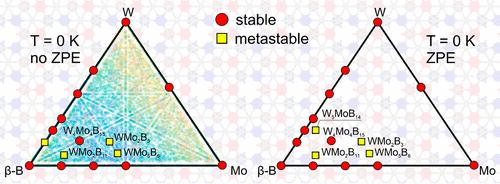
Scientists from the Skolkovo Institute of Science and Technology (Skoltech), Institute of Solid State Chemistry and Mechanochemistry (ISSC SB RAS), Pirogov Medical University and Yerevan State University have predicted new hard and superhard ternary compounds in the tungsten-molybdenum-boron system using computational methods. Their research was published in the journal Chemistry of Materials.

According to Alexander Kvashnin, a senior research scientist at Skoltech and a co-author of the paper, the study is a natural follow-on to lengthy research into binary systems. In pursuit of new materials, the scientists had to create a more complex system by adding a third element, which resulted in strongly altered properties and new compounds. These changes were the focus of interest for the scientists.

The team predicted the structure of potentially superhard ternary compounds in the W-Mo-B system using the USPEX evolutionary algorithm developed by Artem Oganov, a Skoltech professor and a co-author of the paper, and his students.

“We planned to predict a series of ternary compounds that would display better mechanical properties, such as hardness and fracture resistance, as compared to binary compounds. We did predict several ternary compounds which turned out to be high-entropy alloys. The mixing of tungsten and molybdenum atoms produced compounds that were disordered and, therefore, had varying stability depending on temperature,” explains Alexander Kvashnin.

Carbides ? four- or five-component compounds – are typically classified as high-entropy compounds. Scientists believe that their study is the first step towards finding such compounds among boride systems.

“Obvious prospects of this research may translate into new hard materials outperforming their existing counterparts and withstanding higher temperatures or pressures. Companies such as Gazpromneft may use those materials for drilling or other purposes,” adds Christian Tantardini, one of the authors of the paper and an employee of ISSC and Skoltech.

The scientists intend to pursue their research effort. They are eager to find out what happens to even more complex compounds in response to temperature and pressure changes.

###

Media Contact
Ilyana Zolotareva
[email protected]

Original Source

https://www.skoltech.ru/en/2020/09/scientists-predicted-new-hard-and-superhard-ternary-compounds/

Related Journal Article

http://dx.doi.org/10.1021/acs.chemmater.0c02440

Tags: Algorithms/ModelsChemistry/Physics/Materials SciencesComputer ScienceMaterialsResearch/DevelopmentSuperconductors/SemiconductorsTheory/Design
Share13Tweet8Share2ShareShareShare2

Related Posts

Evaluating Pediatric Emergency Care Quality in Ethiopia

February 7, 2026

TPMT Expression Predictions Linked to Azathioprine Side Effects

February 7, 2026

Improving Dementia Care with Enhanced Activity Kits

February 7, 2026

Decoding Prostate Cancer Origins via snFLARE-seq, mxFRIZNGRND

February 7, 2026
Please login to join discussion

POPULAR NEWS

  • Robotic Ureteral Reconstruction: A Novel Approach

    Robotic Ureteral Reconstruction: A Novel Approach

    82 shares
    Share 33 Tweet 21
  • Digital Privacy: Health Data Control in Incarceration

    63 shares
    Share 25 Tweet 16
  • Study Reveals Lipid Accumulation in ME/CFS Cells

    57 shares
    Share 23 Tweet 14
  • Breakthrough in RNA Research Accelerates Medical Innovations Timeline

    53 shares
    Share 21 Tweet 13

About

We bring you the latest biotechnology news from best research centers and universities around the world. Check our website.

Follow us

Recent News

Evaluating Pediatric Emergency Care Quality in Ethiopia

TPMT Expression Predictions Linked to Azathioprine Side Effects

Improving Dementia Care with Enhanced Activity Kits

Subscribe to Blog via Email

Enter your email address to subscribe to this blog and receive notifications of new posts by email.

Join 73 other subscribers
  • Contact Us

Bioengineer.org © Copyright 2023 All Rights Reserved.

Welcome Back!

Login to your account below

Forgotten Password?

Retrieve your password

Please enter your username or email address to reset your password.

Log In
No Result
View All Result
  • Homepages
    • Home Page 1
    • Home Page 2
  • News
  • National
  • Business
  • Health
  • Lifestyle
  • Science

Bioengineer.org © Copyright 2023 All Rights Reserved.