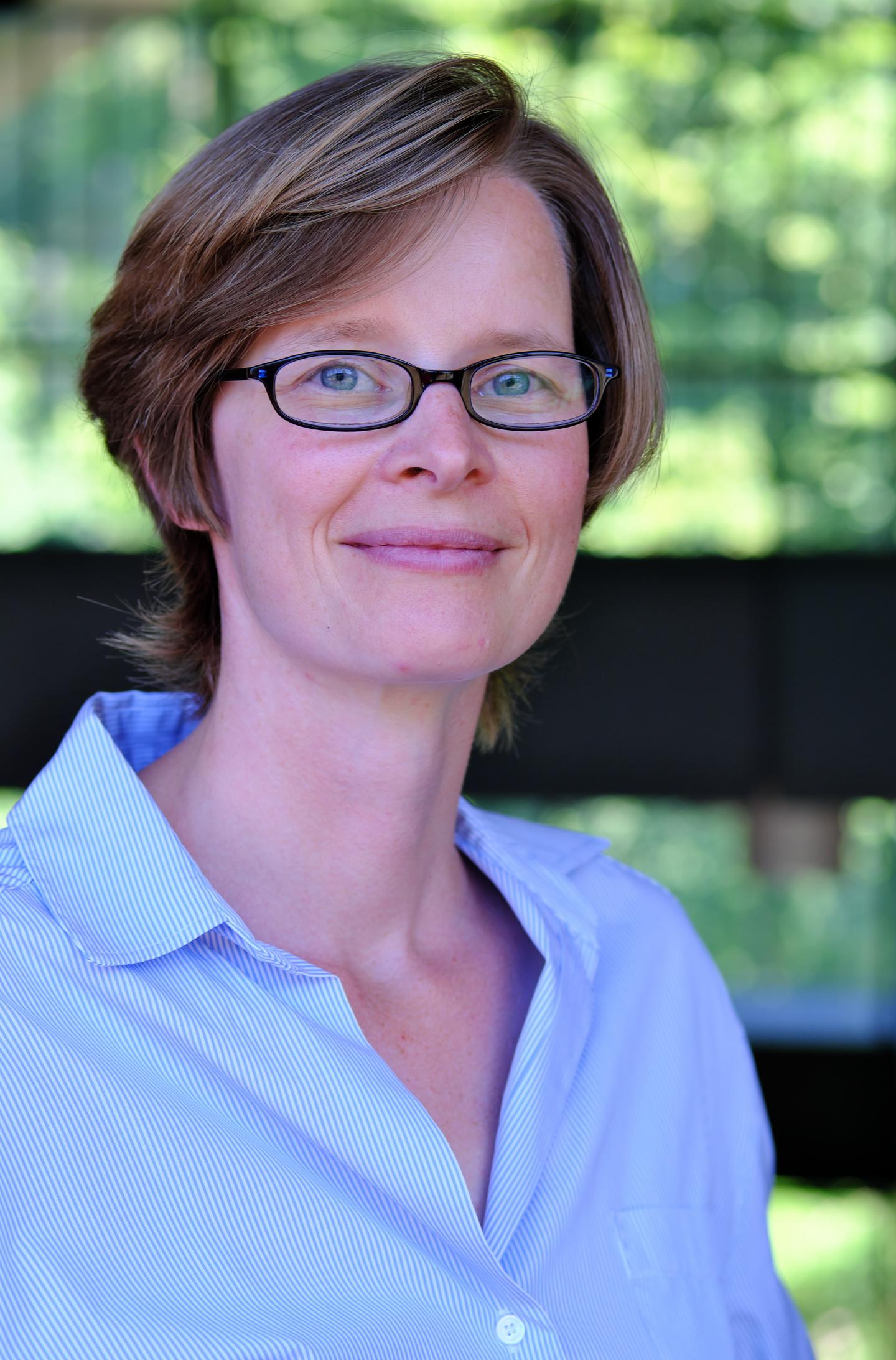
Credit: Thorsten Mohr, Saarland Universität
People infer things beyond what is literally said – and everyone makes his or her own assumptions. This fact poses a major difficulty for computers. For her research project on this topic, Vera Demberg has received the prestigious ERC Starting Grant from the European Research Council, which provides 1.5 million euros over five years.
In this research project, Vera Demberg is working with computer systems that can explain or summarize content. So-called chatbots, programs that automatically ask customers about problems and offer them solutions, are an example of this. “The goal of my research project is to ensure that systems that automatically generate language adapt to individual users in their manner of expression. In this way, I want to reduce misunderstandings and ensure that people can communicate with computers more naturally,” says the Saarbrücken-based computational linguist.
Current voice-based computer systems react to a specific user only to a very limited extent, for example by recommending certain products. “People, however, adjust not only the content but also the spoken form of their statements to their counterpart, so that as much as possible of what they say is understood. This is exactly what I want to achieve for computer systems,” explains Vera Demberg. In the future, a computer system should be able to recognize whether it is, for example, talking to an expert or a layperson, and adapt the frequency of technical terms or the sentence length accordingly.
To achieve this, the researcher must first analyze how people understand language on an individual level and how this process can be modeled in a computer. “An essential component of individual language comprehension is what conclusions one draws when hearing an ambiguous statement,” explains Vera Demberg. For example, the sentence “Today Anna arrived precisely at three o’clock” allows two different interpretations: Anna came on time (as always), or Anna came on time (as an exception). Explicitly emphasizing the word “precisely” allows both interpretations.
It is essential to model such individual conclusions, so-called inferences, in a computer so that the system can anticipate and prevent possible misunderstandings. “The project is therefore very interdisciplinary. I am working together with colleagues from computer science, language science and psycholinguistics to get to the bottom of this question,” explains Demberg.
As an application for her basic research, Demberg mentions dialog- and task-oriented systems in which facts are explained and summarized or users are provided with a virtual tutor. The new technology could also be used in cars to create driver assistance systems that are able to adapt their language to the traffic situation – just like a real co-driver.
The project, titled “Individualized Interaction in Discourse (IDDISC),” is located at the Saarland Informatics Campus at Saarland University. It is funded by the European Research Council with a grant of 1.5 million Euros over five years, creating five scientific jobs. The award is already the tenth ERC Starting Grant and the 21st award of the European Research Council assigned to a project at the Saarland Informatics Campus.
###
Questions can be directed at:
Prof. Dr. Vera Demberg
Chair of Computer Science and Computational Linguistics
Tel.: +49 681 302 70024
E-Mail: vera@)coli.uni-saarland.de
Background Saarland Informatics Campus:?
800 scientists and about 2000 students from more than 80 nations make the Saarland Informatics Campus (SIC) one of the leading locations for computer science in Germany and Europe. Five world-renowned research institutes, namely the German Research Center for Artificial Intelligence (DFKI), the Max Planck Institute for Computer Science, the Max Planck Institute for Software Systems, the Center for Bioinformatics and the Cluster for “Multimodal Computing and Interaction” as well as Saarland University with three cooperating departments and 21 degree programs cover the entire spectrum of computer science.
Public relations work at the Saarland Informatics Campus is supported by the Competence Center Computer Science Saarland, funded by the European Regional Development Fund (ERDF) and the Saarland State Chancellery.
Media Contact
Philipp Zapf-Schramm
[email protected]
Original Source
https:/