Two experimental drugs fight non-small cell lung cancer by affecting their blood vessels, oxygen levels, and other environmental factors
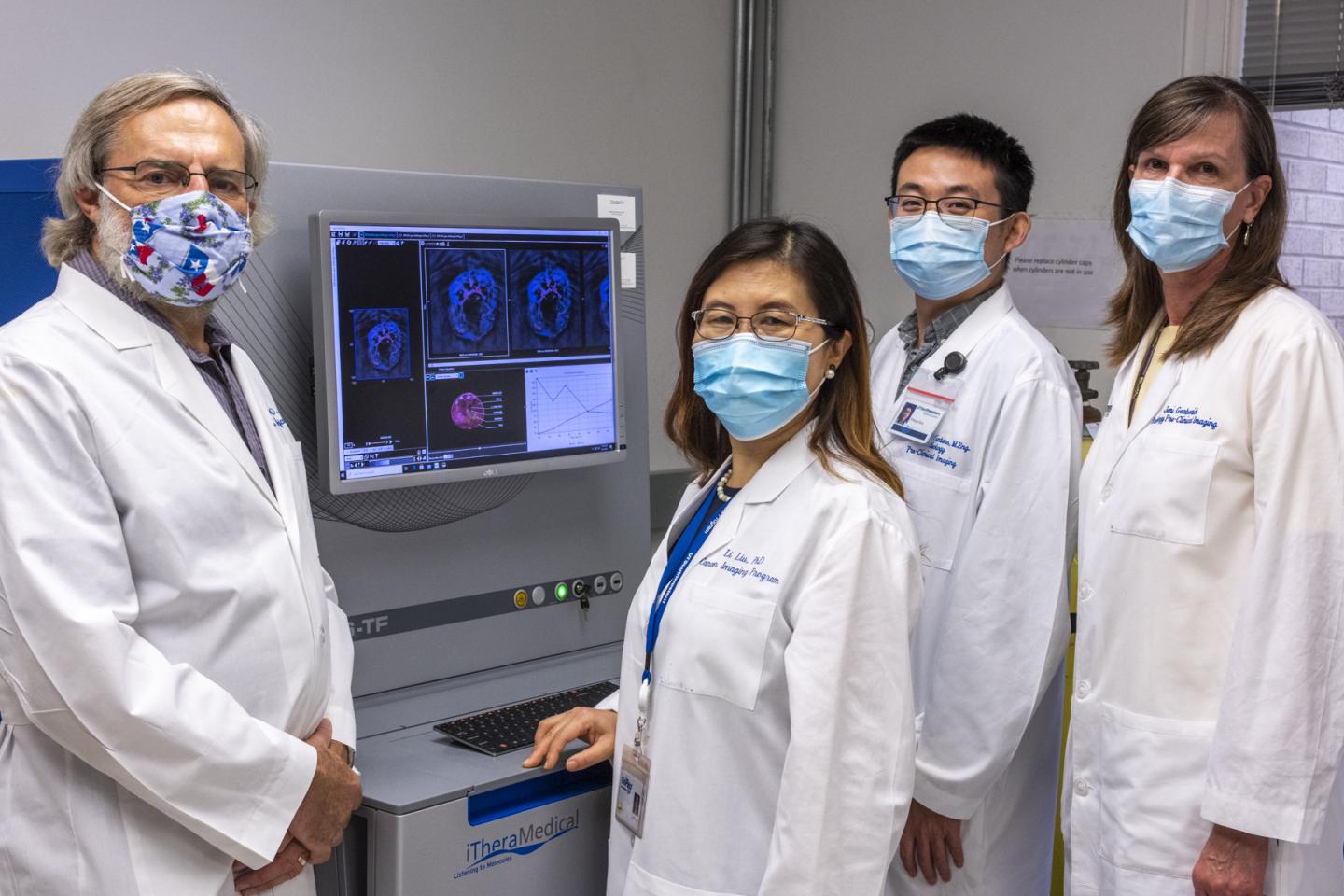
Credit: UT Southwestern Medical Center
DALLAS – Sept. 3, 2020 – A new technology that allows researchers to peer inside malignant tumors shows that two experimental drugs can normalize aberrant blood vessels, oxygenation, and other aspects of the tumor microenvironment in non-small cell lung cancer (NSCLC), helping to suppress the tumor’s growth and spread, UT Southwestern researchers report.
The findings, published online in Cancer Research, highlight the use of this novel visualization tool as well as the promise of these drugs for NSCLC, a disease that remains one of the leading causes of cancer-related deaths in the U.S. despite decades of research.
NSCLC is the most common form of lung cancer, comprising about 85-90 percent of the nearly 230,000 cases of lung cancer diagnosed each year in the U.S. However, despite state-of-the-art treatments for this disease, including targeted therapies and immunotherapies, the five-year survival rate for lung cancer remains at only 10-20 percent – far lower than for many other cancers including breast (90 percent) and prostate (99 percent.)
The experimental drugs cyclopamine tartrate (CycT) and heme-sequestering peptide 2 (HSP2) have shown promise in inhibiting cancer growth and progression in mice bearing human NSCLC tumors. Although it’s known that both of the drugs target heme, the molecule that carries oxygen in red blood cells – CycT inhibits heme synthesis and HSP2 inhibits heme uptake into cells – how these therapies work to suppress NSCLC was unknown.
To answer that question, Li Liu, Ph.D., assistant professor of radiology at UTSW, and her colleagues used a new tool called multispectral optoacoustic tomography (MSOT) to examine the inside of human NSCLC tumors growing in mice. (The imaging technology uses light pulses to generate ultrasound waves.) They looked specifically at tumor blood vessels and how well they carried oxygen to the cells within, comparing tumors in animals that received injections of either CycT, HSP2, or saline every three days.
After three weeks, tests showed that either drug significantly suppressed the growth of the tumors compared with mice that received just saline, supporting previous studies. But Liu, a member of the Harold C. Simmons Comprehensive Cancer Center, and her colleagues showed that while untreated tumors consumed copious amounts of oxygen, lowering this blood gas in the tumor microenvironment, tumors in mice treated with CycT or HSP2 consumed significantly less. Similarly, these animals generated less ATP, a molecule that cells use for energy that requires heme for its formation.
Using MSOT, they found that treatment with either drug reduced the abnormally large amount of blood vessel formation in these tumors and increased blood oxygen saturation and tumor oxygenation, bringing both of these measures closer to that of healthy tissue. The treatments also reduced the amount of total hemoglobin, a measure that reflects the amount of blood circulating through tumor tissue.
Further experiments showed that cells isolated from the tumors of mice treated with CycT and HSP2 had reduced amounts of molecular markers for low oxygen and molecules associated with blood vessel formation.
Together, Liu says, these findings suggest that these two heme-targeting medications can attack NSCLC tumors from multiple angles: inhibiting the production of ATP and the oxygen consumption they need to live and grow, reducing blood circulation and oxygen levels to that of healthy tissue, and decreasing the tumors’ ability to create new blood vessels. This study also shows the utility of MSOT as a noninvasive tool to survey tumors and track how well drugs such as CycT and HSP2 are working in real time.
“The more we learn about these deadly tumors and potential new treatments,” says Liu, “the more hope we can offer patients, who currently have few effective options for therapy.”
###
Clinical trials are underway at other institutions to explore the feasibility of using MSOT to evaluate tumors in patients, she added.
Other UTSW researchers who participated in this study were Yihang Guo, Jingyu Chen, Shigen Zhong, James Campbell, Jeni Gerberich, and Ralph P. Mason. Other contributors from local or international institutions or companies included Poorva Ghosh, Adnin Ashrafi, Sachareeka Dey, Jie Liu, Purna Chaitanya Konduri, Li Zhang, and Massoud Garrossian.
This study was funded by Cancer Prevention and Research Institute of Texas grants RP160617 and RP200021 and infrastructure provided by the Southwestern Small Animal Imaging Research Program (SW-SAIRP) supported in part by P30 CA142543 and Shared Instrumentation Grants 1S10 RR024757, S10 OD018094-01A1.
About UT Southwestern Medical Center
UT Southwestern, one of the premier academic medical centers in the nation, integrates pioneering biomedical research with exceptional clinical care and education. The institution’s faculty has received six Nobel Prizes, and includes 23 members of the National Academy of Sciences, 16 members of the National Academy of Medicine, and 13 Howard Hughes Medical Institute Investigators. The full-time faculty of more than 2,500 is responsible for groundbreaking medical advances and is committed to translating science-driven research quickly to new clinical treatments. UT Southwestern physicians provide care in about 80 specialties to more than 105,000 hospitalized patients, nearly 370,000 emergency room cases, and oversee approximately 3 million outpatient visits a year.
Media Contact
UT Southwestern Medical Center
[email protected]