The process occurs in active-core nuclei. A molecular gas cloud that accumulates in the central region is blown away by radiation from the black hole’s accretion disk, forming a huge expanding hot bubble, whose radius can reach 300 light years.
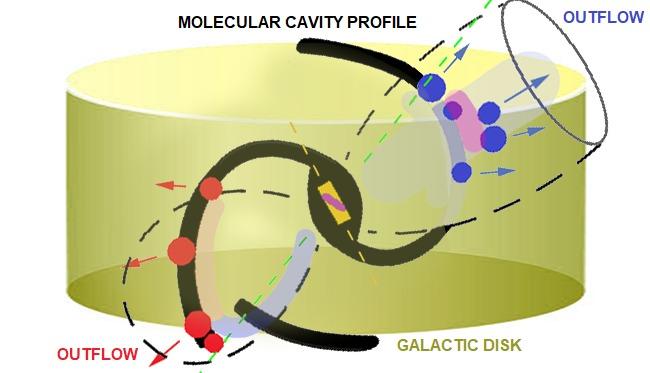
Credit: Daniel May
Black holes can expel a thousand times more matter than they capture. The mechanism that governs both ejection and capture is the accretion disk, a vast mass of gas and dust spiraling around the black hole at extremely high speeds. The disk is hot and emits light as well as other forms of electromagnetic radiation. Part of the orbiting matter is pulled toward the center and disappears behind the event horizon, the threshold beyond which neither matter nor light can escape. Another, much larger, part is pushed further out by the pressure of the radiation emitted by the disk itself.
Every galaxy is thought to have a supermassive black hole at its center, but not all galaxies have, or still have, accretion disks. Those that do are known as active galaxies, on account of their active galactic nuclei. The traditional model posits two phases in the matter that accumulates in the central region of an active galaxy: a high-speed ionized gas outflow of matter ejected by the nucleus, and slower molecules that may flow into the nucleus.
A new model that integrates the two phases into a single scenario has now been put forward by Daniel May, a postdoctoral researcher in the University of São Paulo’s Institute of Astronomy, Geophysics and Atmospheric Sciences (IAG-USP) in Brazil. “We found that the molecular phase, which appears to have completely different dynamics from the ionized phase, is also part of the outflow. This means there’s far more matter being blown away from the center, and the active galactic nucleus plays a much more important role in the structuring of the galaxy as a whole,” May told Agência FAPESP.
An article on the study by May and collaborators is published in the journal Monthly Notices of the Royal Astronomical Society. The study was supported by FAPESP via a doctoral scholarship and a postdoctoral scholarship awarded to May. João Steiner, Full Professor at IAG-USP and a co-author of the article, supervised May’s PhD and postdoc research.
May identified the pattern on the basis of a study of two active galaxies: NGC 1068, which he investigated in 2017, and NGC 4151, which he investigated in 2020. NGC stands for New General Catalogue of Nebulae and Clusters of Stars, established in the late nineteenth century.
“Using a highly meticulous image treatment methodology, we identified the same pattern in two very different galaxies. Most astronomers today are interested in studying very large datasets. Our approach was the opposite. We investigated the individual characteristics of these two objects in an almost artisanal manner,” May said.
“Our study suggests that initially a cloud of molecular gas in the central region of the galaxy collapses and activates its nucleus, forming the accretion disk. The photons emitted by the disk, which reaches temperatures on the order of a million degrees, push most of the gas a long way outward, while a smaller part of the gas is absorbed by the disk and eventually plunges into the black hole. As the cloud is sucked into the disk, two distinct phases take shape: one is ionized owing to exposure to the disk, and the other is molecular and overshadowed by its radiation. We discovered that the molecular part is entirely tied to the ionized part, which is known as the outflow. We were able to relate the two phases of the gas, previously considered disconnected, and fit their morphologies into a single scenario.”
The ionized gas derives from fragmentation of this molecular gas, May explained. As it fragments, it is pushed further out in an expanding hot bubble that can be as large as 300 light years in radius. For the sake of comparison, it is worth recalling that this is almost 70 times the distance from Earth to Proxima Centauri, the nearest star to the Solar System.
“When we observe the central regions of these two galaxies, we see this enormous bubble in profile, delineated by its walls of molecules,” May said. “We see the walls fragmenting and the ionized gas being driven out. The accretion disk appears as an extremely bright spot. All the information that reaches us from it corresponds to a pixel, so we don’t have enough resolution to discern its possible parts. The black hole is known about only from its effects.”
In the ancient Universe there was much more available gas, so the effect of a process such as that described by him was more intense, May explained. What he observed in relatively nearby galaxies such as NGC 1068 and NGC 4151 is a mild form of the process that occurred in more distant galaxies, whose active nuclei in the remote past are now detected as quasars.
The article “The nuclear architecture of NGC 4151: on the path toward a universal outflow mechanism in light of NGC 1068” can be retrieved from: academic.oup.com/mnras/article-abstract/496/2/1488/5851281?redirectedFrom=fulltext#205434907.
Media Contact
Heloisa Reinert
[email protected]
Original Source
https:/
Related Journal Article
http://dx.