• HOME
  • NEWS
  • EXPLORE
    • CAREER
      • Companies
      • Jobs
    • EVENTS
    • iGEM
      • News
      • Team
    • PHOTOS
    • VIDEO
    • WIKI
  • BLOG
  • COMMUNITY
    • FACEBOOK
    • INSTAGRAM
    • TWITTER
Tuesday, December 30, 2025
BIOENGINEER.ORG
No Result
View All Result
  • Login
  • HOME
  • NEWS
  • EXPLORE
    • CAREER
      • Companies
      • Jobs
        • Lecturer
        • PhD Studentship
        • Postdoc
        • Research Assistant
    • EVENTS
    • iGEM
      • News
      • Team
    • PHOTOS
    • VIDEO
    • WIKI
  • BLOG
  • COMMUNITY
    • FACEBOOK
    • INSTAGRAM
    • TWITTER
  • HOME
  • NEWS
  • EXPLORE
    • CAREER
      • Companies
      • Jobs
        • Lecturer
        • PhD Studentship
        • Postdoc
        • Research Assistant
    • EVENTS
    • iGEM
      • News
      • Team
    • PHOTOS
    • VIDEO
    • WIKI
  • BLOG
  • COMMUNITY
    • FACEBOOK
    • INSTAGRAM
    • TWITTER
No Result
View All Result
Bioengineer.org
No Result
View All Result
Home NEWS Science News Health

From virtual to reality! Virtual training improves physical and cognitive functions

Bioengineer by Bioengineer
September 1, 2020
in Health
Reading Time: 2 mins read
0
IMAGE
Share on FacebookShare on TwitterShare on LinkedinShare on RedditShare on Telegram

IMAGE

Credit: Tohoku University

Researchers at the Smart-Aging Research Center (IDAC) at Tohoku University have developed an innovative training protocol that, utilizing immersive virtual reality (IVR), leads to real physical and cognitive benefits.

We all know that physical exercise is crucial for overall well-being and helps postpone aging-related disorders; what is more surprising is that physical exercise can have beneficial effects not only on the body but on cognitive functions too. Unfortunately, physical activities are not always possible for people suffering or recovering from long-term diseases.

IVR, which allows the creation of a realistic virtual world that we can explore with our virtual body, can help solve this problem. It sounds unreal, but the illusion is so effective that even with the person sitting and the virtual body walking, the person thinks he/she is moving – it even generates comparable physiological reactions.

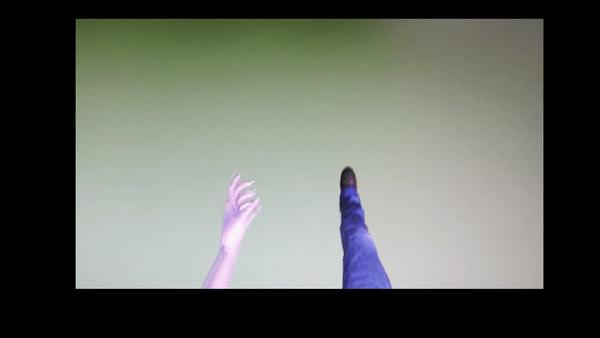
Professor Ryuta Kawashima, director of IDAC, led the team of researchers to explore whether or not virtual training can have similar benefits on cognitive functions as physical exercise. Healthy, young participants underwent the virtual training protocol. Wearing an IVR headset while sitting, they saw a virtual body (also called an avatar) displayed in the first person perspective. This created the illusory feeling of being the avatar itself. The virtual body alternated between 30 seconds of walking and 30 seconds of running for 8 minutes.

Researchers found that participants’ heart rate increased coherently with the virtual movements, despite the fact that subjects were completely still; more importantly, cognitive functions (specifically, executive functions) and their neural basis were tested before and after the virtual training. The results showed that participants improved their cognitive performance (specifically, they were faster), as also confirmed by the increased activation of the brain-related areas (specifically, the left dorsolateral prefrontal cortex).

“The application of immersive virtual reality for clinical purposes is often doubted because it was originally designed for entertainment,” says Professor Dalila Burin, who developed and conducted the experiment. “But this study proves that training protocols in IVR can be useful for people with motor impairments to have comparable benefits to real physical activity.” Professor Burin adds, “It is also beneficial for people who want to start exercising in an entertaining and safe way.”

By introducing the virtual reality technology in the cognitive neuroscience field, researchers aim to provide clinical solutions for patients and also contribute to theoretical models of body representation and motor control.

###

Media Contact
Dalila Burin
[email protected]

Original Source

https://www.tohoku.ac.jp/en/press/from_virtual_to_reality.html

Related Journal Article

http://dx.doi.org/10.1016/j.neuroimage.2020.117297

Tags: Health Care Systems/ServicesMedicine/Healthneurobiology
Share12Tweet8Share2ShareShareShare2

Related Posts

MDMA Therapy for Eating Disorders: Insights and Future

December 30, 2025

E2F8 Boosts DTL, Driving Endometrial Cancer via MAPK

December 30, 2025

Brain Imaging Insights in Early-Onset Precocious Puberty

December 30, 2025

Self-Efficacy and Identity Predict Spiritual Care Competence

December 30, 2025
Please login to join discussion

POPULAR NEWS

  • Robotic Waist Tether for Research Into Metabolic Cost of Walking

    NSF funds machine-learning research at UNO and UNL to study energy requirements of walking in older adults

    71 shares
    Share 28 Tweet 18
  • Exploring Audiology Accessibility in Johannesburg, South Africa

    51 shares
    Share 20 Tweet 13
  • Nurses’ Views on Online Learning: Effects on Performance

    70 shares
    Share 28 Tweet 18
  • SARS-CoV-2 Subvariants Affect Outcomes in Elderly Hip Fractures

    44 shares
    Share 18 Tweet 11

About

We bring you the latest biotechnology news from best research centers and universities around the world. Check our website.

Follow us

Recent News

MDMA Therapy for Eating Disorders: Insights and Future

Micro- and Nanoplastics’ Toxicity in COPD Cells

E2F8 Boosts DTL, Driving Endometrial Cancer via MAPK

Subscribe to Blog via Email

Enter your email address to subscribe to this blog and receive notifications of new posts by email.

Join 71 other subscribers
  • Contact Us

Bioengineer.org © Copyright 2023 All Rights Reserved.

Welcome Back!

Login to your account below

Forgotten Password?

Retrieve your password

Please enter your username or email address to reset your password.

Log In
No Result
View All Result
  • Homepages
    • Home Page 1
    • Home Page 2
  • News
  • National
  • Business
  • Health
  • Lifestyle
  • Science

Bioengineer.org © Copyright 2023 All Rights Reserved.