Credit: ©Science China Press
Newton’s law of universal gravitation, which describes the attractive force between two masses separated by the distance, is one of the greatest achievements in the 17th century. The strength of this force is defined by the constant of proportionality G, which is called the gravitational constant, independent of the size, shape, and composition of the objects. G is one of the earliest fundamental constants introduced by human beings, and extensively used in the fields of cosmology and astrophysics, and also plays an important role in many other fields of physics.
However, the measurement precision of G is improved by only about two orders of magnitude through more than two centuries of efforts. Up to now, it remains the least precisely known during all fundamental physical constants, due to the extreme weakness and unshieldability of gravity, and in addition, there is not any quantitative relationship with any other fundamental constants.
The following graph shows latest values of G with high precision which were obtained after the year 2000, the difference between them reaches more than 500 ppm (part per million). This phenomenon of inconsistent measurement results of G value has almost occurred in entire history of G measurement and made so many scientists puzzled. It is most likely that there could be some undiscovered systematic errors in the G measurements.
In a new overview published in the Beijing-based National Science Review, scientists at Sun Yat-sen University (Zhuhai Campus) in Zhuhai, China and Huazhong University of Science and Technology in Wuhan, China present the latest advances in the measurements of G. Co-authors Chao Xue, Jian-Ping Liu, Qing Li, Jun-Fei Wu, Shan-Qing Yang, Qi Liu, Cheng-Gang Shao, Liang-Cheng Tu, Zhong-Kun Hu, and Jun Luo trace the history of the development of the G measurements; they also review the values of G adopted in the Committee on Data for Science and Technology recommended value, CODATA-2014, after the year 2000 and their latest two values published in 2018 using two independent methods. These scientists likewise outline the development directions of future experiments for G.
“Since Cavendish’s first laboratory measurement of G value by using torsion balance over 200 years ago, experimenters have devoted tremendous efforts to investigating many possible contributions to the measurement uncertainty, but the relative uncertainty of G has not been greatly improved.” they state in an article titled “Precision Measurement of the Newtonian Gravitational Constant”
“With the development of science and technology in recent years, experimenters have performed some novel techniques to improve the sensitivity of experiments.” they add. “Unfortunately, there is still a large discrepancy of about 550 ppm among thirteen values of G which are reviewed in this paper, even though the relative standard uncertainties of many results have been less than 50 ppm.”.
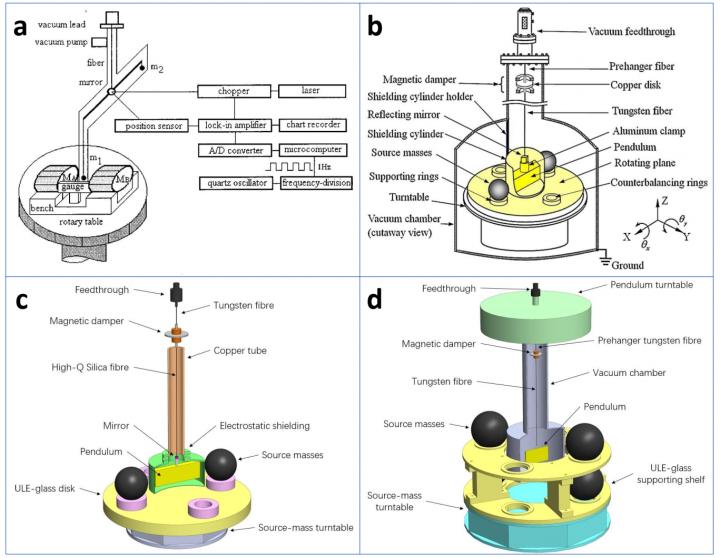
The measurement process, results and advantages and disadvantages of eleven values of G, which are adopted in CODATA-2014 after the year 2000, are described and analyzed in detail. Meanwhile, the values of G, which were obtained by the co-author’s research team, are described systematically and comprehensively, the schematic diagram of four experimental devices are shown as follow. Especially the latest two values published in 2018. “an improved experiment with high accuracy and high confidence level needed to be carried out.” they state. “These two G values of HUST-18 experiment with different methods have the smallest uncertainties reported until now, and both agree with each other within a 3σ range. S. Schlamminger from National Institute of Standards and Technology published the views to emphasize that our study was an example of excellent craftsmanship in precision measurements”
“Why is the scatter of the G values so large? In principle, there are two possibilities in science and technology that can explain the obvious inconsistency.” They add. “The first is that there could be the systematic errors which are not fully understood exist in some or all of the experiments.” “The second possibility is that there might be some unknown physical mechanism to explain the discrepancy of G values.”
“For the future development of G measurement, the main target should be to reduce the discrepancy of every values of G.” the scientists expect. “Every groups need to repeat their experiments with the same method and the same devices, and should make much more effort to estimate the potential systematic errors.” “After that, different groups should strengthen the international cooperation to discuss the possible undiscovered systematic errors among different methods.” Finally, they hope that “more and more scientists could be involved in G measurement and the problem of “Big G” can be solved in the near future”
###
This research received funding from the National Natural Science Foundation of China, the National Basic Research Program of China and the National Precise Gravity Measurement Facility.
See the article:
Chao Xue, Jian-Ping Liu, Qing Li, Jun-Fei Wu, Shan-Qing Yang, Qi Liu, Cheng-Gang Shao, Liang-Cheng Tu, Zhong-Kun Hu, and Jun Luo
Precision Measurement of the Newtonian Gravitational Constant
Natl Sci Rev nwaa165
https:/
Media Contact
Shan-Qing Yang
[email protected]
Related Journal Article
http://dx.