Credit: L. Brian Stauffer
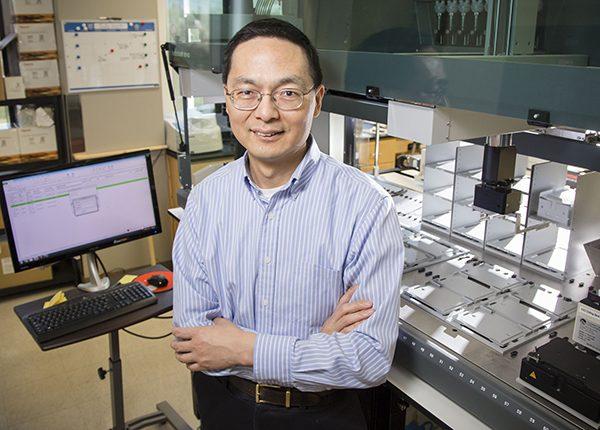
A team led by Steven L. Miller Chair professor of chemical and biomolecular engineering at the University of Illinois, Huimin Zhao, was awarded a five-year $20 million grant from the National Science Foundation (NSF) for the NSF Artificial Intelligence (AI) Institute for Molecular Discovery, Synthetic Strategy and Manufacturing (Molecule Maker Lab Institute or MMLI). The multi-institutional team consists of researchers and collaborators from the University of Illinois Urbana-Champaign, University Laboratory High School, Ulsan National Institute of Science and Technology, Northwestern University, Penn State, and Rochester Institute of Technology.
The MMLI focuses on development of new AI-enabled tools, such as AlphaSynthesis, to accelerate automated chemical synthesis and advance the discovery and manufacture of novel materials and bioactive compounds. Researchers use the data generated from the analysis of these molecules to guide further development of synthesis planning and catalyst design tools using AI and machine learning. The institute also serves as a training ground for the next generation of scientists with combined expertise in AI, chemistry, and bioengineering.
“The MMLI is a first-of-its-kind research infrastructure that will have a powerful impact on the U.S. research community,” said Zhao, a member of the Carl R. Woese Institute for Genomic Biology at Illinois. “This proposed infrastructure will respond to high-priority needs of communities seeking to 1) discover and optimize a wide range of molecular functions (Molecules), 2) harness the power of data to advance the science of molecular synthesis (Data), and 3) inspire a broad audience of scientists, teachers, students, and citizen scientists to participate in the process of molecular innovation (Open Door). The MMLI will revolutionize the way chemistry is taught and capture the imagination of a new generation of molecule makers.”
The NSF is establishing five new AI institutes to accelerate research, expand America’s workforce, and transform society in the decades to come. Enabled by sustained federal investment and channeled toward issues of national importance, continued advancement in AI research holds the potential for further economic impact and improvements in quality of life.
With an investment of over $100 million over the next five years, NSF’s AI Institutes represent the nation’s most significant federal investment in AI research and workforce development to date. The $20 million investment in each of five NSF AI institutes is just the beginning, with more institute announcements anticipated in the coming years.
“Recognizing the critical role of AI, NSF is investing in collaborative research and education hubs, such as the NSF MMLI anchored at the Carl R. Woese Institute for Genomic Biology at the University of Illinois Urbana-Champaign, which will bring together academia, industry, and government to unearth profound discoveries and develop new capabilities advancing American competitiveness for decades to come,” said NSF Director Sethuraman Panchanathan. “Just as prior NSF investments enabled the breakthroughs that have given rise to today’s AI revolution, the awards being announced today will drive discovery and innovation that will sustain American leadership and competitiveness in AI for decades to come.”
“Over the past decade there have been major advances in both AI and automated chemical and biochemical synthesis, making the timing for the launch of the MMLI both judicious and urgent,” said Zhao. “Synergistically integrating these powerful disciplines now has the potential to dramatically accelerate and advance the manufacturing and discovery of molecules with important functions that address major unsolved problems in society. Not doing so would result in a major missed opportunity for the U.S. research community.”
###
Media Contact
Nicholas Vasi
[email protected]
Original Source
https:/