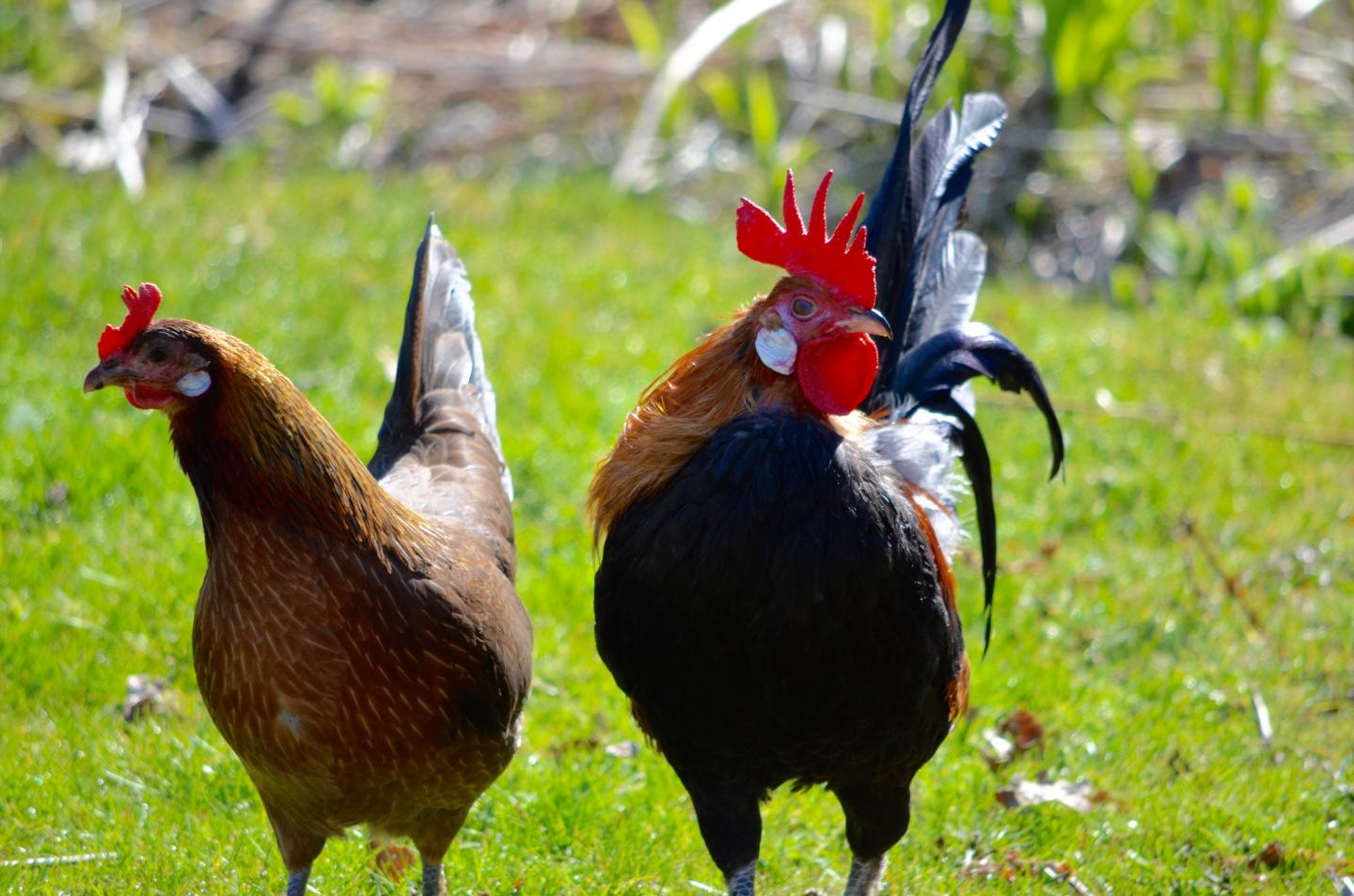
Credit: Per Jensen
Researchers from Linköping University suggest a process by which the timid junglefowl from the rain forest could have become today’s domesticated chicken. When the scientists selectively bred the junglefowl with least fear of humans for 10 generations, the offspring acquired smaller brains and found it easier to become accustomed to frightening but non-hazardous events. The results shed new light over how domestication may have changed animals so much in a relatively short time.
Chickens are the most common birds on Earth. There are currently more than 20 billion individuals on the planet. All of them have come from the Red Junglefowl, originally found in south-east Asia. This species was tamed and domesticated by humans approximately 10,000 years ago. The results of the current study show that when our ancestors selected the tamest individuals for breeding, they may at the same time have unconsciously selected birds with a different brain – one that may have been more suitable for a life among humans. The findings are published in Royal Society Open Science.
Researchers Rebecca Katajamaa and Per Jensen started with a group of wild Red Junglefowl and selected as parents the birds that showed least fear of humans in a standard test. The breeding experiment was conducted for 10 generations. The birds that showed greatest fear of humans were placed into a second group. The researchers believe that they have in this way imitated the factor that must have been the most important during early domestication, namely that it was possible to tame the animals.
A somewhat unexpected result of the breeding was that the brains of the domesticated birds gradually became smaller relative to body size, which mirrors what has happened to modern domesticated chickens during the domestication process. The change was particularly pronounced in the brain stem, a primitive part of the brain that is involved in, among other things, certain stress reactions. The brain stem was relatively smaller in animals that were not overly timid.
The scientists carried out two behavioural experiments, to determine whether the difference in brain size and composition affected the ability of the fowl to learn. One test investigated how rapidly the birds became accustomed to something that could be experienced as frightening, but which was actually non-hazardous, in this case a flashing light. The tame birds became accustomed and stopped reacting to the stimulus significantly more rapidly.
“We believe that the ability to become accustomed rapidly is beneficial for the birds that are to live among humans, where events that are unknown and frightening, but not dangerous, are part of everyday life”, says Rebecca Katajamaa, doctoral student in the Department of Physics, Chemistry and Biology at Linköping University.
The researchers also investigated whether the birds differed in the ability to learn to associate two things with each other, such as coupling a certain pattern with food. This process is known as “associative learning”. However, they found no differences between the two groups.
It is not possible to say whether the differences in behaviour shown in the study are directly connected with the differences in brain size and composition. The researchers plan to investigate this in more detail.
“Our study not only sheds light on a possible process by which chickens – and possibly other species – become domesticated. It may also give new insight into how the structure of the brain is connected with differences in behaviour between individuals and species”, says Per Jensen, professor in the Department of Physics, Chemistry and Biology at Linköping University.
###
The research has received financial support from the Swedish Research Council.
The article: “Selection for reduced fear in Red Junglefowl changes brain composition and affects fear memory”, Katajamaa R, Jensen P. (2020), Royal Society Open Science 7: 200628, published online 26 August 2020, doi: 10.1098/rsos.200628
https:/
Media Contact
Per Jensen
[email protected]
Original Source
https:/
Related Journal Article
http://dx.