Super-Kamiokande gets an upgrade to see neutrinos from ancient supernovae
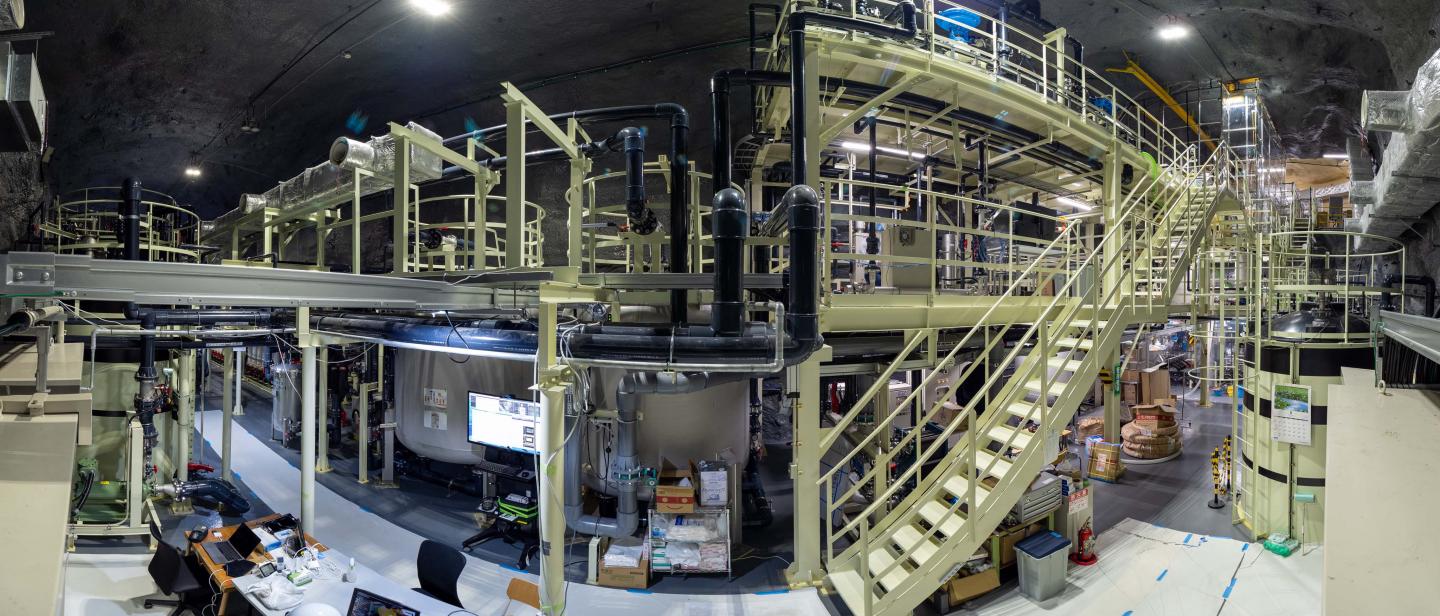
Credit: © 2020 Kamioka Observatory, ICRR (Institute for Cosmic Ray Research), The University of Tokyo
The Super-Kamiokande neutrino observatory can detect different kinds of neutrino-related phenomena, including supernova explosions in our own galaxy. It is normally full of pure water, but it has recently received a dose of the rare-earth element gadolinium. This will give the observatory the ability to see supernova explosions in more distant galaxies as well.
Buried 1 kilometer underground near the city of Hida in central Japan is an enormous cylinder 40 meters tall and filled with 50 million liters of water. This is the Super-Kamiokande neutrino observatory, and since 1996 it has been observing neutrinos, subatomic particles, from solar, extrasolar, terrestrial and artificial sources. It detects these particles with highly sensitive optical sensors which record minute flashes of light that occur when a neutrino interacts with a molecule of water.
The sensors need to be very sensitive as neutrino events are hard to record. Neutrinos have such little mass that they mostly pass through ordinary matter as if it wasn’t there, interacting only rarely. By building the observatory deep underground, it helps block other kinds of particles and radiation but allows neutrinos to enter the chamber, sort of like a filter. The specific characteristics of the flashes of light tell researchers about the kind of neutrino they’ve just detected, as there are several different types relating to various phenomena that create them.
Researchers are keen to observe anti-electron neutrinos in particular as those can tell us a surprising number of things about our universe. Although a supernova in our own galaxy has been detected before, they occur only rarely, several decades apart. So researchers look further afield to supernovae that happened billions of years ago in distant galaxies, but there’s a catch.
Neutrino signals from these distant supernovae are very weak and hard to distinguish from background noise. The telltale flashes that signify a supernova event need a boost to help researchers extract the signal. The solution is to add an impurity to the water that creates bright flashes in response to neutrons caused by antielectron neutrino interactions but does not otherwise affect the observations at Super-Kamiokande.
Researchers have mixed several tons of the rare-earth element gadolinium into the otherwise pure water. Gadolinium interacts with neutrons produced by certain neutrino interactions, and gives off an easily detectable gamma-ray flash. These flashes indirectly inform researchers about the neutrinos that caused them. Initially, 13 tons of a gadolinium compound have been added, giving a gadolinium concentration of about 0.01%. Researchers will increase this to further improve sensitivity to neutrino events.
“With a gadolinium concentration of 0.01% Super-Kamiokande should detect neutrons from neutrino collisions with 50% efficiency,” said Professor Masayuki Nakahata who is overseeing this project. “We plan to increase the concentration in a few years to increase efficiency. I hope we can observe neutrinos from ancient supernovae within a few years.”
###
Useful links
Super-Kamiokande – http://www-sk.
Institute for Cosmic Ray Research – https:/
Research Contact
Professor Masayuki Nakahata
Institute for Cosmic Ray Research, The University of Tokyo
5-1-5 Kashiwa-no-Ha, Kashiwa City, Chiba, 277-8582, Japan
Email: [email protected]
Press Contact
Mr. Rohan Mehra
Division for Strategic Public Relations, The University of Tokyo
7-3-1 Hongo, Bunkyo-ku, Tokyo 113-8654, JAPAN
Tel: +81-(0)80-9707-8450
Email: [email protected]
About the University of Tokyo
The University of Tokyo is Japan’s leading university and one of the world’s top research universities. The vast research output of some 6,000 researchers is published in the world’s top journals across the arts and sciences. Our vibrant student body of around 15,000 undergraduate and 15,000 graduate students includes over 4,000 international students. Find out more at http://www.
Media Contact
Professor Masayuki Nakahata
[email protected]
Original Source
https:/