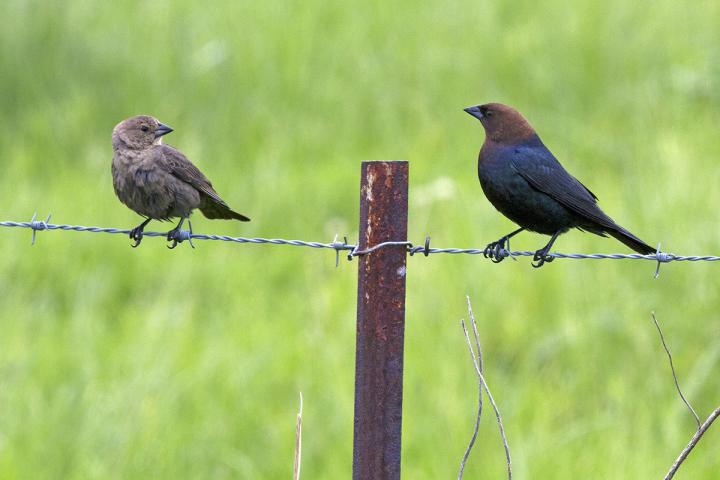
Credit: Photo by Michael Jeffords and Sue Post
CHAMPAIGN, Ill. — Some birds lay their eggs in the nests of other bird species and let the host parents raise their young. A new study finds that in times of environmental flux, these brood parasites “diversify their portfolios,” minimizing the risks of their unorthodox lifestyle by increasing the number and variety of hosts they select as adoptive parents.
“We found that, in unstable environments, brood parasites choose to not put all their eggs in one basket,” said study lead author Nicholas Antonson, a Ph.D. student at the University of Illinois, Urbana Champaign. “Our results are consistent with the idea that brood parasites diversify their reproductive risk in areas that are ecologically, behaviorally or environmentally unpredictable.”
Antonson led the study with Mark Hauber, a U. of I. professor of evolution, ecology and behavior; Dustin Rubenstein, a professor of environmental biology at Columbia University; and Carlos Botero, a professor of biology at Washington University in St. Louis. They report their findings in the journal Nature Communications.
“This research begins to answer a longstanding question about how species first interact and then coevolve in environments that are also changing,” Hauber said. “Theory suggests that in unpredictable environments, predators and parasites should rely on a greater number and variety of prey hosts. But with so many variables in flux, this is a challenging thing to study.”
Brood parasite success depends on the host’s acceptance of the outsider’s eggs and its ability to raise the young. Some birds learn to recognize that the foreign eggs are different and eject them or build new nests. Others seem not to notice. They incubate, hatch and care for the parasitic offspring as if they were their own.
Several other factors could influence how many hosts and which host species a brood parasite targets. The host must be in egg-laying mode when the interloper comes to call. If only one foster parent is involved in taking care of the young, its nest might not succeed as well as one with two parents present. But having two parents around makes it more difficult for parasites to get into the nest to lay their eggs.
“Similarly, if the host returns from a long migratory trip and begins to nest right away, the parasite might have fewer chances to locate its nest for sneaking in the extra egg,” Hauber said. “Variability in temperature and precipitation during the breeding season is another potential influence.”
To account for these factors, the researchers aggregated published and publicly available data on 81 of the nearly 100 species of avian brood parasites, including cowbirds, cuckoos, black-headed ducks, indigobirds and honeyguides. They used records from the Field Museum of Natural History in Chicago to determine the number and diversity of hosts each brood parasite used in different contexts. The team also accounted for the relative abundance of published research on different species, “as a number of brood parasites closer to the equator remain poorly studied,” Antonson said.
They found that in unpredictable environments, brood parasites target more – and more diverse – hosts. The parasites take advantage of as many host species as possible when opportunity allows. The team found a particularly pronounced relationship between temperature variability and bet-hedging.
“In areas where temperatures are stable, brood parasites tend to specialize on fewer and less diverse host species. Those hosts also tend to build more complex and potentially safer nests,” Antonson said. “But as the thermal environment becomes more uncertain, the evolutionary pattern that we see is that they spread around the risk of offspring survival by drawing from a larger and more diverse pool of host species.”
The new findings offer insight into the evolution of specialization and generalization, Hauber said. They also suggest that “ecological risks and environmental unpredictability favor the evolution of bet-hedging.”
###
Editor’s notes:
To reach Nicholas Antonson, email [email protected].
To reach Mark Hauber, email [email protected].
The paper “Ecological uncertainty favours the diversification of host use in avian brood parasites” is available from the U. of I. News Bureau.
Michael Jeffords and Susan Post are wildlife photographers and research affiliates of the Illinois Natural History Survey at the Prairie Research Institute of the U. of I. Their photographs are available here.
Media Contact
Diana Yates, Life Sciences Editor, U. of I. News Bureau
[email protected]
Related Journal Article
http://dx.