• HOME
  • NEWS
  • EXPLORE
    • CAREER
      • Companies
      • Jobs
    • EVENTS
    • iGEM
      • News
      • Team
    • PHOTOS
    • VIDEO
    • WIKI
  • BLOG
  • COMMUNITY
    • FACEBOOK
    • INSTAGRAM
    • TWITTER
Saturday, March 28, 2026
BIOENGINEER.ORG
No Result
View All Result
  • Login
  • HOME
  • NEWS
  • EXPLORE
    • CAREER
      • Companies
      • Jobs
        • Lecturer
        • PhD Studentship
        • Postdoc
        • Research Assistant
    • EVENTS
    • iGEM
      • News
      • Team
    • PHOTOS
    • VIDEO
    • WIKI
  • BLOG
  • COMMUNITY
    • FACEBOOK
    • INSTAGRAM
    • TWITTER
  • HOME
  • NEWS
  • EXPLORE
    • CAREER
      • Companies
      • Jobs
        • Lecturer
        • PhD Studentship
        • Postdoc
        • Research Assistant
    • EVENTS
    • iGEM
      • News
      • Team
    • PHOTOS
    • VIDEO
    • WIKI
  • BLOG
  • COMMUNITY
    • FACEBOOK
    • INSTAGRAM
    • TWITTER
No Result
View All Result
Bioengineer.org
No Result
View All Result
Home NEWS Science News Chemistry

Researchers measure the global magnetic field in solar corona for the first time

Bioengineer by Bioengineer
August 20, 2020
in Chemistry
Reading Time: 2 mins read
0
IMAGE
Share on FacebookShare on TwitterShare on LinkedinShare on RedditShare on Telegram

IMAGE

Credit: YANG Zihao and TIAN Hui

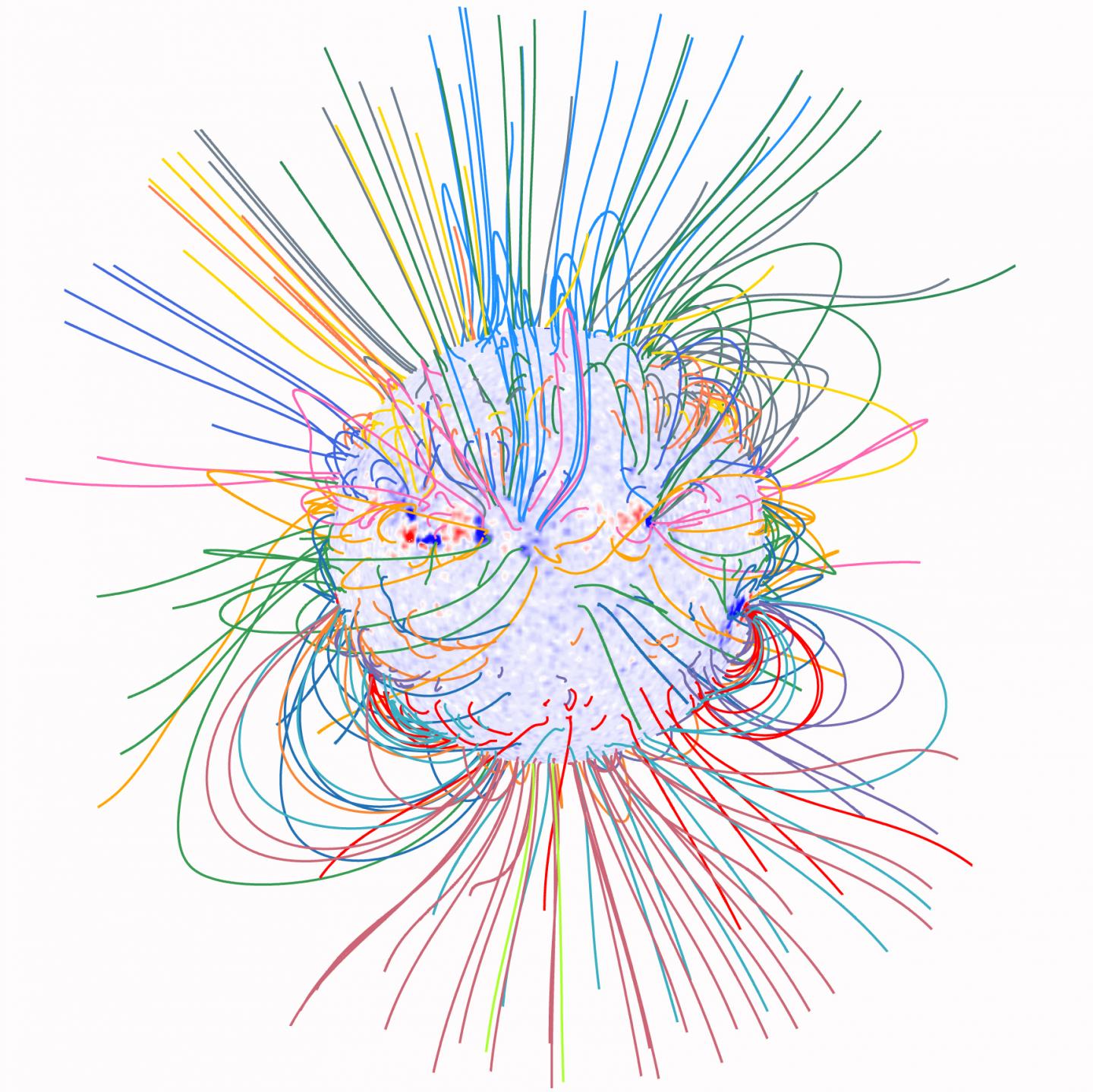
The Sun is a magnetized star. Its magnetic field is essentially three dimensional and it occupies all layers of the solar atmosphere. However, routine measurements of the solar magnetic field have only been achieved at the photospheric level, or the solar surface.

Lacking precise knowledge about the magnetic field in the outermost solar atmosphere, the corona, has impeded our understanding of the solar magnetism and many phenomena in the solar atmosphere.

An international team led by TIAN Hui, a professor from both Peking University and National Astronomical Observatories of Chinese Academy of Sciences (NAOC), has measured the global magnetic field of the solar corona for the first time. The study was published in Science on August 7.

The team used observations from the Coronal Multi-channel Polarimeter (CoMP), an instrument operated by the High Altitude Observatory, National Center for Atmospheric Research, USA.

More than 20 years ago, a technique called coronal seismology or magneto-seismology has been introduced for coronal magnetic field measurements. This method makes use of some types of oscillations or waves that are observed in coronal structures.

However, these oscillations/waves are just occasionally observed in small regions of the corona, and thus their potential for magnetic field measurements is limited.

CoMP is a coronagraph with a 20-cm aperture. It can observe the solar corona using the Fe XIII 1074.7 nm and 1079.8 nm infrared spectral lines. The Doppler image sequence obtained from CoMP observations often reveal the prevalence of propagating periodic disturbances, indicating the ubiquitous presence of transverse plasma waves in the corona.

The team applied the magneto-seismology method to these pervasive waves. They extended the previously developed wave-tracking technique to the whole field of view, and obtained the distribution of the wave propagation speed in the global corona.

They also obtained a global map of the coronal density from observations of the two Fe XIII lines. Combing the maps of wave propagation speed and density, they mapped the magnetic field in the global corona.

“By applying this technique to CoMP-like instruments in the future, global coronal magnetic field maps could be routinely obtained, filling in the missing part of the measurements of the Sun’s global magnetism,” said Prof. TIAN.

Such measurements could provide critical information to advance our understanding of the physical mechanisms responsible for solar eruptions and the 11-year sunspot cycle.

###

Media Contact
XU Ang
[email protected]

Original Source

http://english.cas.cn/

Related Journal Article

http://dx.doi.org/10.1126/science.abb4462

Tags: AstrophysicsSpace/Planetary ScienceStars/The Sun
Share12Tweet8Share2ShareShareShare2

Related Posts

Isolated H2-Reduced Clusters Boost CO2-to-Methanol Catalysis

Isolated H2-Reduced Clusters Boost CO2-to-Methanol Catalysis

March 25, 2026
blank

Physicists Identify Electronic Drivers Behind Flat Band Quantum Materials

March 21, 2026

Würzburg Chemistry Professor Claudia Höbartner Receives Prestigious Honor

March 20, 2026

Scientists Reveal How Magnets Control Metamaterial Behavior

March 20, 2026
Please login to join discussion

POPULAR NEWS

  • blank

    Revolutionary AI Model Enhances Precision in Detecting Food Contamination

    96 shares
    Share 38 Tweet 24
  • Imagine a Social Media Feed That Challenges Your Views Instead of Reinforcing Them

    1004 shares
    Share 397 Tweet 248
  • Uncovering Functions of Cavernous Malformation Proteins in Organoids

    54 shares
    Share 22 Tweet 14
  • Promising Outcomes from First Clinical Trials of Gene Regulation in Epilepsy

    51 shares
    Share 20 Tweet 13

About

We bring you the latest biotechnology news from best research centers and universities around the world. Check our website.

Follow us

Recent News

In-Sensor Cryptography Links Physical Process to Digital Identity

Can Psychosocial Factors Influence Cancer Risk?

Depression Factors in Elderly: Pre vs. Post-COVID Analysis

Subscribe to Blog via Email

Enter your email address to subscribe to this blog and receive notifications of new posts by email.

Join 78 other subscribers
  • Contact Us

Bioengineer.org © Copyright 2023 All Rights Reserved.

Welcome Back!

Login to your account below

Forgotten Password?

Retrieve your password

Please enter your username or email address to reset your password.

Log In
No Result
View All Result
  • Homepages
    • Home Page 1
    • Home Page 2
  • News
  • National
  • Business
  • Health
  • Lifestyle
  • Science

Bioengineer.org © Copyright 2023 All Rights Reserved.