• HOME
  • NEWS
  • EXPLORE
    • CAREER
      • Companies
      • Jobs
    • EVENTS
    • iGEM
      • News
      • Team
    • PHOTOS
    • VIDEO
    • WIKI
  • BLOG
  • COMMUNITY
    • FACEBOOK
    • INSTAGRAM
    • TWITTER
Saturday, February 7, 2026
BIOENGINEER.ORG
No Result
View All Result
  • Login
  • HOME
  • NEWS
  • EXPLORE
    • CAREER
      • Companies
      • Jobs
        • Lecturer
        • PhD Studentship
        • Postdoc
        • Research Assistant
    • EVENTS
    • iGEM
      • News
      • Team
    • PHOTOS
    • VIDEO
    • WIKI
  • BLOG
  • COMMUNITY
    • FACEBOOK
    • INSTAGRAM
    • TWITTER
  • HOME
  • NEWS
  • EXPLORE
    • CAREER
      • Companies
      • Jobs
        • Lecturer
        • PhD Studentship
        • Postdoc
        • Research Assistant
    • EVENTS
    • iGEM
      • News
      • Team
    • PHOTOS
    • VIDEO
    • WIKI
  • BLOG
  • COMMUNITY
    • FACEBOOK
    • INSTAGRAM
    • TWITTER
No Result
View All Result
Bioengineer.org
No Result
View All Result
Home NEWS Science News

A new iron based superelastic alloy capable of withstanding extreme temperatures

Bioengineer by Bioengineer
August 20, 2020
in Science News
Reading Time: 2 mins read
0
IMAGE
Share on FacebookShare on TwitterShare on LinkedinShare on RedditShare on Telegram

IMAGE

Credit: Tohoku University

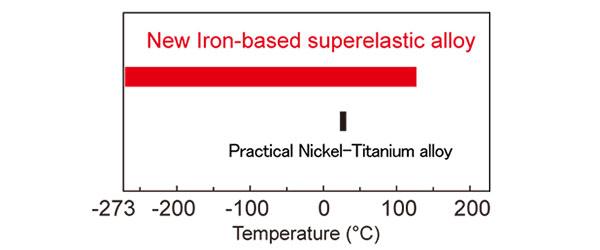
Researchers from Tohoku University’s Graduate School of Engineering have discovered a novel iron-based superelastic alloy (SEA) capable of withstanding extreme temperatures -both high and low.

SEAs are found in a wide variety of commercial applications because of their superelasticity, allowing them to regain their original shape. Superelasticity occurs when the metal undergoes deformation at the point known as critical stress.

Generally, SEAs have a positive temperature dependence; the critical stress increases as the temperature rises. Conventional metal-based SEAs such as Ti-Ni, cannot be used at temperatures lower than -20C or higher than 80C and are costly to make. This limits their application to the form of thin wires or tubes.

Associate Professor at Tohoku University, Toshihiro Omori and his team developed an iron-based SEA system, known as Fe-Mn-Al-Cr-Ni. This cost-effective SEA can also operate at a much wider temperature range.

A significant advantage of the new SEA is its controllable temperature dependence. Increasing the amount of Chromium allowed the researchers to change the temperature dependence from a positive to a negative. Balancing the Chromium content resulted in zero temperature dependence with the critical stress remaining almost constant at various temperatures.

The discovery possesses wide-spread application for outer-space exploration given the large temperature fluctuations that occur,” says Professor Omori.”

Omori points to the fact that NASA is developing a superelastic tire that can withstand excessive deformation for Moon and Mars missions. The temperature differences between night and day on the Moon and Mars are -170C to 120C and -150C to 20C respectively.

“Yet, the new, SEA’s usage does not stop there.” Professor Omori adds, “It can potentially be used in tension braces in buildings or column elements in bridges – providing greater resistance to earthquakes.”

The discovery possesses wide-spread application for outer-space exploration given the large temperature fluctuations that occur,” says Professor Omori.”

Omori points to the fact that NASA is developing a superelastic tire that can withstand excessive deformation for Moon and Mars missions. The temperature differences between night and day on the Moon and Mars are -170C to 120C and -150C to 20C respectively.

“Yet, the new, SEA’s usage does not stop there.” Professor Omori adds, “It can potentially be used in tension braces in buildings or column elements in bridges – providing greater resistance to earthquakes.”

###

Media Contact
Toshihiro Omori
[email protected]

Related Journal Article

http://dx.doi.org/10.1126/science.abc1590

Tags: Chemistry/Physics/Materials SciencesComputer ScienceTechnology/Engineering/Computer Science
Share12Tweet8Share2ShareShareShare2

Related Posts

Evaluating Pediatric Emergency Care Quality in Ethiopia

February 7, 2026

TPMT Expression Predictions Linked to Azathioprine Side Effects

February 7, 2026

Improving Dementia Care with Enhanced Activity Kits

February 7, 2026

Decoding Prostate Cancer Origins via snFLARE-seq, mxFRIZNGRND

February 7, 2026
Please login to join discussion

POPULAR NEWS

  • Robotic Ureteral Reconstruction: A Novel Approach

    Robotic Ureteral Reconstruction: A Novel Approach

    82 shares
    Share 33 Tweet 21
  • Digital Privacy: Health Data Control in Incarceration

    63 shares
    Share 25 Tweet 16
  • Study Reveals Lipid Accumulation in ME/CFS Cells

    57 shares
    Share 23 Tweet 14
  • Breakthrough in RNA Research Accelerates Medical Innovations Timeline

    53 shares
    Share 21 Tweet 13

About

We bring you the latest biotechnology news from best research centers and universities around the world. Check our website.

Follow us

Recent News

Evaluating Pediatric Emergency Care Quality in Ethiopia

TPMT Expression Predictions Linked to Azathioprine Side Effects

Improving Dementia Care with Enhanced Activity Kits

Subscribe to Blog via Email

Success! An email was just sent to confirm your subscription. Please find the email now and click 'Confirm' to start subscribing.

Join 73 other subscribers
  • Contact Us

Bioengineer.org © Copyright 2023 All Rights Reserved.

Welcome Back!

Login to your account below

Forgotten Password?

Retrieve your password

Please enter your username or email address to reset your password.

Log In
No Result
View All Result
  • Homepages
    • Home Page 1
    • Home Page 2
  • News
  • National
  • Business
  • Health
  • Lifestyle
  • Science

Bioengineer.org © Copyright 2023 All Rights Reserved.