• HOME
  • NEWS
  • EXPLORE
    • CAREER
      • Companies
      • Jobs
    • EVENTS
    • iGEM
      • News
      • Team
    • PHOTOS
    • VIDEO
    • WIKI
  • BLOG
  • COMMUNITY
    • FACEBOOK
    • INSTAGRAM
    • TWITTER
Monday, March 30, 2026
BIOENGINEER.ORG
No Result
View All Result
  • Login
  • HOME
  • NEWS
  • EXPLORE
    • CAREER
      • Companies
      • Jobs
        • Lecturer
        • PhD Studentship
        • Postdoc
        • Research Assistant
    • EVENTS
    • iGEM
      • News
      • Team
    • PHOTOS
    • VIDEO
    • WIKI
  • BLOG
  • COMMUNITY
    • FACEBOOK
    • INSTAGRAM
    • TWITTER
  • HOME
  • NEWS
  • EXPLORE
    • CAREER
      • Companies
      • Jobs
        • Lecturer
        • PhD Studentship
        • Postdoc
        • Research Assistant
    • EVENTS
    • iGEM
      • News
      • Team
    • PHOTOS
    • VIDEO
    • WIKI
  • BLOG
  • COMMUNITY
    • FACEBOOK
    • INSTAGRAM
    • TWITTER
No Result
View All Result
Bioengineer.org
No Result
View All Result
Home NEWS Science News Biology

DNA damage triggers reprogramming into stem cells

Bioengineer by Bioengineer
August 17, 2020
in Biology
Reading Time: 2 mins read
0
IMAGE
Share on FacebookShare on TwitterShare on LinkedinShare on RedditShare on Telegram

Discovery of a new adaptive strategy that plants use under harsh environments
IMAGE

Credit: NIBB

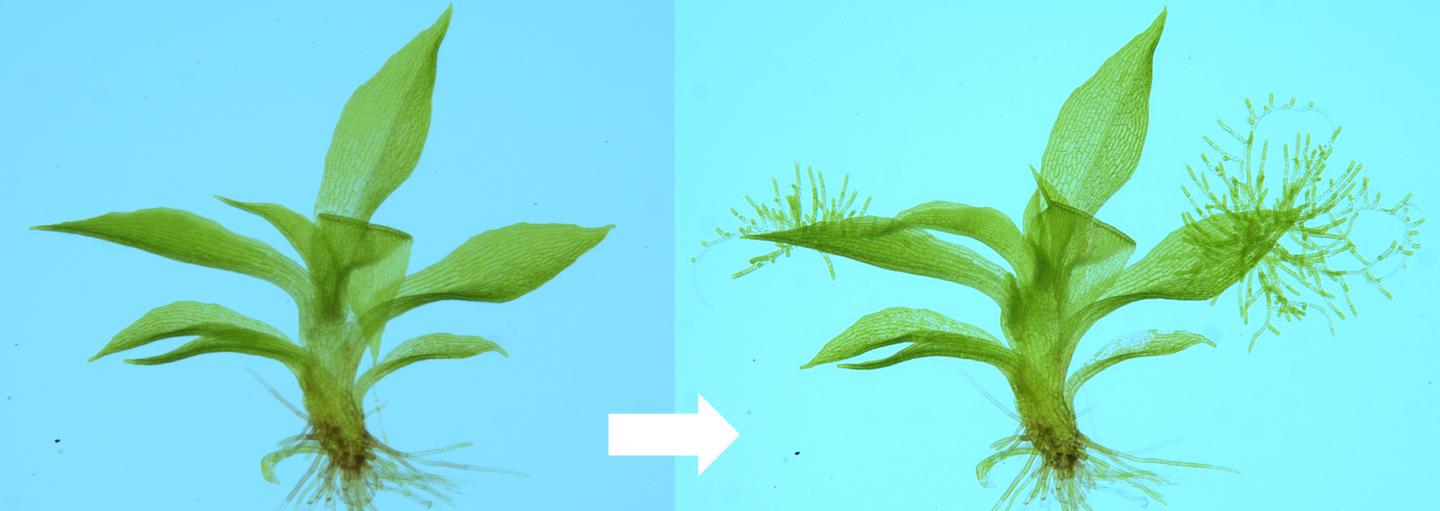
A joint research team from the National Institute for Basic Biology (NIBB) in Japan, Huazhong Agricultural University in China, and the Czech Academy of Sciences in the Czech Republic has discovered that DNA damage causes cells to reprogram themselves into stem cells and regenerate new plant bodies in the moss Physcomitrella patens. The researchers describe this phenomenon as a unique environmental adaptation of plants.

In animals, cells with severe DNA damage undergo apoptosis–cell death–and are eliminated. These new results published in Nature Plants tell a different story for moss cells. Ms. Nan Gu, a NIBB Special Inter-University Researcher who is a graduate student at Huazhong Agricultural University under the mentorship of Dr. Chunli Chen, and her collaborators discovered that when DNA of the moss is damaged, the DNA is immediately repaired. Furthermore, the cells with repaired DNA become stem cells, which can produce an entire plant body, similar to fertilized egg cells. Nan Gu says, “I was shocked by the result, because animal cells select to die, but plant cells select to produce new offspring”.

After Physcomitrella plants were soaked in a DNA-damaging solution for 6 hours, their DNA was severely broken. However, the damaged DNA was repaired to almost its original state within one day. After that, the STEMIN1 gene, a master regulator of reprogramming was triggered. STEMIN1-positive cells eventually became stem cells and went on to form whole plants with stems and leaves.

“It has been known that, in plants, differentiated cells around dead cells can become stem cells. However, this is the first discovery that differentiated cells with damaged DNA themselves become stem cells”, explains Dr. Yosuke Tamada, a co-first author of this study.

“This phenomenon we discovered is a strategy for environmental adaptation, especially in plants, which are not able to escape from adverse environments as quickly as animals”, said Professor Mitsuyasu Hasebe from NIBB, who led the research team.

###

Paper Information

“DNA damage triggers reprogramming of differentiated cells into stem cells in Physcomitrella” by Nan Gu, Yosuke Tamada, Akihiro Imai, Gergo Palfalvi, Yukiko Kabeya, Shuji Shigenobu, Masaki Ishikawa, Karel J. Angelis, Chunli Chen, and Mitsuyasu Hasebe has been published in Nature Plants at DOI: https://doi.org/10.1038/s41477-020-0745-9

Media Contact
NIBB Office of Public Relations
[email protected]

Original Source

https://www.nibb.ac.jp/en/press/2020/08/17.html

Related Journal Article

http://dx.doi.org/10.1038/s41477-020-0745-9

Tags: BiologyCell BiologyEvolutionMolecular BiologyPlant Sciences
Share12Tweet8Share2ShareShareShare2

Related Posts

Squirrels Scale Greater Heights to Access Superior Snacks

Squirrels Scale Greater Heights to Access Superior Snacks

March 30, 2026
New Zebrafish Study Sheds Light on Why Haploid Fish Embryos Often Fail to Fully Develop

New Zebrafish Study Sheds Light on Why Haploid Fish Embryos Often Fail to Fully Develop

March 30, 2026

Boron Neutron Capture Therapy: A Breakthrough in Cancer Treatment

March 29, 2026

Bacteria Integrate Polyfluoroalkyl Carboxylates into Membranes

March 29, 2026
Please login to join discussion

POPULAR NEWS

  • blank

    Revolutionary AI Model Enhances Precision in Detecting Food Contamination

    96 shares
    Share 38 Tweet 24
  • Imagine a Social Media Feed That Challenges Your Views Instead of Reinforcing Them

    1005 shares
    Share 397 Tweet 248
  • Promising Outcomes from First Clinical Trials of Gene Regulation in Epilepsy

    51 shares
    Share 20 Tweet 13
  • Advancements in EV Battery Technology to Surpass Climate Change-Induced Degradation

    45 shares
    Share 18 Tweet 11

About

We bring you the latest biotechnology news from best research centers and universities around the world. Check our website.

Follow us

Recent News

Holistic Strategy in New Brain-Heart Guidelines Revolutionizes Chronic Disease Management

AI Reveals NPC1’s Role in COVID-19 Risk

Ultra-Broadband Soliton Microcombs Boosted by Resonant Coupling

Subscribe to Blog via Email

Success! An email was just sent to confirm your subscription. Please find the email now and click 'Confirm' to start subscribing.

Join 78 other subscribers
  • Contact Us

Bioengineer.org © Copyright 2023 All Rights Reserved.

Welcome Back!

Login to your account below

Forgotten Password?

Retrieve your password

Please enter your username or email address to reset your password.

Log In
No Result
View All Result
  • Homepages
    • Home Page 1
    • Home Page 2
  • News
  • National
  • Business
  • Health
  • Lifestyle
  • Science

Bioengineer.org © Copyright 2023 All Rights Reserved.