• HOME
  • NEWS
  • EXPLORE
    • CAREER
      • Companies
      • Jobs
    • EVENTS
    • iGEM
      • News
      • Team
    • PHOTOS
    • VIDEO
    • WIKI
  • BLOG
  • COMMUNITY
    • FACEBOOK
    • INSTAGRAM
    • TWITTER
Friday, July 3, 2026
BIOENGINEER.ORG
No Result
View All Result
  • Login
  • HOME
  • NEWS
  • EXPLORE
    • CAREER
      • Companies
      • Jobs
        • Lecturer
        • PhD Studentship
        • Postdoc
        • Research Assistant
    • EVENTS
    • iGEM
      • News
      • Team
    • PHOTOS
    • VIDEO
    • WIKI
  • BLOG
  • COMMUNITY
    • FACEBOOK
    • INSTAGRAM
    • TWITTER
  • HOME
  • NEWS
  • EXPLORE
    • CAREER
      • Companies
      • Jobs
        • Lecturer
        • PhD Studentship
        • Postdoc
        • Research Assistant
    • EVENTS
    • iGEM
      • News
      • Team
    • PHOTOS
    • VIDEO
    • WIKI
  • BLOG
  • COMMUNITY
    • FACEBOOK
    • INSTAGRAM
    • TWITTER
No Result
View All Result
Bioengineer.org
No Result
View All Result
Home NEWS Science News Biology

The behavior of therapeutic antibodies in immunotherapy

Bioengineer by Bioengineer
August 13, 2020
in Biology
Reading Time: 2 mins read
0
IMAGE
Share on FacebookShare on TwitterShare on LinkedinShare on RedditShare on Telegram

IMAGE

Credit: © Nicolas Reyes

Since the late 1990s, immunotherapy has been the frontline treatment against lymphomas where synthetic antibodies are used to stop the proliferation of cancerous white blood cells. However, in the more than 20 years since their use began, the molecular mechanisms that underlie this therapy are still little understood. For the first time, scientists from the CNRS, Institut Pasteur and Université de Bordeaux have observed the interaction between therapeutic antibodies and their target protein. The research, published in Science on 14 August 2020, describes these molecular mechanisms and opens the way to the development of new treatments.

Non-Hodgkin lymphomas are among the most common cancers affecting almost 1.5 million people globally. They cause uncontrolled proliferation of B lymphocytes, a type of white blood cell, to the detriment of healthy cells. Since the end of the 1990s, immunotherapy had been a frontline treatment using synthetic antibodies to target a protein on the surface of B lymphocytes called CD20. The body’s defences then identify these cells covered in antibodies as pathogens and destroy them.

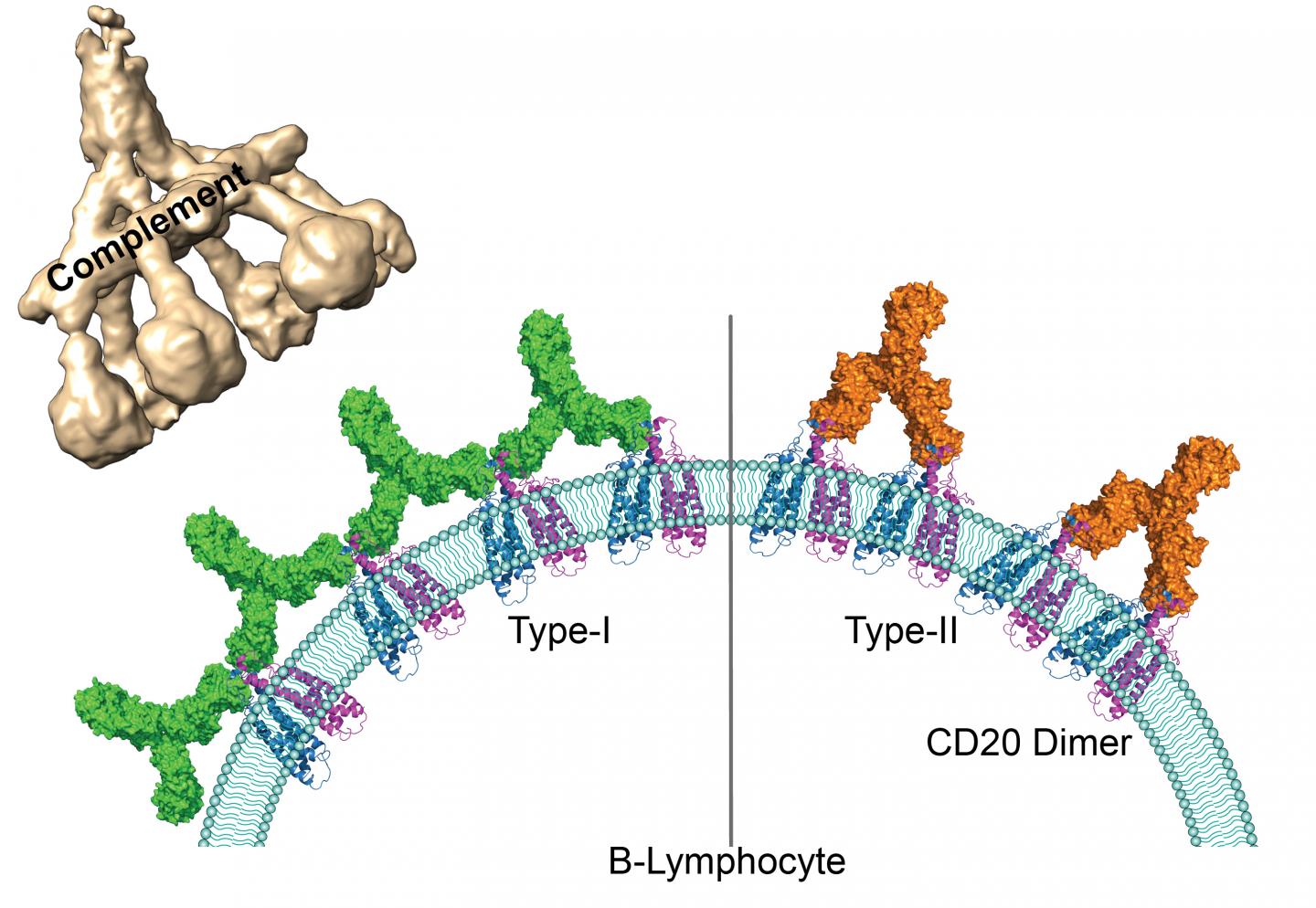
Presently, the types of therapeutic antibodies used are classified into two groups according to how many CD20 molecules they bind to and the immunity response they trigger. Antibodies from the first group have the ability to interact with twice as many CD20 molecules than antibodies from the second group and can set off a cascading immune response called a “complement pathway”. Until now, the molecular mechanisms at the root of underlying the differences between these two groups were unknown.

By using cryogenic electron microscopy, scientists from the CNRS, Institut Pasteur, and Université de Bordeaux1 were able, for the first time, to observe on an atomic level the interaction between the representatives of both groups of antibodies and their target molecules. They have shown that because of the availability of space, CD20 proteins can bind to two type 1 antibodies but to only one type 2 antibody. Due to their larger numbers on the surface of B lymphocytes, type 1 antibodies can form clusters. The team demonstrates that these clusters trigger the complement pathway which leads to the destruction of the target B lymphocytes. Type 2 antibodies, on the other hand, are thinly dispersed on the cell surface and therefore do not trigger a cascading response. Other independent immune responses are still able to destroy the cells.

Never before has the mechanism of action of therapeutic antibodies been described with such precision. This research could lead to new synthetic antibodies able to control a patient’s immune response. In addition, this description of the mechanism activating the complement pathway opens the way to new research possibilities aiming at an understanding of how immune defences work.

###

Notes:

1- With scientists from the Laboratoire de Microbiologie Fondamentale et Pathogénicité (CNRS/Université de Bordeaux), the “Humoral Immunity” laboratory (Inserm/Institut Pasteur/Sorbonne Université), the “Mécanismes des protéines membranaires”

unit (Institut Pasteur) and the European Institute of Chemistry and Biology (IECB/Université de Bordeaux).

Media Contact
François Maginiot
[email protected]

Related Journal Article

http://dx.doi.org/10.1126/science.abb8008

Tags: BiologycancerCell BiologyImmunology/Allergies/AsthmaMedicine/HealthMolecular Biology
Share12Tweet8Share2ShareShareShare2

Related Posts

Evolution-Inspired Biosensors Revolutionize Lipid Tracking in Real Time — Biology

Evolution-Inspired Biosensors Revolutionize Lipid Tracking in Real Time

July 2, 2026
New Study Reveals How to Reduce Risk of Dangerous Wildlife Encounters This Summer — Biology

New Study Reveals How to Reduce Risk of Dangerous Wildlife Encounters This Summer

July 2, 2026

Hepatic IFRD1 Alleviates Metabolic Dysfunction-Linked Steatohepatitis Through the GLUD1/α-KG Pathway

July 2, 2026

Intricate Food Webs Support Ecosystem Health and Stability

July 2, 2026
Please login to join discussion

POPULAR NEWS

  • Detection of EDCs in Breast Milk and Infant Urine Up to Six Months Highlights Early Exposure Risks

    77 shares
    Share 31 Tweet 19
  • Saying Goodbye to PGY-6: Pediatric Fellowship Realities

    103 shares
    Share 41 Tweet 26
  • New Drug Candidate Developed at McMaster Shows Potential for Treating Brain Cancer

    58 shares
    Share 23 Tweet 15
  • KTU Researchers Explore Ultrasound’s Role in Enhancing Blood Flow Beyond Diagnostics

    53 shares
    Share 21 Tweet 13

About

BIOENGINEER.ORG

We bring you the latest biotechnology news from best research centers and universities around the world. Check our website.

Follow us

Recent News

Steatosis Drives Liver Metastasis Diversity in CRC

Unlocking the Mysteries of Alzheimer’s Disease

Pensoft Introduces New Peer-Reviewed Journal of Regeneration to Advance Restorative Biology Across Species

Subscribe to Blog via Email

Enter your email address to subscribe to this blog and receive notifications of new posts by email.

Join 83 other subscribers
  • Contact Us

Bioengineer.org © Copyright 2023 All Rights Reserved.

Welcome Back!

Login to your account below

Forgotten Password?

Retrieve your password

Please enter your username or email address to reset your password.

Log In
No Result
View All Result
  • Homepages
    • Home Page 1
    • Home Page 2
  • News
  • National
  • Business
  • Health
  • Lifestyle
  • Science

Bioengineer.org © Copyright 2023 All Rights Reserved.