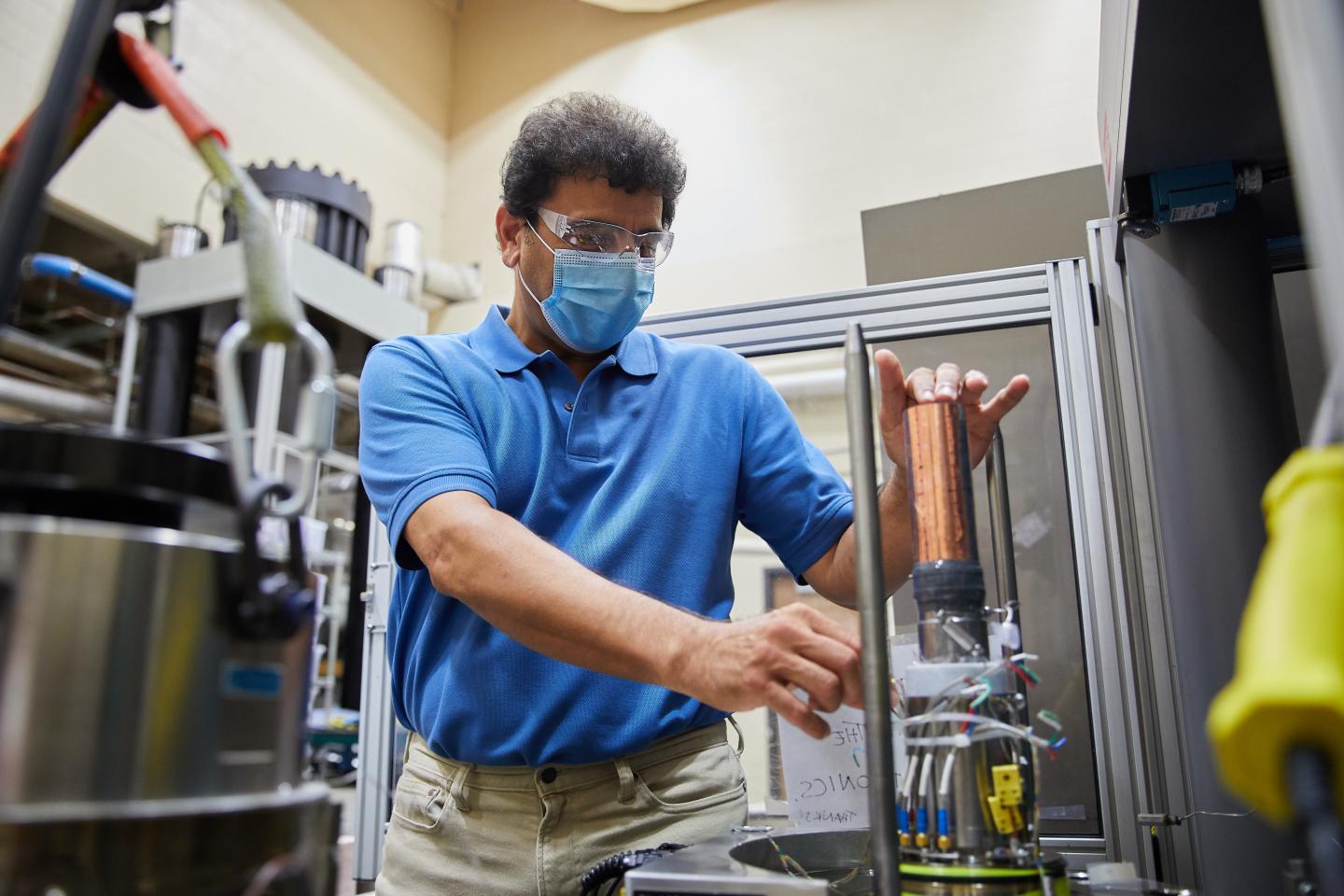
Credit: University of Oklahoma
NORMAN, OKLA. – Ahmad Ghassemi, the McCasland Chair and professor of petroleum engineering at the Mewbourne College of Earth and Energy at the University of Oklahoma, received $2.5 million of a $28 million grant from the U.S. Department of Energy with an additional $700,000 in matching funds from Coso Operating Company for a study that aims to develop technologies to increase power production from geothermal wells while decreasing production costs.
“I am very proud to hear that the Department of Energy is equipping and empowering the University of Oklahoma to pursue a groundbreaking project to unleash safe and sustainable energy,” said Congressman Tom Cole (OK-04). “Widely recognized as a center for scientific excellence and innovation, OU’s contributions will indeed be critical in honing production and refining the use of geothermal energy.”
Geothermal power is generated by wells that harness heat from the sub-surface of the earth. This heat generates steam, which can be used to create electricity. Geothermal energy is a low-carbon source of energy used around the world. While the United States is one of the world’s top producers of geothermal energy, its potential remains largely untapped.
Thanks to this support from the DOE and Coso Operating Co., Ghassemi and his collaborators will first do extensive modeling around the geothermal wells that will be used in the research. In continuous operation since 1987, these wells sit on the U.S. Navy’s Naval Air Weapons Station China Lake, which is in the heart of the Coso Volcanic Field in eastern California.
In this phase of the project, researchers will use tools ranging from traditional geological analysis to the most advanced 3D-modeling technology to understand the area. From this data, they plan to determine suitable injection rates, chemical composition and temperature to use in field tests to create fractures.
The second phase of the study moves from modeling to experimental. The team will use the modeling results to create the fracture network in the Naval Air Weapons Station China Lake geothermal wells. This will entail identifying and isolating zones in the wellbores to pressurize. The pressure will create fractures, forming the permeable fracture network.
In the final stage of the study, researchers will monitor the wells to determine flow rate improvements and the evolution of the fractures over time. Ghassemi anticipates the project will take three years.
“Ghassemi’s innovative project in support of the Department of Energy has enormous potential to open up new avenues to extract geothermal energy from the earth’s subsurface at low cost. Success in the development of this important clean energy technology will no doubt have significant, real-world impacts for Oklahoma, the nation and the world,” said Tomás Díaz de la Rubia, vice president for research and partnerships.
To make this project a reality, Ghassemi assembled a team of experts, including Steve Pye, a researcher at the University College London and researchers at the Navy Geothermal Office, as well as industry experts from Coso Operating Co., Veizades and Associates, and GeoLogica.
“We’ve assembled a highly qualified team with expertise in geothermal energy, geological field work, state-of-the-art 3D modeling, experimental capabilities, drilling and wellbore construction experience, oil and gas experience, and specific knowledge of the regional geology of the Coso Volcanic Field,” Ghassemi said.
Among the members of the team are graduate students from the Mewbourne College of Earth and Energy.
“Involvement of postdoctoral and graduate students from OU give the project a nice educational aspect as well,” said Ghassemi. “Not only will it contribute to their education, but it can potentially expand the geothermal workforce that is needed as the technology expands in the country.”
For 101 years, the Mewbourne School of Petroleum and Geological Engineering has been a national leader in the energy industry.
“Our research activities address a wide range of subsurface activities in addition to oil and gas,” said school director Runar Nygaard. “These research endeavors include geothermal engineering and carbon storage to mitigate climate change. Geothermal energy is one important aspect of a broad energy portfolio required for continuing prosperity for the United States and the world. Dr. Ghassemi’s Reservoir Geomechanics Research Group is in the forefront of this research.”
###
Media Contact
Chelsea Julian
[email protected]
Original Source
https:/