Credit: Ryan Kerney/Gettysburg College
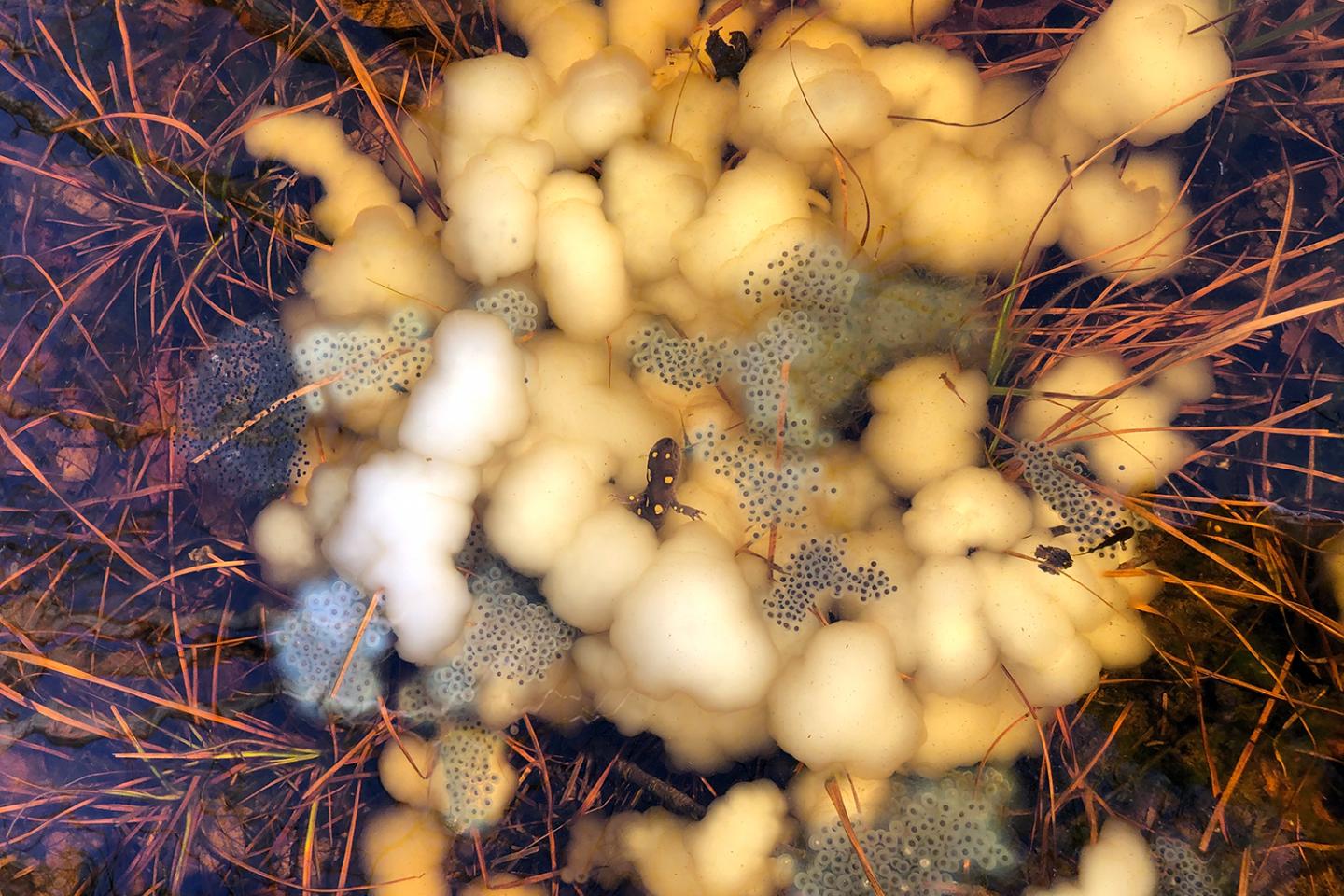
New research has revealed a surprise twist in the symbiotic relationship between a type of salamander and the alga that lives inside its eggs. A new paper in Frontiers in Microbiology reports that the eggs compete with the algae to assimilate carbon from their surroundings – a finding that could inform similar processes in the dark ocean.
Plants and animals sometimes partner up in symbiotic relationships that benefit both, such as corals that provide a protective environment for algae that live inside them, and receive oxygen and nutrients from the algae in return. Originally, scientists believed that the salamander eggs and algae may be helping one another by exchanging sugar molecules – but a series of laboratory experiments showed molecular biologist John Burns and his colleagues Solange Duhamel at the University of Arizona and Ryan Kerney at Gettysburg College that this was not the case. Burns is the newest senior research scientist at Bigelow Laboratory for Ocean Sciences, and much of his research explores how unusual situations in cell biology can inform understanding of the way larger systems function.
“Direct associations between algae and vertebrate animals are rare, and so one of the big questions has always been why this symbiosis exists in the first place,” Burns said. “Learning about the chemical dialog between the algae and salamander eggs is essential for understanding their relationship, and implications for other symbioses.”
Algae and other plants remove carbon dioxide from their surroundings for use in key biochemical processes, such as synthesizing essential molecules. Animals must assimilate, or “fix,” carbon to excrete as the waste product urea. Animals also fix small amounts of carbon for use in other biochemical pathways – including, the researchers discovered, spotted salamander embryos.
Burns believes that this ability could provide a “shortcut” that makes biochemical processes in the embryos more efficient. All animals must synthesize and process dozens of molecules in order to conduct the processes necessary for life, like the conversion of food into energy and waste products. Carbon is one of the essential ingredients in these processes, and being able to quickly incorporate an additional carbon atom could confer a handy evolutionary advantage.
“Research today often doesn’t account for the fact that animals can fix small amounts of carbon,” Burns said. “Understanding that plants and animals can actually compete for carbon is one key to understanding what really happens in these symbiotic relationships.”
Though algae and plants require light to fix carbon, the salamander eggs do not. Burns believes that the processes taking place in the eggs may be similar to those happening in some ocean microbes, and that they could serve as a useful parallel for an often-overlooked type of carbon fixation.
Previous research has shown that carbon fixation continues in the ocean even during the dark of night. It also happens in the deep ocean, beyond the reach of the sun – but it has never been clear how much of an impact these processes have on a global scale.
“Learning more about these chemical dialogs could teach us about the players in dark carbon fixation, and help us begin understanding how big an effect this has on the global ocean,” Burns said. “This research into the minute world inside a salamander egg can prompt us to ask new questions about the effects of competition for inorganic carbon, particularly during symbioses, on entire food webs.”
###
Bigelow Laboratory for Ocean Sciences is an independent, nonprofit research institute located in East Boothbay, Maine. From the Arctic to the Antarctic, Bigelow Laboratory scientists use cutting-edge techniques to understand the ocean’s mysteries, address its challenges, and unlock its hidden opportunities. Learn more at bigelow.org, and join the conversation on Facebook, Twitter.
Media Contact
Steven Profaizer
[email protected]
Original Source
https:/
Related Journal Article
http://dx.