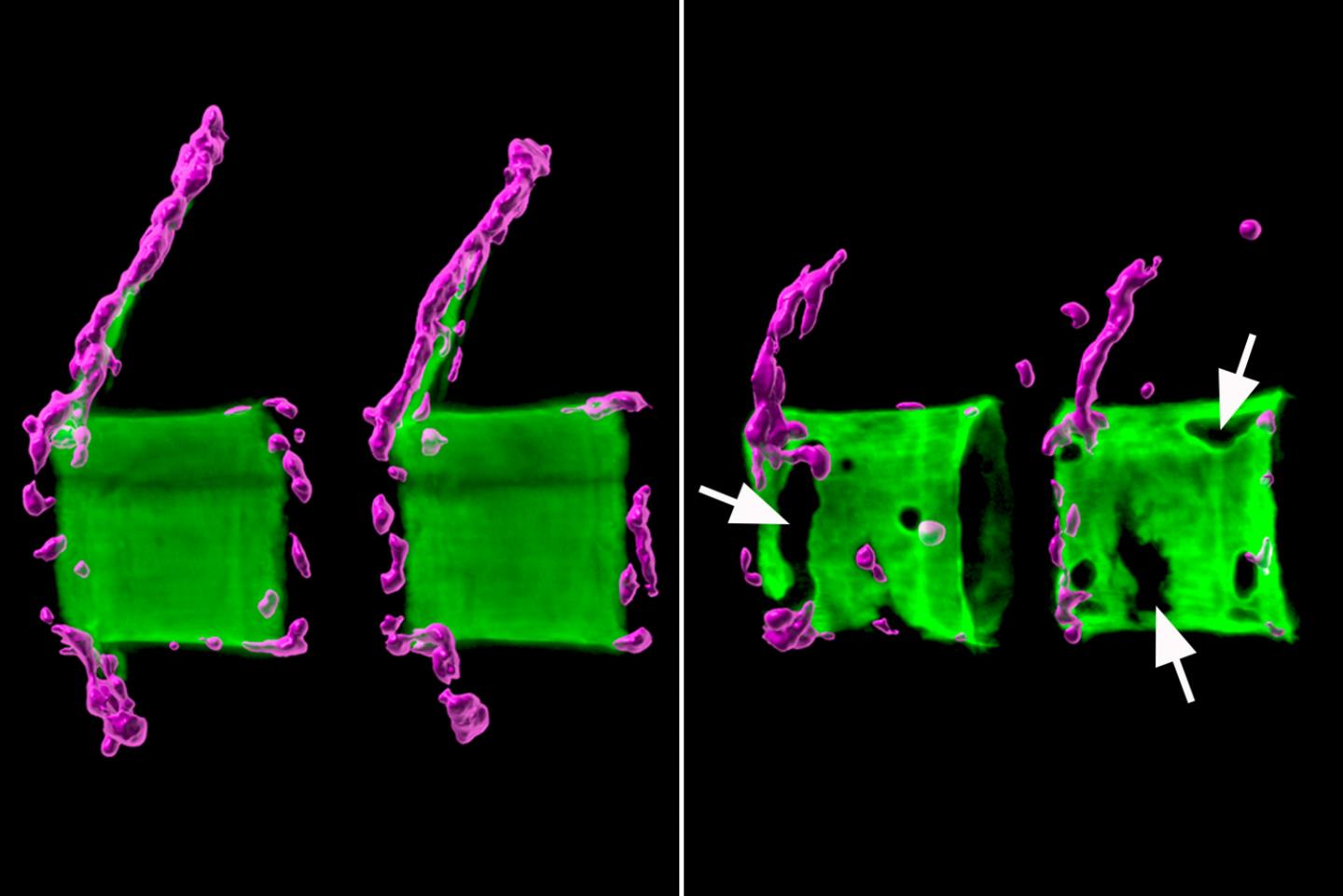
Credit: Tan Wen Hui / University of Singapore
Osteoporosis is the most common age-related bone disease which affects hundreds of millions of individuals worldwide. It is estimated that one in three women and one in five men aged over 50 suffer from osteoporotic bone fractures.
Osteoporosis is caused by excessive activity of bone resorbing cells, while activity of bone-forming cells is reduced. In healthy individuals, a balanced activity of these two cell types allows constant bone turnover to maintain healthy and strong bones.
In osteoporosis, disproportionate bone resorption leads to low bone mineral density and consequently weak and fracture-prone bones. When new bone formation is unable to catch up with bone loss, bone eventually weakens, and becomes more prone to fractures.
Current medicines have disadvantages
Most current osteoporosis therapies include the use of bisphosphonates, which block the activity of bone resorbing cells, and thus prevent excessive bone resorption. However, prolonged treatment with these drugs eliminates the necessary bone turn-over leading to increased fracture risk and other unwanted side effects. Therefore, there is an urgent need to develop new strategies that overcome the limitations of current treatments.
There are now new progresses in this area. They have been developed in a cooperation of Professors Christoph Winkler (Department of Biological Sciences, National University of Singapore, NUS) and Manfred Schartl (Biocenter, Julius-Maximilians-Universität Würzburg, JMU, Germany); the results have been published in the journal PNAS.
Small protein mobilises bone resorbing cells
Using genetic analysis in a small laboratory fish model, the Japanese medaka (Oryzias latipes), the research team identified a small protein, the chemokine CXCL9, that, under osteoporotic conditions, diffuses towards reservoirs that hold bone resorbing cell precursors. These precursors produce a receptor, CXCR3, on their cell surface. Upon activation by CXCL9, the precursors are mobilised and migrate long distances in a highly directed fashion towards the bone matrix, where they start resorbing bone.
Known inhibitors are highly effective
Both CXCL9 and its receptor CXCR3 have long been known to modulate the migration of immune cells to inflammation sites, for example in psoriasis and rheumatoid arthritis. There are several chemical inhibitors blocking CXCR3 activity that have had little success in clinical tests for the treatment of psoriasis. The research team showed that these inhibitors are highly effective in blocking bone resorbing cells’ recruitment and protecting bone from osteoporotic insult.
Finely tuned therapies seem possible
The conclusion of the professors Schartl and Winkler: “Our studies provided new avenues to osteoporosis therapy. The new strategy allows a fine-tuned modulation of osteoclast numbers that are recruited to bone matrix rather than a widespread blockage of osteoclast activity as in traditional therapies. This has major advantages as excessive bone resorption can be prevented in a targeted manner but normal bone turn-over will still continue. This offers potential to avoid increased fracture risks in osteoporosis patients and to maintain healthy bone for improved quality of life.”
Christoph Winkler is an alumnus of JMU. He was a PhD student and research assistant in Manfred Schartl’s team and followed the call for a professorship in Singapore in 2007. He returned to JMU for a while in 2016 – for a sabbatical, financially supported by the Würzburg University Board. During this time, the ground was prepared for the cooperation the results of which can now be read in PNAS.
###
Media Contact
Manfred Schartl
[email protected]
Original Source
https:/
Related Journal Article
http://dx.