Rainfall maps with high temporal resolution derived from the attenuation of commercial microwave links (CMLs) by precipitation
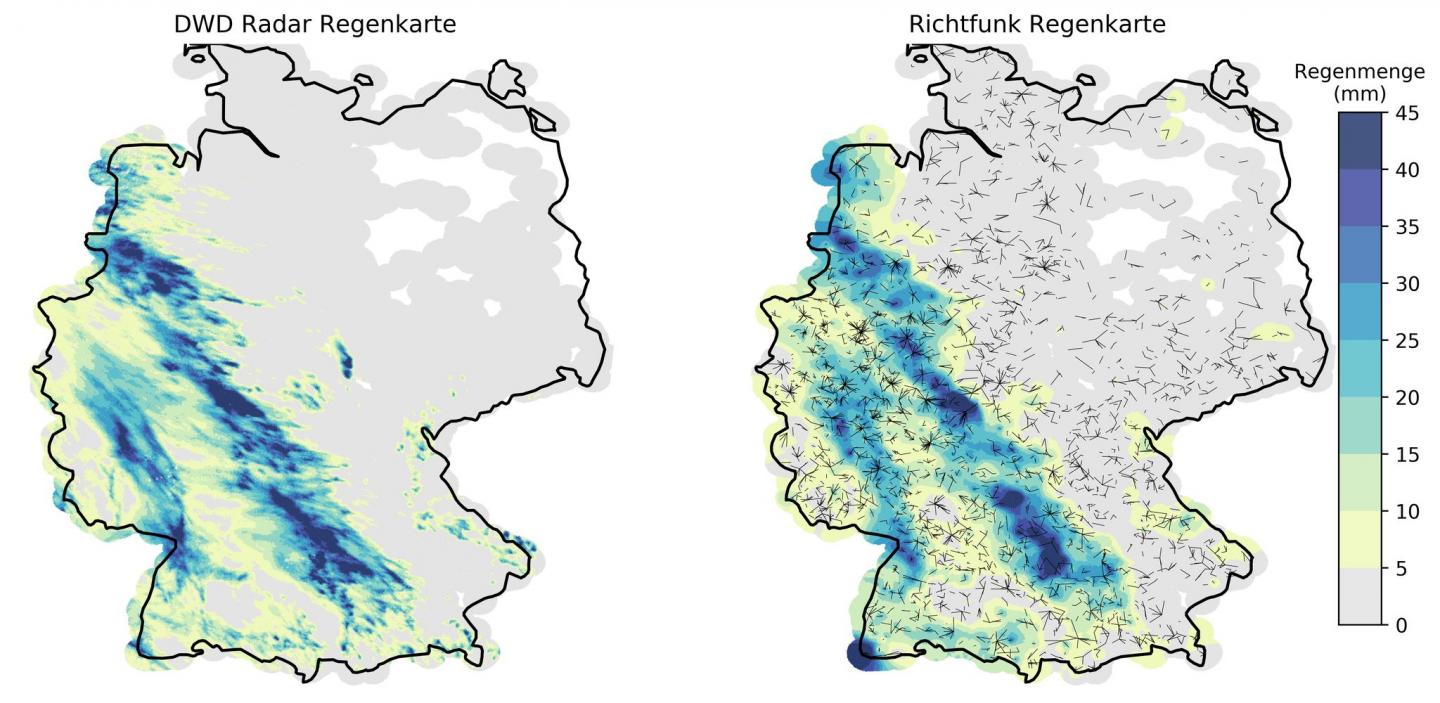
Credit: (Graphics: Graf et al., 2020)
Whether in flood early-warning systems or in agriculture – rainfall measurements are of great importance. However, there is a lack of accurate data for many regions in the world due to the fact that comprehensive measurements have so far been too expensive. This could change with a new method that has just passed its practical test. Researchers at KIT (Karlsruhe Institute of Technology) and the University of Augsburg have succeeded in utilizing the commercial microwave link network (CML) operated by mobile network providers for Germany-wide rainfall measurements. This new technology is now planned to be used in West Africa. The team published their results in the scientific journals Hydrology and Earth System Sciences and Atmospheric Measurement Techniques.
Rain can significantly impair the performance of a mobile network. But a phenomenon that can cause headaches for telecommunications companies is a stroke of luck for meteorological research: “We have developed a completely new method for rain measurement from this interaction between weather events and human technology,” says Professor Harald Kunstmann from the Institute of Meteorology and Climate Research – Atmospheric Environmental Research (IMK-IFU), the so-called Campus Alpin of KIT. “If a commercial microwave link network (CML) is in place, we neither need a new infrastructure nor additional ground staff.” Together with scientists from the University of Augsburg, his KIT team now succeeded in performing the first Germany-wide rainfall measurement with the new method: They were able to derive rainfall maps with high temporal resolution based on the attenuation of the CMLs between several thousand of mobile phone masts that is caused by precipitation. “A comparison with the measurements of the German Meteorological Service shows that we have achieved a high degree of correlation,” explains Maximilian Graf, member of the research team.
Improved accuracy thanks to artificial intelligence (AI)
Precipitation could be determined thanks to the CML antennas installed in mobile phone masts for signal transmission over long distances. “A frequency of 15 to 40 gigahertz is used here. Its wavelength corresponds to the typical size of raindrops,” explains Dr. Christian Chwala who coordinates this research work at the University of Augsburg. “Increasing precipitation weakens the signal that radio masts use to exchange information. Over one year, we measured the current attenuation obtained from 4,000 CMLs with a temporal resolution of 1 minute. The resulting data set is unique in its resolution and enormous size.”
Besides the classical methods of data analysis, the researchers used artificial intelligence (AI) to filter the rain signal from the noisy measurement results. “Other factors, such as wind or the sun, can also cause a slight attenuation of the signal. With the help of our AI, we were able to identify the signal attenuation that was due to rainfall,” says Julius Polz, another scientist from the research group. “We have now trained our AI in such a way that we no longer need to calibrate the system using traditional methods of rain measurement.” Thus, it is suitable for application in regions without significant rainfall measurements that could be considered for AI training, such as West Africa.
Planned use in West Africa
For Germany, however, the method works mainly in spring, summer, and fall. “This is because sleet and freezing rain cause a higher attenuation than liquid precipitation, and snow cannot be measured with the CML network at all,” explains Harald Kunstmann. Several projects are currently underway where the researchers will measure rainfall using CMLs, with one particular focus on Germany, in cooperation with the German Meteorological Service and the Office for the Environment of the state of Saxony. In the course of the summer, further projects will start in the Czech Republic and in Burkina Faso, where a nationwide collection of CML data is to be established for the first time in Africa.
###
Original publications:
Graf, M., Chwala, C., Polz, J., and Kunstmann, H. (2020): Rainfall estimation from a German-wide commercial microwave link network: optimized processing and validation for 1 year of data. Hydrology and Earth System Sciences, 24, 2931-2950, https:/
Polz, J., Chwala, C., Graf, M., & Kunstmann, H. (2020): Rain event detection in commercial microwave link attenuation data using convolutional neural networks. Atmospheric Measurement Techniques, 13, 3835-3853, https:/
More information on the KIT Climate and Environment Center: http://www.
Press contact: Martin Heidelberger, Editor/Press Officer, Tel.: +49 721 608-41169, martin heidelberger@kit edu
Being “The Research University in the Helmholtz Association”, KIT creates and imparts knowledge for the society and the environment. It is the objective to make significant contributions to the global challenges in the fields of energy, mobility, and information. For this, about 9,300 employees cooperate in a broad range of disciplines in natural sciences, engineering sciences, economics, and the humanities and social sciences. KIT prepares its 24,400 students for responsible tasks in society, industry, and science by offering research-based study programs. Innovation efforts at KIT build a bridge between important scientific findings and their application for the benefit of society, economic prosperity, and the preservation of our natural basis of life. KIT is one of the German universities of excellence.
Media Contact
Monika Landgraf
[email protected]
Original Source
http://www.
Related Journal Article
http://dx.