• HOME
  • NEWS
  • EXPLORE
    • CAREER
      • Companies
      • Jobs
    • EVENTS
    • iGEM
      • News
      • Team
    • PHOTOS
    • VIDEO
    • WIKI
  • BLOG
  • COMMUNITY
    • FACEBOOK
    • INSTAGRAM
    • TWITTER
Saturday, February 7, 2026
BIOENGINEER.ORG
No Result
View All Result
  • Login
  • HOME
  • NEWS
  • EXPLORE
    • CAREER
      • Companies
      • Jobs
        • Lecturer
        • PhD Studentship
        • Postdoc
        • Research Assistant
    • EVENTS
    • iGEM
      • News
      • Team
    • PHOTOS
    • VIDEO
    • WIKI
  • BLOG
  • COMMUNITY
    • FACEBOOK
    • INSTAGRAM
    • TWITTER
  • HOME
  • NEWS
  • EXPLORE
    • CAREER
      • Companies
      • Jobs
        • Lecturer
        • PhD Studentship
        • Postdoc
        • Research Assistant
    • EVENTS
    • iGEM
      • News
      • Team
    • PHOTOS
    • VIDEO
    • WIKI
  • BLOG
  • COMMUNITY
    • FACEBOOK
    • INSTAGRAM
    • TWITTER
No Result
View All Result
Bioengineer.org
No Result
View All Result
Home NEWS Science News

Nanoreactor strategy generates superior supported bimetallic catalysts

Bioengineer by Bioengineer
July 31, 2020
in Science News
Reading Time: 2 mins read
0
IMAGE
Share on FacebookShare on TwitterShare on LinkedinShare on RedditShare on Telegram

IMAGE

Credit: TIAN Zhengbin

Supported bimetallic catalysts are an important class of catalysts in heterogeneous catalysis. They can be applied in various fields, such as electrocatalysis, biomass conversion, and hydrogen production.

However, traditional impregnation and immobilization methods for synthesizing supported bimetallic nanoparticles (BNPs) are often uncontrollable, thus creating BNPs with non-uniform particle size, low alloy degree and inhomogeneous distribution on the supports. The result is poor catalytic performance and low metal utilization.

To improve the performance and efficiency of the supported BNPs, Prof. WANG Guanghui and Prof. JIANG Heqing from the Qingdao Institute of Bioenergy and Bioprocess Technology (QIBEBT) of the Chinese Academy of Sciences (CAS), in collaboration with Prof. LIU Jian from the Dalian Institute of Chemical Physics (DICP) of CAS, recently proposed a nanoreactor strategy for scalable synthesis of the supported ultrafine BNPs.

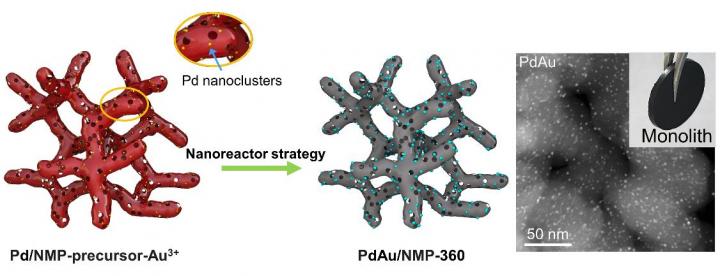
This strategy introduces high-quality seeds (Pd nanoclusters) and Au ions into the nitrogen-doped mesoporous polymer (NMP). The NMP is used as a nanoreactor for the seeded growth of PdAu BNPs in solid state during thermal reduction.

“The synthesized Pd1Au1/4 BNPs are very uniform in diameter with an error of 0.5 nm, and are homogeneously dispersed in the NMP support,” said Prof. WANG.

The Pd1Au1/4/NMP sample showed enhanced catalytic performance in formic acid (FA) dehydrogenation compared with the monometallic analogues Pd/NMP and Au/NMP.

“The enhanced activity can be attributed to the electronic interaction between Pd and Au in the Pd1Au1/4 BNPs. In addition, the electronic interaction could be adjusted by changing the composition of PdAu BNPs during synthesis,” said Prof. JIANG.

Moreover, the PdAu/NMP product can be molded into a monolith by a pellet press under mild pressure (1.0 bar) without any binders, due to its coral-like structure. The monolith contains abundant macropores which can be of benefit for mass transfer in a liquid reaction.

Notably, the monolith of Pd1Au1/4/NMP still exhibits considerable activity in FA dehydrogenation with a TOF value of 3684 h-1 at 333 K, and can be recycled five times without mass loss and changes in activity.

Many other supported Pd-based BNPs (diameters ranging from 2-3 nm) have also been synthesized using this method, including PdRu, PdCo, PdNi, PdZn, PdAg and PdCu BNPs.

This proposed nanoreactor strategy provides an effective route for synthesizing various supported bimetallic catalysts. These catalysts are promising for applications in green and sustainable catalytic processes.

###

This study was published in Materials Today on July 30. It was supported by the National Natural Science Foundation of China, QIBEBT and the DNL Cooperation Fund, CAS.

Media Contact
CHENG Jing
[email protected]

Original Source

http://english.cas.cn/

Related Journal Article

http://dx.doi.org/10.1016/j.mattod.2020.05.017

Tags: Atomic/Molecular/Particle PhysicsChemistry/Physics/Materials SciencesMaterialsNanotechnology/Micromachines
Share12Tweet8Share2ShareShareShare2

Related Posts

Inflammasome Protein ASC Drives Pancreatic Cancer Metabolism

February 7, 2026

Phage-Antibiotic Combo Beats Resistant Peritoneal Infection

February 7, 2026

Boosting Remote Healthcare: Stepped-Wedge Trial Insights

February 7, 2026

Barriers and Boosters of Seniors’ Physical Activity in Karachi

February 7, 2026
Please login to join discussion

POPULAR NEWS

  • Robotic Ureteral Reconstruction: A Novel Approach

    Robotic Ureteral Reconstruction: A Novel Approach

    82 shares
    Share 33 Tweet 21
  • Digital Privacy: Health Data Control in Incarceration

    63 shares
    Share 25 Tweet 16
  • Study Reveals Lipid Accumulation in ME/CFS Cells

    57 shares
    Share 23 Tweet 14
  • Breakthrough in RNA Research Accelerates Medical Innovations Timeline

    53 shares
    Share 21 Tweet 13

About

We bring you the latest biotechnology news from best research centers and universities around the world. Check our website.

Follow us

Recent News

Inflammasome Protein ASC Drives Pancreatic Cancer Metabolism

Phage-Antibiotic Combo Beats Resistant Peritoneal Infection

Boosting Remote Healthcare: Stepped-Wedge Trial Insights

Subscribe to Blog via Email

Enter your email address to subscribe to this blog and receive notifications of new posts by email.

Join 73 other subscribers
  • Contact Us

Bioengineer.org © Copyright 2023 All Rights Reserved.

Welcome Back!

Login to your account below

Forgotten Password?

Retrieve your password

Please enter your username or email address to reset your password.

Log In
No Result
View All Result
  • Homepages
    • Home Page 1
    • Home Page 2
  • News
  • National
  • Business
  • Health
  • Lifestyle
  • Science

Bioengineer.org © Copyright 2023 All Rights Reserved.