• HOME
  • NEWS
  • EXPLORE
    • CAREER
      • Companies
      • Jobs
    • EVENTS
    • iGEM
      • News
      • Team
    • PHOTOS
    • VIDEO
    • WIKI
  • BLOG
  • COMMUNITY
    • FACEBOOK
    • INSTAGRAM
    • TWITTER
Tuesday, May 26, 2026
BIOENGINEER.ORG
No Result
View All Result
  • Login
  • HOME
  • NEWS
  • EXPLORE
    • CAREER
      • Companies
      • Jobs
        • Lecturer
        • PhD Studentship
        • Postdoc
        • Research Assistant
    • EVENTS
    • iGEM
      • News
      • Team
    • PHOTOS
    • VIDEO
    • WIKI
  • BLOG
  • COMMUNITY
    • FACEBOOK
    • INSTAGRAM
    • TWITTER
  • HOME
  • NEWS
  • EXPLORE
    • CAREER
      • Companies
      • Jobs
        • Lecturer
        • PhD Studentship
        • Postdoc
        • Research Assistant
    • EVENTS
    • iGEM
      • News
      • Team
    • PHOTOS
    • VIDEO
    • WIKI
  • BLOG
  • COMMUNITY
    • FACEBOOK
    • INSTAGRAM
    • TWITTER
No Result
View All Result
Bioengineer.org
No Result
View All Result
Home NEWS Science News Chemistry

ETRI develops eco-friendly color thin-film solar cells

Bioengineer by Bioengineer
July 31, 2020
in Chemistry
Reading Time: 2 mins read
0
IMAGE
Share on FacebookShare on TwitterShare on LinkedinShare on RedditShare on Telegram

IMAGE

Credit: Electronics and Telecommunications Research Institute (ETRI)

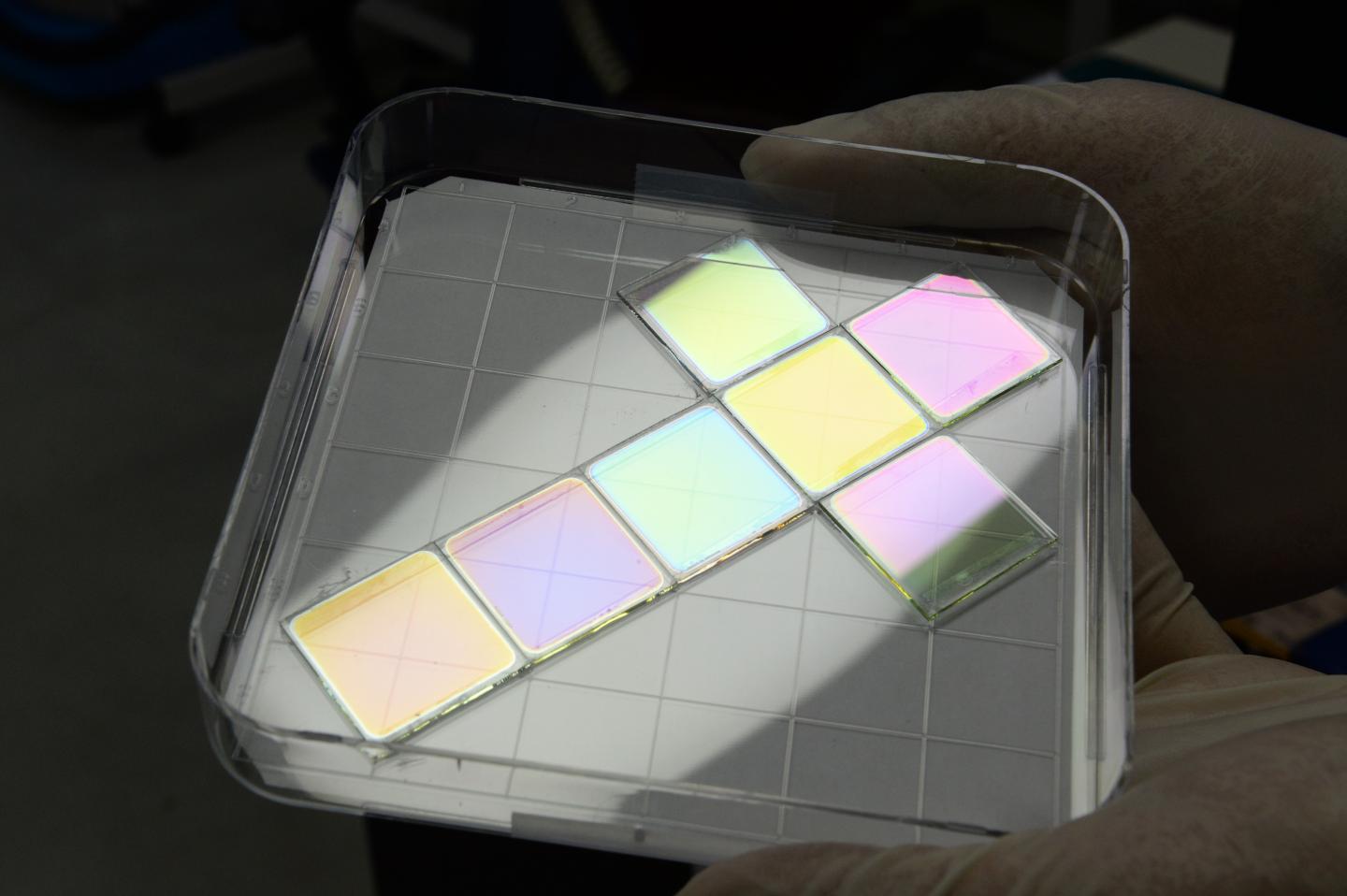
Research on solar cells to secure renewable energy sources are ongoing around the world. The Electronics and Telecommunications Research Institute (ETRI) in South Korea succeeded in developing eco-friendly color Cu(In,Ga)Se2 (CIGS) thin-film solar cells.

CIGS thin-film solar cells are used to convert sunlight into electrical energy and are made by coating multiple thin films on a glass substrate. They have a relatively higher absorption coefficient among non-silicon based cells, resulting in high conversion efficiency and long stability. Also, they require less raw materials compared to silicon-based cells; hence less process and material costs.

One downside has been the difficulty in commercialization as they use the buffer layer which contains toxic heavy metal, cadmium. Thus, the ETRI team replaced the cadmium sulfide (CdS) buffer layer with zinc (Zn) based materials– which is not harmful — and managed to achieve approximately 18% conversion efficiency; thus eliminating the obstacle to commercialization.

Likewise, the availability of more than 7 colors including purple, green, and blue — without the need for additional process or cost — means one step closer to full-on commercialization. Moreover, the researchers succeeded in identifying a new analysis method using photo-pumping terahertz spectroscopy and a mechanism for improving the conversion efficiency of solar cells with Zn-based buffer layers.
The solar cells are only 3? thick and can be coated on a flexible substrate as well as a glass substrate. This means that they could be bent or folded, expanding applications as a next-generation eco-friendly energy source.

“This technology will contribute to the solar power system development through the production of high value-added color photovoltaic modules,” said Yong-Duck Chung, the ETRI principal researcher.

The excellence of the research was proven by its publication in ‘Nano Energy’ and ‘Progress in Photovoltaics: Research and Applications’ as the cover article, globally esteemed international journals in the energy sector.

###

About Electronics and Telecommunications Research Institute (ETRI) (https://www.nst.re.kr/nst_en/member/03_11.jsp)

ETRI is a non-profit government-funded research institute. Since its foundation in 1976, ETRI, a global ICT research institute, has been making its immense effort to provide Korea a remarkable growth in the field of ICT industry. ETRI delivers Korea as one of the top ICT nations in the World, by unceasingly developing world’s first and best technologies.

Media Contact
Yong-Duck Chung
[email protected]

Related Journal Article

http://dx.doi.org/10.1016/j.nanoen.2020.104855

Tags: Chemistry/Physics/Materials SciencesTechnology/Engineering/Computer Science
Share12Tweet8Share2ShareShareShare2

Related Posts

Lanthanide Nanocrystals Unlock Room-Temperature Organic Phosphorescence — Chemistry

Lanthanide Nanocrystals Unlock Room-Temperature Organic Phosphorescence

May 25, 2026
Study Reveals How Valproate Affects Early Brain Development: Insights into the Antiepileptic Drug’s Impact — Chemistry

Study Reveals How Valproate Affects Early Brain Development: Insights into the Antiepileptic Drug’s Impact

May 22, 2026

Sustainable Chemistry: Iron Replaces Noble Metals in Catalytic Reactions

May 22, 2026

Advancing Thin-Film Device Manufacturing with Imaging Ellipsometry for Enhanced Process Control

May 22, 2026
Please login to join discussion

POPULAR NEWS

  • ESMO 2025: mRNA COVID Vaccines Enhance Efficacy of Cancer Immunotherapy

    316 shares
    Share 126 Tweet 79
  • New Study Reveals Plants Can Detect the Sound of Rain

    734 shares
    Share 293 Tweet 183
  • Common Food Preservatives Associated with Elevated Blood Pressure and Increased Heart Disease Risk

    56 shares
    Share 22 Tweet 14
  • Research Indicates Potential Connection Between Prenatal Medication Exposure and Elevated Autism Risk

    847 shares
    Share 339 Tweet 212

About

We bring you the latest biotechnology news from best research centers and universities around the world. Check our website.

Follow us

Recent News

Growing Partisan Divide in U.S. Civil Rights Law

Quality of Life Predictors in Zoroastrian Elders

Corrosion-Blast Impact on Buried Cast Iron Damage

Subscribe to Blog via Email

Enter your email address to subscribe to this blog and receive notifications of new posts by email.

Join 82 other subscribers
  • Contact Us

Bioengineer.org © Copyright 2023 All Rights Reserved.

Welcome Back!

Login to your account below

Forgotten Password?

Retrieve your password

Please enter your username or email address to reset your password.

Log In
No Result
View All Result
  • Homepages
    • Home Page 1
    • Home Page 2
  • News
  • National
  • Business
  • Health
  • Lifestyle
  • Science

Bioengineer.org © Copyright 2023 All Rights Reserved.